



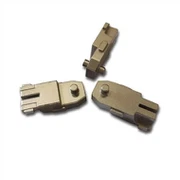
Magnetic Core Seat PM Sintered Part
Magnetic core seat PM sintered part magnetic core refers to a sintered magnetic metal oxide composed of various iron oxide mixtures. For example, manganese-zinc ferrite and nickel-zinc ferrite are typical core body materials. Manganese-zinc ferrites are characterized by high magnetic permeability and high magnetic flux density, and have low loss characteristics.
Product Introduction
|
Magnetic core seat PM sintered part |
||||||
|
Item |
Material |
Production Process |
Sintering Temperature |
Mold |
Custom |
|
|
Core Holder |
customizable |
Powder metallurgy |
1280℃ |
To be customized |
Yes |
|
|
Available Materials |
Low carbon stainless steel, titanium alloy (Ti, TC4), copper alloy, tungsten alloy, hard alloy, high temperature alloy (718, 713) |
|||||
Product advantages
|
Smoothness |
Dimensional accuracy |
Product density |
Appearance treatment |
Appropriate weight |
|
Roughness 1~5μm |
(±0.1%~±0.5%) |
92~95% |
mirror reflection |
0.03g~400g) |
Materials Analysis
Magnetic core seat PM sintered part magnetic core refers to a sintered magnetic metal oxide composed of various iron oxide mixtures. For example, manganese-zinc ferrite and nickel-zinc ferrite are typical core body materials. Manganese-zinc ferrites are characterized by high magnetic permeability and high magnetic flux density, and have low loss characteristics. Nickel-zinc ferrite has the characteristics of extremely high resistivity and low magnetic permeability of less than a few hundred. Ferrite cores are used in coils and transformers in various electronic devices. The following editor will introduce to you Magnetic core seat PM sintered part "What are the magnetic core materials? Magnetic core material comparison table".
1. What are the core materials?
1. Iron powder core
Iron powder core is a popular term for the core material ferric oxide, the main component is iron oxide, the price is relatively low, the saturation magnetic induction is about 1.4T: the magnetic permeability ranges from 22-100, and the initial magnetic permeability ui value varies with the frequency The change stability is good, and the DC current superposition performance is good, but the consumption is high at high frequency.
2. Mn-Zn type: (70% Fe2O3 17% MnO 13% ZnO)
The material has a strong electrical conductivity, and generally requires coating insulation. The coating layer is generally green, and the material is usually selected according to the characteristic requirements. For a large inductance, Mn-Zn material is usually used, and Mn-Zn material is easy to magnetically saturate.
That is, IDC1 is very small. Find out the corresponding inductance coefficient (AL value) through the manufacturer's product catalog, and then calculate the required number of turns through the formula L=AL.N². The characteristics of Mn-Zn materials are unstable, and the range of inductance usually needs to be determined. 30% or more!
The material is obviously affected by the external temperature and pressure, so we usually set the sensitivity to XXuH MIN when making this kind of samples. If the customer has a range of sensitivity requirements, we must use self-drying glue (1005A /1005B) to fix the BASE or partition, remember not to bake.
3. Ni-Zn ferrite
This type of material is most widely used in CHOKE inductor coils. Its main component is ferric oxide, plus a small amount of trace elements such as zinc oxide, nickel oxide, copper oxide, and cobalt oxide. It has stable characteristics and small variability.
The Ni-Zn magnetic ring is usually not painted, and it is required to measure the impedance, that is, the Z value. Sometimes a sense of volume is also required. There are not many Ni-Zn magnetic rings used in our factory. Generally, they are RH, R6H, RID and other BEAD types, and the main supplier is Umag. Ni-Zn materials are sometimes used in TOROID products. Generally, it is painted green, which is the same color as the MN-ZN material, so pay attention to distinguishing it. the
Ni-Zn material has a high surface impedance, is an electrical insulator, used for EMI anti-magnetic interference (low frequency low impedance, high frequency high impedance) Ni-Zn materials generally have low saturation magnetic flux density (BS) and high Coercive force (HC), unable to withstand large current and much hysteresis loss, has high surface resistance,
4. MPP CORES iron-nickel-molybdenum metal magnetic powder core
MPP is composed of 81%Ni, 2%Mo and Fe powder. The main features are: the saturation magnetic induction value is around 7500Gs; the magnetic permeability range is large, from 14 to 550; it has the lowest loss in the powder magnetic core; the temperature stability is excellent, and it is widely used in space equipment, open-air equipment, etc.; The stretching coefficient is close to zero, and there is no noise when working at different frequencies.

(The picture comes from the Internet)
2. Magnetic core material comparison table
The magnetic core refers to a sintered magnetic metal oxide composed of various iron oxide mixtures. For example, manganese-zinc ferrite and nickel-zinc ferrite are typical core body materials. Manganese-zinc ferrites are characterized by high magnetic permeability and high magnetic flux density, and have low loss characteristics. Nickel-zinc ferrite has the characteristics of extremely high resistivity and low magnetic permeability of less than a few hundred. Ferrite cores are used in coils and transformers in various electronic devices.

Metal Injection Molding Process

Detection Systems




Send Inquiry
