



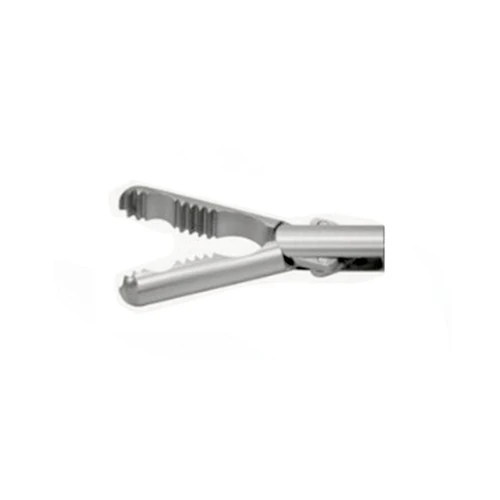
Laparoscopic Forceps MIM Parts
17-4PH Stainless Steel (also known as Type 630) is a martensitic stainless steel that has been cryogenically treated to achieve high strength and hardness. As a precipitation/age hardening steel, 17-4 stainless steel can be tempered to improve ductility and toughness, which, combined with its excellent oxidation resistance, makes it an excellent choice for use in chemical processing equipment.
Product Introduction
Laparoscopic forceps MIM Parts | |||||||||
Item | Material | Production Process | Sintering Temperature | Mold | Custom | ||||
Laparoscopic forceps | 17-4 | Metal Injection Molding | 1350°C-1500°C | To be customized | Yes | ||||
Chemical Composition | C: ≤0.07 | ||||||||
Available Materials | Low carbon stainless steel, titanium alloy (Ti, TC4), copper alloy, tungsten alloy, hard alloy, high temperature alloy (718, 713) | ||||||||
Finish | Dimensional Accuracy | Product Density | Appearance Treatment | Appropriate Weight | |||||
Roughness 1~5μm | (±0.1%~±0.5%) | 92~95% | Mirror Reflection | 0.03g~400g) | |||||
Mechanical properties | • Tensile strength Rm (MPa): aged at 480°C, ≥1310; aged at 550°C, ≥1060; aged at 580°C, ≥1000; aged at 620°C, ≥930 | ||||||||
Heat Treatment Specifications | 1) Solid solution 1020~1060℃ rapid cooling | ||||||||
17-4PH SUS630
17-4PH Stainless Steel (also known as Type 630) is a martensitic stainless steel that has been cryogenically treated to achieve high strength and hardness. As a precipitation/age hardening steel, 17-4 stainless steel can be tempered to improve ductility and toughness, which, combined with its excellent oxidation resistance, makes it an excellent choice for use in chemical processing equipment. 17-4 Other uses of the material include pump shafts, gears, gate valves, fasteners, and food processing machinery. 17-4 steel consists primarily of steel, with chromium, nickel, and copper being the other major chemical properties. Standard specifications for stainless steel 17-4 include AMS 5604, AMS 5643, ASTM A 564, etc.
What kind of material is 17-4PH?
17-4PH is a martensitic precipitation hardening stainless steel. It has high strength, high hardness, good welding performance and corrosion resistance. It has been widely used in valves, shafts and chemical fiber industries, as well as high-strength parts with certain corrosion resistance requirements. Overview SUS630 stainless steel (Japanese brand) stainless steel: SUS630 features copper added.
17-4 What is the material of PH? What is the material of sus630?
1. 17-4ph stainless steel is martensitic precipitation hardening stainless steel.
2. The performance characteristics of 630 stainless steel are that it is easy to adjust the strength level, which can be adjusted by changing the heat treatment process. The precipitation hardening phase formed by martensitic phase transformation and aging treatment is the main strengthening method. 630 stainless steel has good attenuation performance, corrosion resistance and fatigue resistance. Water droplets are strong.
Will 17-4ph rust?
meeting. 17-4PH/SUS630 Precipitation Hardened Stainless Steel - JIS G4303 What is SUS630 Steel? Grade 630 is a stainless steel classified as martensitic, but otherwise this grade is precipitation hardened for robust mechanical properties. These steels acquire high tensile strength and indentation resistance immediately after heat treatment. Corrosion resistance and heat resistance are comparable to 304 grade steel.
How much HRC is the heat treatment hardness of 17-4PH stainless steel?
17-4PH hardness is 40. sus630 is martensitic precipitation hardening stainless steel, Chinese brand 0Cr17Ni4Cu4Nb. It has high strength, high hardness, good welding performance and corrosion resistance, and has been widely used in valves. Sus630 is a precipitation-hardening martensitic stainless steel composed of copper, niobium/columbium, and has a low carbon content.
630 stainless steel application and characteristics
sus630/17- 4PH/S17400/ 0Cr17Ni4Cu4Nb precipitation hardening stainless steel sus630 is a martensitic precipitation hardening stainless steel. It has high strength, high hardness, good welding performance and corrosion resistance. It has been widely used in valves, shafts and chemical fiber industries, as well as high-strength parts with certain corrosion resistance requirements.
What kind of saw blade is used for sawing SUS630?
Grade SUS630 martensitic precipitation hardening stainless steel II:
chemical composition
C : s0.07
Si: s1.00
Mn:≤1.00
S : ≤0.030
P : ≤0.035
Cr: 15.50~17.50
Ni: 3.00~5.00
Copper Cu: 3.00~5.00
How can 17-4PH be below 25HRC?
sus630/17 _4PH/S 17400/ 0Cr17Ni4Cu4Nb precipitation hardening stainless steel sus630 is a martensitic precipitation hardening stainless steel. It has high strength, high hardness, good welding performance and corrosion resistance. It has been widely used in valves, shafts and chemical fiber industries, as well as high-strength parts with certain corrosion resistance requirements.
Nominal Composition
Cr 15 –17.5
Ni 3 – 5
Cu 3 – 5
Mn 1 max
Si 1 max
Cb+Ta .15 – .45
C .07 max
Mo .5 max
P .04 max
S .03 max
Fe Balance
Standard Specifications
AMS 5604
AMS 5622
AMS 5643
AMS 5803
AMS 5825
AMS 5827
UNS S17400
W.Nr 1.4548
ASTM A 564
ASTM A 693
ASTM A 705
17-4 Steel Forgings
17-4 Round Bar
17-4 Flat Bar
17-4 Rectangular Bar
17-4 Rolled Rings
17-4 Forged Rings
17-4 Disc
Other Products Forms
17-4 Sheet
17-4 Plate
17-4 Extrusion
17-4 Extrusion angles
17-4 Billet
17-4 Ingot
17-4 Machined Parts
17-4PH mechanical properties
Yuan steel heat treatment | Tensile strength | Yield point | Elongation | Rate of reduction in area | Hardness |
H900(Precipitation Hardening) | ≥1310 | ≥1172 | ≥10 | ≥40 | 388~444 |
H925(Precipitation Hardening) | ≥1172 | ≥1069 | ≥10 | ≥44 | 375~429 |
H1025(Precipitation Hardening) | ≥1069 | ≥1000 | ≥12 | ≥45 | 331~401 |
H1075(Precipitation Hardening) | ≥1000 | ≥862 | ≥13 | ≥45 | 311~375 |
H1100(Precipitation Hardening) | ≥965 | ≥793 | ≥14 | ≥45 | 302~363 |
H1150(Precipitation Hardening) | ≥931 | ≥724 | ≥16 | ≥50 | 277~352 |
S(Solution Treatment) | ≤363 |
Heat Treatment
S (solution treatment): 1900°F±25°F (1038°C±14°C), rapid cooling;
H900 (precipitation hardening): after solution treatment, keep at 900°F±10°F (482°C±6°C) for 1h±5min, and air cool;
H925 (precipitation hardening): After solution treatment, keep at 925±10°F (496°C±6°C) for 4h±15min, and air cool;
H1025 (precipitation hardening): after solution treatment, keep at 1025±10°F (552°C±6°C) for 4h±15min, air cooling;
H1075 (precipitation hardening): After solution treatment, keep at 1075±10°F (579°C±6°C) for 4h±15min, air cooling:
H1100 (precipitation hardening): after solution treatment, keep at 1100±10°F (593°C±6°C) for 4h±15min, air cooling;
H1150 (precipitation hardening): After solution treatment, keep at 1150±10°F (621°C±6°C) for 4h±15min, air cooling.
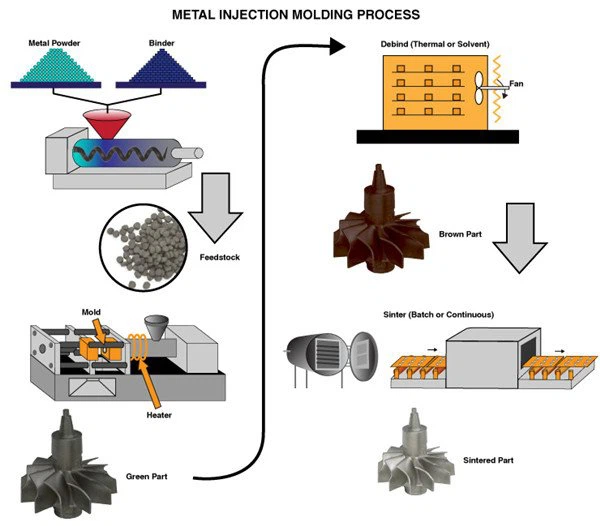
Metal Injection Molding Process
Detection Systems


Send Inquiry
