



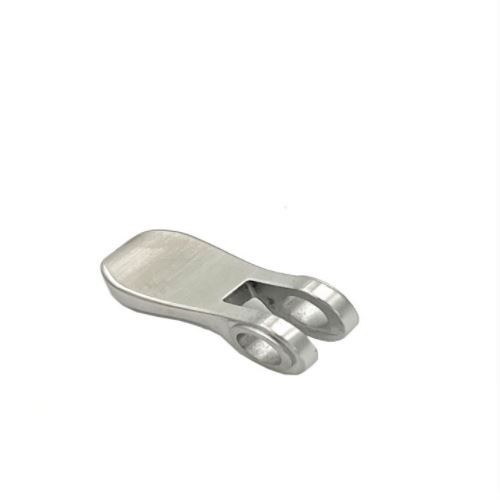
Flow Meter Handles MIM Parts
A flow meter measures the flow of a fluid. For example, a mining system or pipeline system carries fluids, and flow meters may be used to measure the flow of fluid through the mining system or pipeline system.
Product Introduction
Item | Material | Production Process | Sintering Temperature | Mold | Custom | ||||
Flow Meter Handles | 316 | Metal Injection Molding | 1550℃ | To be customized | Yes | ||||
Chemical Composition | Secret | ||||||||
Available materials | Low carbon stainless steel, titanium alloy (Ti, TC4), copper alloy, tungsten alloy, hard alloy, high temperature alloy (718, 713) | ||||||||
Finish | Dimensional Accuracy | Product Density | Appearance Treatment | Appropriate Weight | |||||
Roughness 1~5μm | (±0.1%~±0.5%) | 92~95% | Mirror Reflection | 0.03g~400g) | |||||
Flow meter and manufacturing method
A flow meter measures the flow of a fluid. For example, a mining system or pipeline system carries fluids, and flow meters may be used to measure the flow of fluid through the mining system or pipeline system. The configuration of the flow meter can affect the ability of the flow meter to accurately measure the flow of a fluid, and can also affect the durability of the flow meter and the installation process of the flow meter. Accordingly, it would be desirable to improve the configuration of flow meters.
Detailed ways
One or more specific embodiments of the present disclosure will be described below. These described embodiments are merely exemplary of the present disclosure. Additionally, in an effort to provide a concise description of these example implementations, all features of an actual implementation may not be described in the specification. It should be understood that in the development of any such actual implementation, as in any engineering or design project, many implementation-specific decisions must be made to achieve the developer's specific goals, such as compliance with system-related Due to business-related constraints, these specific goals may vary from one implementation to another. Furthermore, it should be appreciated that such a development effort might be complex and time consuming, but would nevertheless be a routine undertaking of design, fabrication, and production for those of ordinary skill having the benefit of this disclosure.
Certain systems, such as mining systems (eg, drilling and production systems) or pipeline systems, may include various fluid handling components (eg, conduits, storage tanks, injectors). For example, a conduit may direct the flow of a fluid (eg, water, chemical, gas, liquid, production fluid, drilling fluid) from one location to another. A flow meter may be provided to monitor the flow of fluid through the conduit.
The flow meter system may include a flow meter body formed by machining a solid structure (e.g., a block of metal) into a generally cylindrical conduit with a central hole that aligns with adjacent conduits to A stream of fluid is enabled to flow through the flow meter. Some flow meters may include a connector (eg, an annular connector) that extends radially from the meter body and that is configured to support a measurement device (eg, a transmitter or flow sensor). The connectors can be machined separately and then welded to the side walls of the flowmeter body. Additionally, some flow meters may include flanges at the ends of the flow meter body to facilitate coupling the flow meter to adjacent conduits. The flange can also be machined separately and then welded to the meter body.
In some cases, it may be desirable to form the flowmeter, connectors, and/or flanges from high-strength materials, such as nickel-based alloys (e.g., inconel 718) or stainless steel materials (e.g., martensitic precipitates such as 174ph hardened stainless steel). However, such materials can be difficult to weld correctly or efficiently without localized failure, such as cracking. As a result, the manufacturing process can be lengthy and complex, and flowmeters produced through the welding process are often identified as not meeting regulatory standards during testing and final inspection. Furthermore, due to the limited space around the meter body to support additional separate welded joints and due to the increased risk of local failure and defective meters due to additional welded joints, additional connectors are used to support multiple sensors (e.g. , ultrasonic sensors or other flow sensors) may not be appropriate. In addition, flow meters can be solid, heavy components, which in turn can make transportation, installation and maintenance of the flow meters challenging.
Accordingly, certain disclosed embodiments relate to flow meters having a flow meter body assembly having a flow meter body configured to support a measurement device (eg, a transmitter with an electronic controller) to facilitate monitoring of a fluid Connector for accurate measurement of flow. Some or all of the flow meter body, connectors, rotor, and impeller may be formed as a one-piece structure without welded joints with additive structures (eg, open cell structures, non-solid structures, non-continuous structures, or frames). For example, the additive structure may include a through hole extending between opposing axially facing surfaces of the flange. The additive structure can reduce the weight of the flow meter (eg, compared to a flow meter with a solid flange manufactured via conventional techniques), thereby facilitating transportation, installation, and/or maintenance of the flow meter. For example, in some embodiments, a flange with an additive structure may weigh at least 10%, 20%, 30%, 40%, or 50% less than a flange without an additive structure (eg, a solid flange). %.
In certain embodiments, the flow meter system can be fabricated via additive manufacturing techniques. This technique enables the construction of flow meter systems through computer models without difficult machining steps. Typically, additive manufacturing techniques involve applying an energy source, such as a laser or electron beam, to a deposited raw material, such as powder or filament, in order to grow parts with specific shapes and characteristics. The flowmeters disclosed herein may be used as part of any suitable fluid handling system, such as an energy harvesting or processing system (e.g., a hydrocarbon production or processing system such as subsea or surface oil or gas wells, pipelines, natural gas processing terminals, refineries, or power plants powered by natural gas).
As will be discussed in more detail below, some or all of the components of flow meter system 10 may be formed via an additive manufacturing process. Accordingly, the components of flow meter system 10 may be formed together as a one-piece structure without welded joints (eg, a continuous one-piece structure with no gaps).
Metal Injection Molding Process

Detection Systems



Send Inquiry
