




Fiber Optic Plug MIM Parts
The Metal Injection Molding Association of Japan, the United States and Europe jointly issued the ISO standard-ISO22068 sintered metal injection molding material specification, which is intended to provide design and material engineers with the information required for the materials specified in the parts manufactured by the MIM part process.
Product Introduction
Fiber Optic Plug MIM Parts | |||||||||
Item | Material | Production Process | Sintering Temperature | Mold | Custom | ||||
Fiber Optic Plug | 316 | Metal Injection Molding | 1350°C-1500°C | To be customized | Yes | ||||
Chemical Composition | C:≤0.08 | ||||||||
Available Materials | Low carbon stainless steel, titanium alloy (Ti, TC4), copper alloy, tungsten alloy, hard alloy, high temperature alloy (718, 713) | ||||||||
Finish | Dimensional Accuracy | Product Density | Appearance Treatment | Appropriate Weight | |||||
Roughness 1~5μm | (±0.1%~±0.5%) | 92~95% | Mirror Reflection | 0.03g~400g) | |||||
Physical Properties | • 316 Annealed • 316L annealed • 316/316L spring tempered | ||||||||
Key Criteria for Selecting MIM Part Technology
The Metal Injection Molding Association of Japan, the United States and Europe jointly issued the ISO standard-ISO22068 sintered metal injection molding material specification, which is intended to provide design and material engineers with the information required for the materials specified in the parts manufactured by the MIM part process. Regarding the process criteria for selecting MIM parts, it is determined that there are some main things to consider:
★Quality/mass
For parts with large material loss during cutting or grinding, MIM parts are extremely effective in reducing production costs.
★Quantity
Tooling and build costs are prohibitive for low volumes. Therefore, it is most suitable for MIM parts when the annual output exceeds 20,000 pieces.
★Material
MIM parts are most attractive for parts designed in difficult-to-machine materials such as titanium, stainless steel, and nickel alloys.
★Complexity
The MIM part process is most suitable for the manufacture of multi-axis parts with complex geometries and positions that need to be transformed during cutting operations.
★Performance
If performance in service is important, the performance of densely formed MIM parts is often competitive.
★Surface roughness
Surface roughness reflects the size of the initial powder particles, however, unlike competing processes, the controlled texture may have little impact on cost.
★Tolerance
If the required tolerances are tight, the cost of MIM parts tends to increase due to the need for subsequent processing, and the tolerance of sintered parts is about ±0.3%.
★ Combination
In order to save inventory and assembly costs, it can benefit when combining multiple parts into a single part.
★Defect
It is necessary to make the inherent defects of MIM parts in non-critical positions, or remove them after manufacturing and forming, such as gate marks, lifter pin marks or joint lines, etc.
★New composite material
MIM parts can produce new composite materials that are difficult to manufacture with traditional processes, such as laminated, two-material structures, or mixed metal-ceramic materials for wear resistance.
Current Situation and Main Problems of MIM in my country
After more than 20 years of development, my country's MIM parts practitioners have not only broken through the technical blockade, but also developed a large number of MIM parts products and expanded the market. In recent years, with the introduction of Made in China 2025, the market demand for MIM parts products has become increasingly strong, MIM parts companies have sprung up, and the MIM parts industry has shown a broader prospect and good development potential.
However, judging from the overall development of the industry, the prospect of MIM in my country at this stage is gratifying, but there is still a certain gap between China and foreign countries in some aspects.
1. The development of the industry is not standardized, the product variety is small, the quality is poor, and the market competitiveness is not strong;
2. The scale of the enterprise is small, the level of technology and equipment is backward, and it is difficult to improve the quality and benefit;
3. There are few professional talents, poor scientific research and development capabilities, and insufficient stamina for sustainable development.
Improvement measures and suggestions for current problems MIM parts
In the early 1990s, industrialized countries such as the United States, Europe, and Japan basically completed the transition from MIM parts technology to MIM parts industry. The gap between my country's MIM parts industry and foreign countries' overall level is about 10-15 years. At present, my country is in a favorable period for the development of the manufacturing industry. The application space of MIM parts technology is large, and the product market has broad prospects. This undoubtedly provides a rare strategic opportunity for my country to accelerate the development of the MIM parts industry.
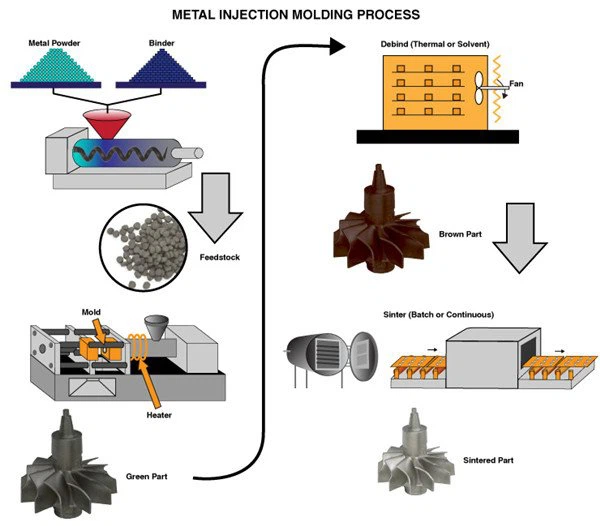
Metal Injection Molding Process
Detection Systems


Send Inquiry
