Introduction to Metal Injection Molding (MIM) Technology
Feb 22, 2023
Introduction to Metal Injection Molding (MIM) Technology
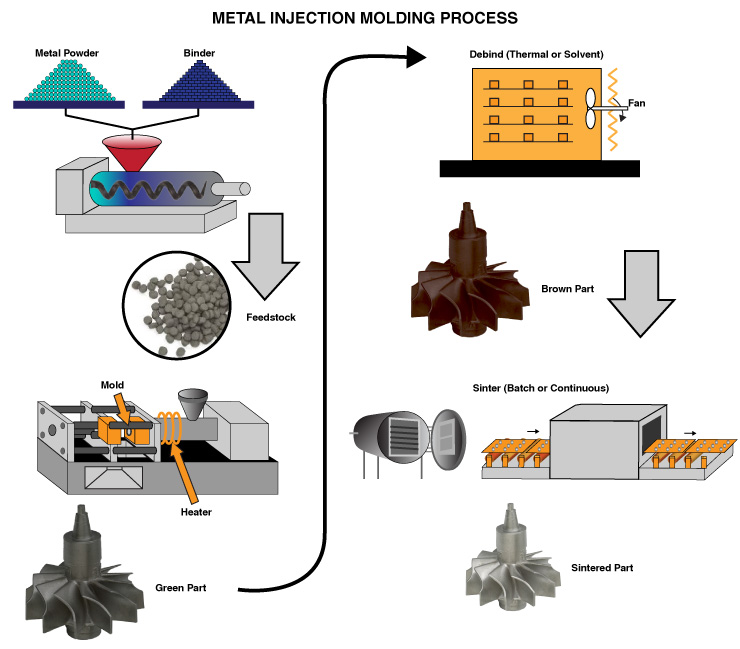
Metal Injection Molding (MIM) is a product of the interaction and intersection of plastic molding technology, polymer chemistry, powder metallurgy technology, metal materials science and other disciplines. It can use mold to inject molding blanks and quickly produce high-density, high-precision, three-dimensional complex shape structural parts through sintering, which can quickly and accurately materialize the design idea into a certain structure It is a new revolution in the manufacturing technology industry that products with functional characteristics can directly produce parts in batches. This process technology not only has the advantages of less conventional powder metallurgy processes, no cutting or less cutting, high economic benefits, but also overcomes the disadvantages of traditional powder metallurgy products such as low density, uneven material, low mechanical properties, difficult to form thin wall and complex structure, especially suitable for mass production of small, complex and metal parts with special requirements.
MIM is usually suitable for products with the following characteristics:

Complex shape: MIM allows free design of 3D shape like injection molding. Because MIM is a forming process, additional product shapes will not increase the cost. If weight reduction is achieved through shape design, the cost will decrease, which makes MIM one of the ideal ways to combine more than one independent part into a multi-functional part. MIM design rules are very close to injection molding, so it is easy to adapt to metal parts with complex three-level shape.
Dimensional precision: the near-net forming precision of MIM is usually ± 0.5% of the size. Some dimensional features can reach ± 0.3%. Like other technologies, high precision means higher cost. Therefore, it is recommended that the dimensional tolerance be moderately relaxed if it can meet the requirements of use. Tolerances that cannot be directly met by MIM can be realized by subsequent processing.
Thin wall products: wall thickness less than 6 mm is suitable for MIM. Thicker outer wall can also be used, but the process time will increase a lot and the material cost will increase. The thin wall less than 0.5 mm can also be achieved by using MIM, and even 0.2 mm extremely thin wall products can be achieved (but there is a certain dependence on the specific product shape).
Weight and size: MIM is suitable for parts with weight less than 100g, and less than 50g is the most common application. However, parts weighing up to 250g can also be processed by MIM process. Raw materials are the key cost factor of the MIM process. In the early stage of MIM product design, the weight of components is often reduced as much as possible. Like plastic products, the weight of components can be reduced through the core and bracket without affecting the integrity of the product. MIM is outstanding in terms of small and micro components, and it is also possible to weigh less than 0.1 g. Products with a length of more than 250mm can also do this.
Batch size: For MIM products, mold and early product development process are necessary for the MIM process, so for small batch products (annual demand is less than thousands of pieces), it usually affects the decision-making process. MIM can increase its output from tens of thousands of pieces per year to tens of millions of pieces per year, which can be realized very economically.
Wide range of raw materials: MIM can handle many materials, including ferroalloy, stainless steel, copper, KOVAR alloy, superalloy, hard alloy, etc.