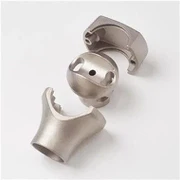
Comparison of the advantages and disadvantages between powder metallurgy and machining of powder metallurgy gear
Nov 07, 2022
Comparison of the advantages and disadvantages between powder metallurgy and machining of "powder metallurgy gear"
Do you know the advantages and disadvantages of powder metallurgy and cutting? What is powder metallurgy and what is cutting? The choice of powder metallurgy or cutting depends mainly on the production batch or part shape. The larger the production batch, the greater the benefit of powder metallurgy. Today, Zhongwei Precision Powder Metallurgy Gear Processing Factory will talk about the advantages and disadvantages of powder metallurgy and cutting.

Powder metallurgy is a forming process with little or no cutting, under the condition that the properties of powder metallurgy materials can meet the requirements of parts. From an economic point of view, the use of powder metallurgy technology means that energy and materials can be saved more or less, and a large amount of equipment investment can be saved. For expensive or difficult to machine materials, the value of powder metallurgy technology is obvious.
Powder metallurgy gear
The tool cost of CNC and automatic lathe turning is lower than that of any production method. Because the machine tool is highly automated, the labor intensity is low, and the cost of turning varies with the number and scope of turning operations. The objects to be processed are usually bars, tubes, plates or blanks. The material utilization rate of the parts processed by turning is very low. When the bar is cut, the material utilization rate is generally less than 50%. If the blank is turned by CNC lathe, the material utilization rate may be even lower. Generally speaking, the greater the amount of metal that is turned off during part processing, the more conducive it is to use powder metallurgy process for manufacturing.
The choice between turning and powder metallurgy may depend more on the shape of parts and economic factors. When the central axis of the part shape is symmetrical and has cylindrical, groove, step, etc., turning is most advantageous. Traditional powder metallurgy processes can produce parts of any shape that can be detached from the mold. Compared with cutting, powder metallurgy also has the following advantages:
1. The consistency of products is good, and the possibility of scrapping is small;
2. Good dimensional tolerance and surface roughness (except grinding and broaching);
3. Inspection and test costs can be saved because there is only one forming operation in the production process of powder metallurgy parts.
This is about the comparison between powder metallurgy and cutting. As CNC machine tools are more popular, the efficiency and accuracy of cutting have been improved. However, for mass production, there are still problems such as operation trouble, chip cleaning trouble, and long time required for all finishing. In these aspects, powder metallurgy manufacturing can find a better solution.