Application of copper in powder metallurgy
Oct 28, 2022
Application of copper in powder metallurgy
The important and characteristic application of copper powder lies in the field of powder metallurgy. Materials in this field of powder metallurgy are not obtained by smelting and casting, for example: dispersion strengthened Cu-Al2O3 is used to strengthen and manufacture welding electrodes (used in automobile and other industrial fields), and W-Cu and Mo Cu are also used in the thermal management field of electronic components. Such materials need to control their porosity. Self lubricating bearings and filters are typical applications in the field of powder metallurgy. These materials require proper porosity control to achieve excellent lubrication effect with oil content. The following is a brief introduction to the use of copper in powder metallurgy.

The primary application of copper powder is to mix copper and tin powder to make bronze parts. In the early 1920s, Metal Refinement (USMR), located in the Cartwright Autonomous Region of New Jersey, began to produce electrolytic copper powder. This factory has a small area and a large cathode bath. In the peak production period, the powder factory has about 455 tons of copper powder per month. In the mid-1980s, smelting and electrolytic refining enterprises were forced to close down. Due to the closure of the Kartlett plant, although some enterprises tried to produce electrolytic copper powder, the United States no longer produced electrolytic copper powder products. Today, electrolytic copper powder is produced in Europe, Japan, Russia, India and South Korea. Guangdong Dahong New Materials has learned that electrolytic copper powder particles have dendritic characteristics through research. By adjusting the process, the loose density is less than 1g/cm3, and the green strength is more than 35MP. By adjusting the settling process and the post-treatment of the powder, the bulk density can be increased.
Zhongwei can precisely produce copper powder with spherical or irregular shape through water atomization and gas atomization process plus redox method. Physical properties of atomized powder (such as loose density, fluidity, particle size and green strength) are related to process conditions, such as specific additives, smelting temperature, atomization pressure, reduction temperature and post-treatment of powder. The powder passing the redox test has a median diameter of 10 microns, a loose density of less than 1.5g/cm3, and a green density of more than 20MP. The particle size and reduction temperature of atomized powder are the key factors to determine the powder product. Zhongwei precisely found that the properties of atomized redox powder are basically the same as those of electrolytic copper powder in application. The difference in application is that dendritic powder and very low bulk density are required.
Processing self-lubricating copper tin base oil bearing (with internal pores) is a unique feature of powder metallurgy. Such bearings are sintered to a certain density, and the pore oil content can reach 10-30%. These bearings require periodic lubrication to ensure safe operation during the life cycle of the equipment. In 1920, self-lubricating bearings were first used in Buick automobile industry. The use in other industries is considerable, changing the industry of household equipment. The manufacture of self-lubricating bearings consumes about 55% of the copper powder output. Cu Pb and Cu Pb Sn bearings are used in automobiles, turbines, thrust washers and industrial pump equipment. The steel back material has replaced the cast and forged bronze bearings. The powder is covered on the steel substrate, and certain density is achieved through sintering and rolling. The porosity of the final product is less than 0.25%.
The brass powder and nickel silver alloy powder are produced by atomization. The zinc content in the brass powder is 10%~30%, and sometimes lead is added to improve the mechanical properties. Brass powder has been used in locks, instrument pointers and driving equipment. Because of its beautiful color, brass is used for decorative metal medals. Brass powder metallurgy parts weighing 2.6 kg have recently been used in robot arms. The tensile strength and elongation of sintered parts with sintering density of 7.7g/cm3 reached 193MPa and 14% respectively.
In 2002, according to the precise data, the consumption of copper powder in the world was estimated to be 59000 to 64000 tons, 22000 tons in North America, 18000 tons in Europe and 4500 tons in other countries. About 55% of copper powder is used for bronze parts, 13% is mixed with iron powder to produce powder metallurgy parts, 12% is used for penetrating sintering powder, 10% is used for brass, and 10% is used for other applications such as friction materials, chemistry, W-Cu and Mo Cu heavy metals, coatings, paints, pastes, and inks. A large number of P/M parts show that P/M process has great potential and creativity for the use of copper based materials.
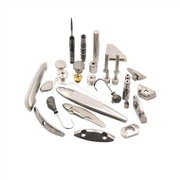
According to the current development situation, the powder with particle size less than 10 μ m is suitable for the production of metal powder injection molded parts. Copper powder can be manufactured into MIM communication medical, MIM intelligent wear and MIM automobile parts with complex shape through metal powder injection molding process. This product has good conductivity and thermal conductivity. We can use high-purity copper powder to improve the conductivity and thermal conductivity by increasing the final density of the parts. The metal powder injection molding process can improve the density of copper powder, and the conductivity and thermal conductivity of the product will be improved accordingly.
For more information about copper in the field of powder metallurgy, please consult the zhongwei precision professional team!