


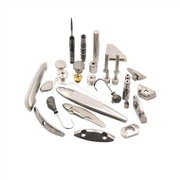
Spline PM Parts
The mechanical method can be divided into: mechanical crushing and atomization method; the physical and chemical method is divided into: electrochemical corrosion method, reduction method, chemical method, reduction-chemical method, vapor deposition method, liquid deposition method and electrolytic method. Among them, the most widely used methods are reduction method, atomization method and electrolysis method.
Product Description
|
Spline PM Parts |
|||||
|
Item |
Material |
Production Process |
Sintering Temperature |
Mold |
Custom |
|
Spline |
440c |
Powder metallurgy sintering |
1550°C |
To be customized |
Yes |
|
Chemical composition |
C: 0.95~1.20 Si: ≤1.00 Mn: ≤1.00 S : ≤0.030 P : ≤0.035 Cr: 16.00~18.00 Ni: allowed to contain ≤0.60 |
||||
|
Available Materials |
Low carbon stainless steel, titanium alloy (Ti, TC4), copper alloy, tungsten alloy, hard alloy, high temperature alloy (718, 713) |
||||
Production process of spline powder metallurgy sintered parts
1. Preparation of raw material powder. The existing milling methods can be roughly divided into two categories: mechanical methods and physical and chemical methods. The mechanical method can be divided into: mechanical crushing and atomization method; the physical and chemical method is divided into: electrochemical corrosion method, reduction method, chemical method, reduction-chemical method, vapor deposition method, liquid deposition method and electrolytic method. Among them, the most widely used methods are reduction method, atomization method and electrolysis method.
2. The Spline PM Parts are formed into a compact of the desired shape. The purpose of forming is to make a compact of a certain shape and size, and to make it have a certain density and strength. The molding method is basically divided into pressure molding and non-pressure molding. Compression molding is the most widely used in compression molding. In addition, 3D printing technology can also be used to make embryo blocks.
3. Sintering of compacts. Sintering is a key process in the powder metallurgy process. The formed compact is sintered to obtain the required final physical and mechanical properties. Sintering is divided into unit system sintering and multi-system sintering. For the solid-phase sintering of the unit system and the multi-component system, the sintering temperature is lower than the melting point of the metal and alloy used; for the liquid-phase sintering of the multi-component system, the sintering temperature is generally lower than the melting point of the refractory component and higher than the melting point of the fusible component. melting point. In addition to ordinary sintering, there are also special sintering processes such as loose packing sintering, immersion immersion method, and hot pressing method.
4. Subsequent processing of products. The treatment after sintering can be done in various ways according to different product requirements. Such as finishing, oil immersion, machining, heat treatment and electroplating. In addition, in recent years, some new technologies such as rolling and forging have also been applied to the processing of powder metallurgy materials after sintering, and achieved satisfactory results.
Powder properties (property of powder)
The general term for all properties of powder. It includes: the geometric properties of the powder (particle size, specific surface, pore size and shape, etc.); the chemical properties of the powder (chemical composition, purity, oxygen content and acid insolubles, etc.); the mechanical properties of the powder (loose density, fluidity, etc.) , formability, compressibility, stacking angle and shear angle, etc.); the physical properties and surface properties of the powder (true density, gloss, wave absorption, surface activity, ze%26mdash;ta(%26ccedil;) potential and magnetic properties, etc. ). Powder properties often determine the performance of powder metallurgy products to a large extent.
The most basic of geometric properties is the particle size and shape of the powder.
(1) Granularity. It affects the processing and shaping of the powder, the shrinkage during sintering and the final properties of the product. The performance of some powder metallurgy products is almost directly related to the particle size. For example, the filtration accuracy of the filter material can be empirically obtained by dividing the average particle size of the original powder particles by 10; In order to obtain cemented carbide with finer grain size, it is only possible to use finer grained WC raw materials. The powders used in production practice have a particle size ranging from a few hundred nanometers to a few hundred microns. The smaller the particle size, the greater the activity, and the easier the surface is to oxidize and absorb water. When it is as small as a few hundred nanometers, it is not easy to store and transport the powder, and when it is small to a certain extent, the quantum effect starts to work, and its physical properties will change dramatically, such as ferromagnetic powder will become superparamagnetic Powder, the melting point also decreases with the particle size decreases.
The particles are dendritic; the iron powder particles obtained by the reduction method are in the shape of sponge flakes; those obtained by the gas atomization method are basically spherical powders. In addition, some powders are egg-shaped, disc-shaped, needle-shaped, onion-shaped, etc. The shape of the powder particles will affect the fluidity and bulk density of the powder. Due to the mechanical meshing between the particles, the compact strength of the irregular powder is also high, especially the dendritic powder has the highest compact strength. But for porous materials, spherical powder is the best.
Mechanical properties The mechanical properties of the powder are the process properties of the powder, which is an important process parameter in the powder metallurgy forming process. The bulk density of the powder is the basis for weighing by the volumetric method during pressing; the fluidity of the powder determines the filling speed of the powder to the die and the production capacity of the press; the compressibility of the powder determines the difficulty of the pressing process and the degree of pressure applied. High and low; while the formability of the powder determines the strength of the billet.
The chemical properties mainly depend on the chemical purity of the raw materials and the milling method. A higher oxygen content will reduce the compaction performance, compact strength and mechanical properties of sintered products, so most of the technical conditions of powder metallurgy have certain regulations on this. For example, the allowable oxygen content of the powder is 0.2% to 1.5%, which is equivalent to an oxide content of 1% to 10%.
Metal Injection Molding Process

Detection Systems




Send Inquiry
