




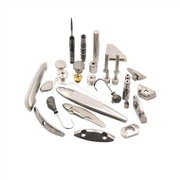
Non-standard Precision PM Parts
Since powder metallurgy can press the billet of final size without or little need for subsequent machining, it can greatly save metal and reduce the cost of finished products. Therefore, when using powder metallurgy to manufacture products, metal The loss of metal is only 1-5%, while the loss of metal can reach 80% when it is produced by general casting method.
Product Description
|
Non-standard precision PM Parts |
|||||
|
Item |
Material |
Production Process |
Sintering Temperature |
Mold |
Custom |
|
Non-standard |
440c |
Powder metallurgy sintering |
1550°C |
To be customized |
Yes |
|
Chemical composition |
C: 0.95~1.20 Si: ≤1.00 Mn: ≤1.00 S : ≤0.030 P : ≤0.035 Cr: 16.00~18.00 Ni: allowed to contain ≤0.60 |
||||
|
Available Materials |
Low carbon stainless steel, titanium alloy (Ti, TC4), copper alloy, tungsten alloy, hard alloy, high temperature alloy (718, 713) |
||||
Advantages and disadvantages of powder metallurgy
1. Advantages of powder metallurgy gears
(1) The vast majority of refractory metals and their compounds, pseudoalloys, and porous materials can only be manufactured by powder metallurgy.
(2) Since powder metallurgy can press the billet of final size without or little need for subsequent machining, it can greatly save metal and reduce the cost of finished products. Therefore, when using powder metallurgy to manufacture products, metal The loss of metal is only 1-5%, while the loss of metal can reach 80% when it is produced by general casting method.
(3) Since the powder metallurgy process does not melt the material during the material production process, and is not afraid of doping impurities from the crucible and deoxidizer, etc., while sintering is generally carried out in a vacuum and reducing atmosphere, it is not afraid of oxidation and will not damage the material. No contamination is caused, so high-purity material can be produced.
(4) Powder metallurgy can ensure that the component distribution ratio of materials is correct and uniform.
(5) Powder metallurgy technology is suitable for the production of non-standard precision PM Parts that are formed on the same day and in large quantities, especially products with high processing costs such as gears. The use of stainless steel powder metallurgy manufacturing capabilities can greatly reduce production costs.
2. Disadvantages of powder metallurgy gears
(1) Consider the size of parts without mass production.
(2) The cost of abrasive tools is much higher than that of casting molds.
Powder metallurgy gear material
The materials used for powder metallurgy gears are as follows:
1. Electromagnetic materials
Including electrical and magnetic materials.
2. Tooling material
Including cemented carbide, powder metallurgy high-speed steel, etc. The latter has uniform structure, fine grains, no segregation, better toughness and wear resistance than cast high-speed steel, less heat treatment deformation, and longer service life. Blanks that can be used to make cutting tools, molds and parts.
3. High temperature materials
Including powder metallurgy superalloys, refractory metals and alloys, cermets, dispersion strengthened and fiber reinforced materials, etc. It is used to manufacture turbine discs, nozzles, blades and other high temperature resistant parts used under high temperature.
4. Friction material
It consists of three parts: base metal (copper, iron or other alloys), lubricating components (lead, graphite, molybdenum disulfide, etc.), friction components (silicon dioxide, asbestos, etc.). It has a high coefficient of friction, can quickly absorb kinetic energy, has fast braking and transmission speeds, low wear, high strength, high temperature resistance, and good thermal conductivity; it has good bite resistance, corrosion resistance, and is less affected by grease and moisture. It is mainly used in manufacturing clutches and brakes.
Discussion on the post-treatment procedure after powder metallurgy sintering

Among many powder metallurgy parts, gears are common, and gears can be formed at one time by powder metallurgy technology, and can meet the requirements of high precision in appearance and size. Powder metallurgy gears like this require post-processing.
In order to improve the strength and wear resistance of powder metallurgy gears, it is necessary to carry out post-treatment after sintering to improve their performance. There are two commonly used treatment methods, one is surface water vapor treatment, which makes water vapor react with Fe on the surface of the gear at high temperature, and then forms a dense substance Fe3O4. Due to its high hardness, if it is attached to the surface of Non-standard precision PM Parts, the wear resistance and surface hardness of the product will increase accordingly.
The other is carburizing treatment, which is the same as that of ordinary gears. The integrated treatment of carbonitriding and quenching is the most widely used operation mode at present.
The above are the two post-processing procedures of powder metallurgy gears after sintering. If you have powder metallurgy gear needs, please contact Jingke online customer service.
Qinhuangdao Zhongwei Precision Machine Parts Co., Ltd. has been committed to using metal powder injection molding technology and MIM powder metallurgy technology to produce miniaturized, three-dimensional complex shape, and high-precision precision metal structure technology. Products are widely used in communication electronics, consumer electronics, mim auto parts, smart locks, industrial automation and other fields.
To sum up, the above is the material knowledge of powder metallurgy gears. I hope it can help everyone. Powder metallurgy gears are commonly used in various automobile engines, and they are very economical and practical in large quantities.
Metal Injection Molding Process

Detection Systems




Send Inquiry
