



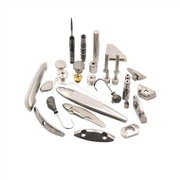
Clutch Plug PM Parts
The hydraulic automatic transmission is mainly composed of a hydraulically controlled gear transmission system, which mainly includes two parts: an automatic clutch and an automatic transmission. The clutch is installed between the engine and the transmission, and is an assembly directly connected with the engine in the car drive train.
Product Description
|
Clutch Plug PM Parts MHZ2-16D base MIM parts |
|||||
|
Item |
Material |
Production Process |
Sintering Temperature |
Mold |
Custom |
|
Clutch Plug |
440c |
Powder metallurgy sintering |
1550°C |
To be customized |
Yes |
|
Chemical composition |
C: 0.95~1.20 Si: ≤1.00 Mn: ≤1.00 S : ≤0.030 P : ≤0.035 Cr: 16.00~18.00 Ni: allowed to contain ≤0.60 |
||||
|
Available Materials |
Low carbon stainless steel, titanium alloy (Ti, TC4), copper alloy, tungsten alloy, hard alloy, high temperature alloy (718, 713) |
||||
Production Process
The hydraulic automatic transmission is mainly composed of a hydraulically controlled gear transmission system, which mainly includes two parts: an automatic clutch and an automatic transmission. The clutch is installed between the engine and the transmission, and is an assembly directly connected with the engine in the car drive train. Clutches are divided into four types: electromagnetic clutches, magnetic powder clutches, friction clutches and hydraulic clutches. The hydraulic clutch uses fluid as the transmission medium. Compared with the mechanical clutch, in addition to the various changes in the transmission characteristics, it also mainly absorbs the vibration and impact caused by the rotation of the driving shaft and the driven shaft. Heavy-duty hydraulic automatic transmission powder metallurgy spacer parts, Clutch Plug PM Parts are mainly used in the assembly and manufacture of heavy-duty hydraulic automatic transmission clutches for heavy vehicles. Prior to this, the part had to be imported from abroad, and the spacer part manufactured by powder metallurgy technology is currently the first domestic development. Through our research and development, the localization process of such products can be accelerated, the cost of products will be effectively reduced, and the market competitiveness of Chinese enterprises and products will be further improved.
Relevant technical requirements for septum products
The main technical index requirements of septum products are as follows:
Material tensile strength: 480MPaMIN; (2) Yield hardness (0.2% offset): 440MPaMIN; (3) Elongation rate: 1.5%MIN; (4) Minimum surface hardness: HRB70MIN; (5) Density (ASTMB328 ): 6800kg/m³MIN.
Process route formulation and development process
Septa products have high requirements on mechanical strength and physical properties. According to the product diagram, it can be seen that the total height and steps of the spacer parts are thin, and forming is difficult. How to ensure the quality of blank forming and solve the problem of sintering deformation is the key. After comprehensive consideration, the proposed process route is as follows: raw materials - ingredients - molding - sintering - shaping - flat grinding - grinding
1. Raw material selection and ratio
In view of the high mechanical strength and physical performance requirements of powder metallurgy spacer parts, in the selection and use of raw materials, imported pre-mixed powders were used. After repeated physical and processing performance tests, a unique iron-based powder metallurgy was developed. Material recipe.
2. Molding
The overall height and steps of powder metallurgy spacer parts are thin, and forming is difficult. How to ensure the quality of blank forming is the key. According to the calculated theoretical pressing force, the company's 315T automatic hydraulic press is selected, and the upper and lower two structures are used for pressing.
(1) Forming mold design
(2) According to previous calculations and tests, determine the parameters related to suppression
(3) Sintering
Since the product is thin and easily deformed during sintering, it was decided to adopt a single-layer sintering method with a backing plate after consideration. After repeated tests and data analysis, the sintering process parameters were adjusted to minimize the degree of deformation[3]. The sintering adopts the company's 460 continuous mesh belt sintering furnace, which is sintered under the protective atmosphere of ammonia decomposition, and the temperature in the high temperature zone is about 1110 °C.
(4) Plastic surgery
This process is a correction of the deformation caused by the sintering of the septum product. In order to ensure the quality of the septum molding, it is necessary to carry out the necessary full-finish shaping in the subsequent sequence to ensure that its performance indicators meet the requirements.
(5) Machining
Later, flat grinding is used to ensure the flatness requirements of the septum product, and the edges and burrs are removed by grinding to ensure the appearance quality of the product.
Summarize
This paper summarizes the following points through the introduction of the development process of powder metallurgy spacers for hydraulic transmission clutches:
1. For Clutch Plug PM Parts, which are thinner and easily deformed by sintering, consider adopting a single-layer sintering method with a backing plate. Repeated tests, data analysis, and adjustment of sintering process parameters are required to minimize the degree of deformation.
2. The general shaping process can correct the sintering deformation to a certain extent, but the follow-up machining process is required for higher precision performance indicators.
3. The septum product developed this time guarantees various performance indicators and successfully realizes the localization of this type of product.
Metal Injection Molding Process

Detection Systems




Send Inquiry
