



Metal Injection Molding Of Anti-skid Nails For Bicycle And Automobile Tires
Refractory metal products In addition to the wires, strips, tubes, sheets and rods widely used in the electronics industry and the light bulb industry, the refractory metal materials of powder metallurgy also have a large amount of molybdenum electrodes used in the glass industry, molybdenum-titanium-zirconium alloy plugs for seamless steel pipe perforation, high-density alloys, tungsten-copper, tungsten-copper-nickel, tungsten-nickel-iron, tungsten-silver pseudoalloys, etc.

Refractory metal products In addition to the wires, strips, tubes, sheets and rods widely used in the electronics industry and the light bulb industry, the refractory metal materials of powder metallurgy also have a large amount of molybdenum electrodes used in the glass industry, molybdenum-titanium-zirconium alloy plugs for seamless steel pipe perforation, high-density alloys, tungsten-copper, tungsten-copper-nickel, tungsten-nickel-iron, tungsten-silver pseudoalloys, etc.
The following introduces these materials separately:
① Molybdenum electrodes for electric melting glass. Molybdenum has excellent corrosion resistance to molten glass. It is used to replace platinum electrodes for melting glass. The effect is very good, which can save precious metal platinum and greatly reduce production costs. The amount used for this purpose accounts for more than 60% of metal molybdenum materials. Powder metallurgy pure molybdenum electrodes are formed by cold isostatic pressing, high-temperature sintering (2000-2200℃), and then hot rolling or hot forging at 1200-1250℃ to make plate-shaped or rod-shaped electrodes.
②Molybdenum-titanium-zirconium alloy plugs for perforating heat-resistant seamless steel pipes. Two types of powder metallurgy molybdenum alloy plugs are currently produced: sintered plugs and sintered-deformed plugs. Powder metallurgy plugs have fine grains and good plasticity. They are not easy to crack during operation, have a long service life, and have good pipe penetration quality. It is made by mixing molybdenum powder with TiH2 powder and ZrH2 powder, cold isostatic pressing, and sintering at high temperature (about 2000℃). To further improve performance, it can be extruded or forged.
③High-density alloy. The alloy is made by liquid phase sintering with tungsten as the base (containing 90-98% tungsten) and adding a small amount of Fe, Ni, Cu and other elements. It has a high specific gravity (16.5-18.8g/cm3), so it is called a high-density alloy. High-density alloys are divided into two series: W-Ni-Fe and W-Ni-Cu. Due to their high specific gravity, high strength and strong ability to absorb X-rays and gamma rays, they are widely used as inertial elements, armor-piercing cores and storage and shielding of radioactive materials. Since Ni, Fe and other elements are added to W, a liquid phase appears during the sintering process, which greatly reduces its sintering temperature, resulting in the so-called "activated sintering". The sintering temperature of high-density alloys produced industrially is generally 1400-1550℃.
④ Tungsten-copper and tungsten-silver pseudoalloys. Tungsten and copper (or silver) do not alloy (do not form a solid solution) or form a compound. Their physical properties are very different and cannot be produced by smelting process, but can only be produced by powder metallurgy. They are composite materials with a two-phase structure and the properties of two metals, so they are called "pseudoalloys". This type of pseudoalloy has high arc erosion resistance, good resistance to fusion welding, good electrical and thermal conductivity, and was used as a contact (contact) for electrical switches as early as the 1930s. W-Ag has lower contact resistance than W-Cu and is mostly used as contactor contacts. W-Cu is mostly used as contacts of high-voltage circuit breakers, especially W-20Cu is the most successful material for high-voltage circuit breaker contacts (see powder metallurgy electrical materials). W-Cu is also used as electrodes for resistance welding and EDM. Since Ag or Cu in W-Ag and W-Cu has a sweating cooling effect at high temperatures, it has been used as a gas nozzle throat lining for solid fuel rocket engines since the 1960s, and the operating temperature can reach above 3000℃.
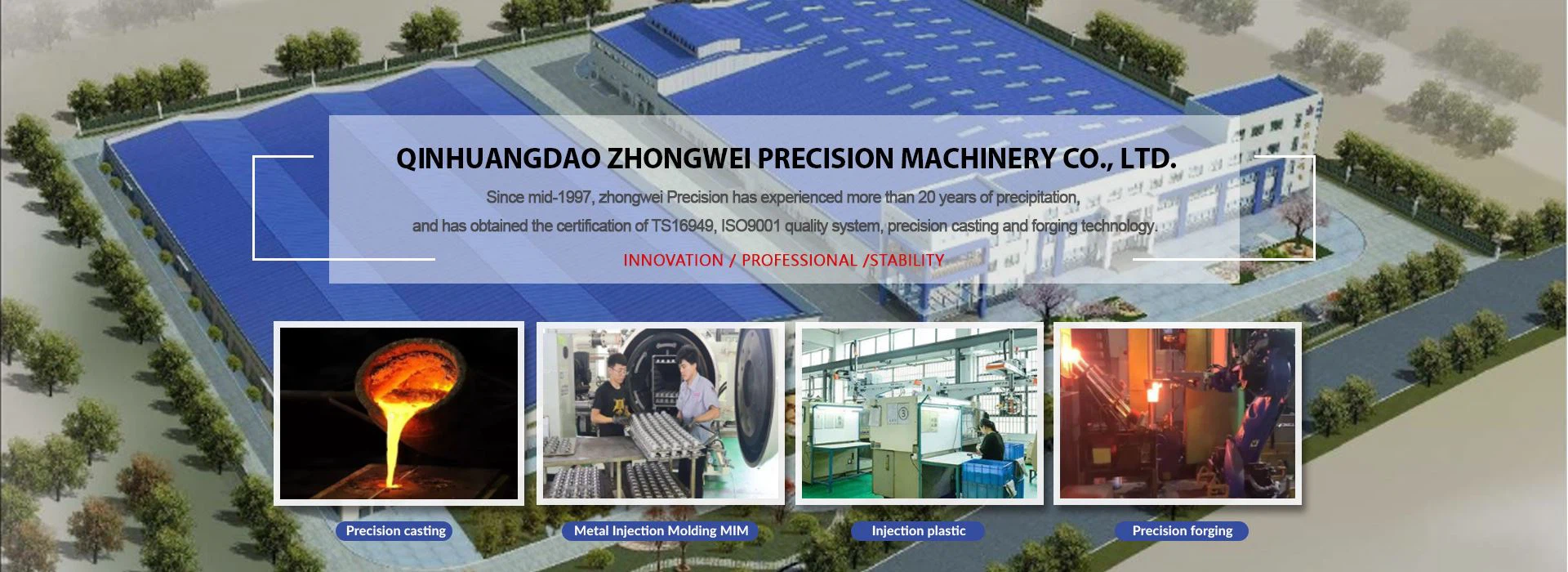
Qinhuangdao Zhongwei Precision Machinery Co., Ltd. is a MIM factory specializing in the development, production and sales of injection molding products of iron-based, stainless steel, titanium alloy, cemented carbide, high-density (specific gravity) tungsten alloy, copper-based and other metal powder metallurgy materials, and mass production of precision, three-dimensional complex shapes and metal parts with special performance requirements. The company has advanced technology and was formed by a group of professionals who have been engaged in the metal injection molding industry for more than ten years, building an efficient R&D design and manufacturing team. The company has excellent equipment and a full set of metal injection molding production and testing equipment to provide customers with superior quality, on-time delivery and highly competitive price services. The company's products include copper-based powder metallurgy, iron-based metallurgy, tungsten alloy powder metallurgy, metal powder injection molding, metal injection molding, cemented carbide powder metallurgy, stainless steel parts, etc.
 Metal Injection Molding 14AL Snow Tire Anti-skid Spikes
 JXTSMI 8-12-1 Car Tire Anti-skid Spike Metal Injecti...
 JX1600 Threaded Anti-skid Shoe Spikes Metal Injectio...
 Export Carbide Anti-skid Spikes Metal Injection Mold...
 Carbide Water Jet Metal Injection Molding MIM Parts
 Tungsten Alloy Bullet Fishing Sink MIM Parts
Send Inquiry
