



Z6CND17.12 Metal Powder Injection Molded Parts
Z6CND17.12 stainless steel has good plasticity, toughness, cold denaturation, and welding process performance. Adding Mo element makes it obtain a special corrosion-resistant structure. Because it has better resistance to chloride corrosion than Z6CN18.09, it is also used as "marine steel".
Product Description
|
Z6CND17.12 metal powder injection molded parts |
|||||
|
Item |
Material |
Production Process |
Sintering Temperature |
Mold |
Custom |
|
Z6CND17.12 |
Stainless steel |
Metal Injection Molding |
1500°C |
To be customized |
Yes |
|
Available Materials |
Low carbon stainless steel, titanium alloy (Ti, TC4), copper alloy, tungsten alloy, hard alloy, high temperature alloy (718, 713) |
||||
Z6CND17.12 stainless steel
Z6CND17.12 stainless steel has good plasticity, toughness, cold denaturation, and welding process performance. Adding Mo element makes it obtain a special corrosion-resistant structure. Because it has better resistance to chloride corrosion than Z6CN18.09, it is also used as "marine steel".
Chemical composition of Z6CND17.12 stainless steel
C: ≤0.07%
Si: ≤1.00%
Mn: ≤2.00%
P: ≤0.040%
S: ≤0.030%
Cr: 16.00-18.00%
Ni: 11.00-13.00%
Mo: 2.50-3.00%
Application range of Z6CND17.12 stainless steel
Z6CND17.12 stainless steel is mainly used in food industry and surgical equipment, and is also suitable for production equipment in seawater, chemical, dye, paper, oxalic acid, fertilizer, photography, food industry, coastal area facilities, ropes, CD rods, bolts , nuts, etc. Z6CND17.12 metal powder injection molded parts.
Z6CND17.12 stainless steel processing specification and metallographic structure
Heat treatment specifications: solid solution 1010 ~ 1150 ℃ rapid cooling;
Metallographic structure: The structure is characterized by austenitic type.
Mechanical properties of Z6CND17.12 stainless steel
Tensile strength σb (MPa): ≥520
Yield strength σ0.2 (MPa): ≥206
Elongation δ5 (%): ≥40
Reduction of area ψ (%): ≥60
Hardness test: ≤187HB; ≤90HRB; ≤200HV
Z6CND17.12 stainless steel welding
Z6CND17.12 stainless steel has good welding performance. All standard welding methods can be used for welding. When welding, different stainless steel filler rods or welding rods can be used for welding according to the application. In order to obtain the best corrosion resistance, the welded section of Z6CND17.12 stainless steel needs to be annealed after welding.
Z6CND17.12 metal powder injection molded parts is a new molding technology for parts formed by combining traditional powder metallurgy technology with modern plastic injection molding technology. The biggest feature of this technology is that it can directly manufacture parts with final shape, minimize the amount of machining and save raw materials, and solve the problem of difficult forming of complex shape products in the field of powder metallurgy; moreover, the material of this technology has wide adaptability , all metals, alloys, ceramics, etc. that can be made into powder can be made into parts by this technology. In addition, this technology can also realize fully automated continuous production, with excellent material performance and high product dimensional accuracy.
The basic process of this technology is: first, uniformly mix the solid powder with certain additive components, after granulation, inject the granular material into the mold cavity with an injection molding machine in a heated state to condense and form, and then chemically or thermally decompose it. The binder in the formed blank is removed, and finally the final product is obtained through sintering and densification.

In recent years, microsystem technology has developed very rapidly in various fields, and at the same time, it has put forward higher requirements for the manufacture of three-dimensional micro-complex components used in micro-engineering. It is hoped that micro-devices can meet the performance requirements while being able to Realize large-scale production. The main components in the microsystem include micro-molds, micro-mechanical structures for sensors and accelerators, biosensors, micro-fluidic elements, micro-reactors, etc. These components have complex shapes and small volumes. Using existing micro-processing technologies such as micro-cutting, laser cutting, and silicon etching technologies, the production efficiency is low and large-scale production cannot be carried out. In recent years, it has developed on the basis of powder injection molding. The advanced powder microinjection molding process provides the most potential preparation technology for the large-scale production of micro components.
At present, the main countries carrying out research on this technology in the world are Germany, Japan, Singapore, the United States and the United Kingdom. Among them, Germany took the lead in carrying out and achieved outstanding results. Domestic Beijing University of Science and Technology, Central South University and Dalian University of Technology have also carried out a series of research work in this field. For example, Beijing University of Science and Technology has developed a mold for powder micro-injection molding with independent intellectual property rights and is suitable for traditional injection molding machines; and using carbonyl iron powder and iron-nickel alloy powder as raw materials, powder micro-injection molding has been successfully realized on traditional injection molding machines Micro gears with addendum circle diameter less than 1mm.
Metal Injection Molding Process

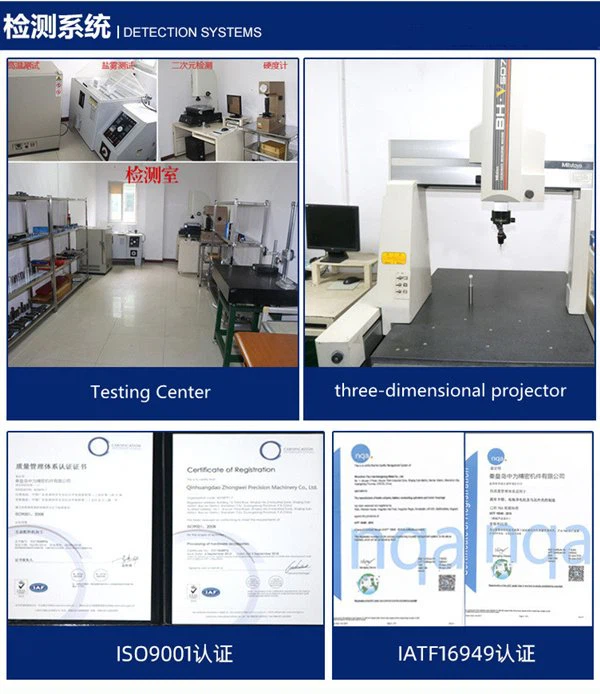
Detection Systems


Send Inquiry
