




Marine Silica Sol Investment Casting
When using wax to make patterns, investment casting is also called "lost wax casting". Investment casting usually refers to making a pattern in a fusible material, coating the surface of the pattern with several layers of refractory material to make a mold shell, and then melting the pattern out of the mold shell to obtain a mold without parting surface.
When using wax to make patterns, investment casting is also called "lost wax casting". Investment casting usually refers to making a pattern in a fusible material, coating the surface of the pattern with several layers of refractory material to make a mold shell, and then melting the pattern out of the mold shell to obtain a mold without parting surface. A casting solution that can be filled with sand. Because patterns are widely made of waxy materials, investment casting is often referred to as "lost wax casting".
The types of alloys that can be produced by investment casting are carbon steel, alloy steel, heat-resistant alloys, stainless steel, precision alloys, permanent magnet alloys, bearing alloys, copper alloys, aluminum alloys, titanium alloys and ductile iron, Marine silica sol investment casting Wait.
Product Description
Basic situation of marine silica sol investment casting
1. Implementation standards: The company strictly implements ISO9001 & TS 16949 certification.
2. Product material standards: ISO, GB, ASTM, SAE, ISO, EN, DIN, JIS, BS
3. Main processes: sand casting, silica sol investment casting, water glass investment casting,shell casting,deburring, sand blasting, machining, heat treatment, leak testing, surface treatment, etc.
4. Available materials:
High manganese steel, high chromium steel, high nickel steel, carbon steel, alloy steel, stainless steel, gray iron, cast iron, cast steel, cast aluminum, cast copper, etc. can be customized according to customer requirements.
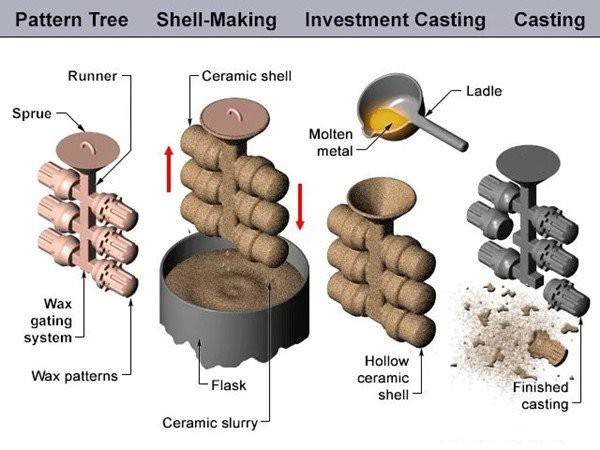
Investment Casting Process
The shape of investment castings is generally more complex, the minimum diameter of the holes that can be cast on the castings can reach 0.5mm, and the minimum wall thickness of the castings is 0.3mm. In production, some parts that were originally composed of several parts can be designed into integral parts by changing the structure of the parts and directly cast by investment casting, so as to save processing time and consumption of metal materials, and make the part structure more accurate. to be reasonable.
The weight of investment castings is mostly ten tenths of cattle (from a few grams to more than ten kilograms, generally not more than 25 kilograms), and it is more troublesome to use the investment casting method to produce too heavy castings.
The process of marine silica sol investment casting is more complicated and difficult to control, and the materials used and consumed are more expensive, so it is suitable for the production of small parts with complex shapes, high precision requirements, or difficult to perform other processing, such as turbines Engine blades, etc.
1. Advantages
The dimensional accuracy of investment castings is relatively high, generally reaching CT4-6 (CT10~13 for sand casting and CT5~7 for die casting). Of course, due to the complex process of investment casting, there are many factors that affect the dimensional accuracy of castings, such as The shrinkage of the mold material, the deformation of the investment mold, the linear change of the shell during the heating and cooling process, the shrinkage rate of the alloy and the deformation of the casting during the solidification process, etc., so the dimensional accuracy of ordinary investment castings is high, but Its consistency still needs to be improved (the dimensional consistency of castings using medium and high temperature waxes is much improved).
When pressing the investment mold, a mold with a high surface finish of the cavity is used, so the surface finish of the investment mold is also relatively high. In addition, the shell is made of high temperature-resistant special binder and refractory paint prepared from refractory materials, which is coated and hung on the investment mold, and the inner surface of the cavity that is in direct contact with the molten metal has a high smoothness. Therefore, the surface finish of investment castings is higher than that of general castings, generally reaching Ra.1.6~3.2μm.
The biggest advantage of investment casting is that investment castings have high dimensional accuracy and surface finish, so machining work can be reduced, just leave a little machining allowance on parts with higher requirements, and even some castings only Leave grinding, polishing allowance, can be used without machining. It can be seen that the investment casting method can save a lot of machine tool equipment and processing time, and greatly save metal raw materials.
Another advantage of the investment casting method is that it can cast complex castings of various alloys, especially superalloy castings. For example, the blade of a jet engine has a streamlined outline and an inner cavity for cooling, which can hardly be formed by machining. The investment casting process can not only achieve mass production and ensure the consistency of castings, but also avoid the stress concentration of residual knife lines after machining.
2. Manufacturing
The first process of investment casting production is to manufacture the investment mold. The investment mold is used to form the model of the cavity in the refractory shell. Therefore, in order to obtain castings with high dimensional accuracy and surface finish, the investment mold itself should have a high size. Precision and surface finish. In addition, the performance of the investment mold itself should also make the subsequent processes such as shell making as simple as possible. In order to obtain the investment mold with the above-mentioned high quality requirements, in addition to having a good pressing shape (the mold for pressing the investment mold), it is also necessary to select the appropriate molding material (referred to as the mold material) and a reasonable molding process.
3. Mold material
The performance of the molding material should not only ensure the convenient production of investment molds with accurate dimensions and high surface finish, good strength and light weight, but also create conditions for the manufacture of mold shells and good castings. Molding materials are generally prepared with wax, natural resin and plastic (synthetic resin). All mold materials mainly prepared with wax materials are called wax-based mold materials, and their melting point is low at 60-70 ° C; all mold materials mainly prepared with natural resins are called resin-based mold materials, with a slightly higher melting point, about 70 ~120°C.
4. Preparation and recycling
(1) Preparation of mold material
The purpose of preparing the mold material is to mix the various raw materials that make up the mold material into a uniform body, and to make the state of the mold material meet the requirements of the pressing investment.
When preparing, the heating method is mainly used to melt and mix various raw materials into a whole, and then under the condition of cooling, the mold material is vigorously stirred to make the mold material into a paste state for pressing and investment. Sometimes, the mold material is melted into a liquid and the investment mold is directly poured.
(2) Recovery of mold material
When using resin-based mold materials, due to the high quality requirements of investment molds, new materials are mostly used to prepare investment molds for mold materials to press castings. The mold material recovered after demolding is used to make the investment mold of the pouring and riser system after remelting and filtering.
When using wax-based mold materials, the mold material obtained after demolding can be recycled and used to make new investment molds. However, when recycled, the performance of the mold material will deteriorate, the brittleness will increase, the ash content will increase, the fluidity will decrease, the shrinkage rate will increase, and the color will change from white to brown, which is mainly related to the deterioration of the stearic acid in the mold material. Therefore, in order to restore the original performance of the old mold material as much as possible, it is necessary to remove the soap salt from the old mold material. The commonly used methods include hydrochloric acid (sulfuric acid) treatment, activated clay treatment and electrolytic recovery.
5. Manufacturing assembly
(1) Manufacture of investment mold
In the production, the method of pressing the paste mold material into the mold is mostly used to manufacture the investment mold. Before pressing the investment, a thin layer of release agent should be applied to the surface of the embossing so that the investment can be removed from the embossing. When pressing wax-based molding materials, the parting agent can be engine oil, turpentine, etc.; when pressing resin-based molding materials, a mixture of sesame oil and alcohol or silicone oil is often used as parting agent. The thinner the parting agent layer, the better, so that the investment mold can better replicate the surface of the embossing and improve the surface finish of the investment mold. There are three methods of pressing investment, plunger pressurization method, air pressure method and piston pressurization method.
(2) Assembly of investment mold
The assembly of the investment mold is to combine the investment mold that forms the casting and the investment mold that forms the gating riser system. There are two main methods:
①Welding method Use a sheet-shaped soldering iron to melt the connection part of the investment to weld the investment together. This method is more common.
②Mechanical assembly method In the mass production of small investment castings, mechanical assembly method combination modules have been widely adopted abroad. The use of this module can greatly improve the combination and efficiency of the modules, and the working conditions have also been improved.
6. Shell manufacturing
Investment casting molds can be divided into two types: solid type and multi-layer shell.
After dipping the module with refractory paint, sprinkle the refractory material in the form of material, and then dry and harden it. This is repeated many times until the refractory coating reaches the required thickness, thus forming a multi-layer shell on the module. , usually it is parked for a period of time to make it fully hardened, and then the module is melted, and a multi-layer shell is obtained.
Some multi-layer shells need to be boxed and filled with sand; some do not, and can be poured directly after roasting.
When the investment is melted, the shell will be under the pressure of the increasing volume of the molten mold material; during firing and pouring, the various parts of the shell will have mutually restrained and uneven expansion and contraction. Therefore, the metal may also High temperature chemical reaction with mold shell material. Therefore, there are certain performance requirements for the shell, such as small expansion rate and shrinkage rate; high mechanical strength, thermal shock resistance, refractoriness and chemical stability at high temperature; the shell should also have a certain air permeability, So that the gas in the shell can escape smoothly when pouring. These are all related to the refractory materials, binders and processes used to manufacture the shell.
7. Materials
The materials used to make the shell can be divided into two types, one is used to directly form the shell, such as refractory materials, binders, etc.; the other is used to obtain high-quality shells, simplify operations and improve processes. materials, such as fluxes, hardeners, surfactants, etc.
(1) Refractory material
The refractories used in investment casting are mainly quartz and corundum, as well as aluminum silicate refractories, such as refractory clay, bauxite, coke gemstones, etc. Sometimes zircon, magnesia (MgO), etc. are also used.
(2) Binder
The most common binder used in investment casting is silicic acid colloidal solution (referred to as silicic acid sol), such as ethyl silicate hydrolyzate, water glass and silica sol. The substances that compose them are mainly silicic acid (H2SiO3) and solvents, and sometimes stabilizers, such as NaOH in silica sol.
Ethyl silicate hydrolyzate is the earliest and most common binder used in silicic acid sol mold casting obtained by hydrolysis of ethyl silicate; the water glass shell is easily deformed and cracked, and the dimensional accuracy and Surface finish is poor. However, in our country, when the production precision requires carbon steel castings and non-ferrous alloy castings with a lower melting point, water glass is still widely used in production; silica sol has good stability, can be stored for a long time, and does not need to be used when making shells. Special hardener, but the wetting of the investment mold by silica sol is slightly poor, and the shell hardening process is a drying process, which takes a long time.
8. Shell making process
The main processes and processes in the shell making process are:
(1) Degreasing and degreasing of modules
In order to improve the ability of the coating to wet the surface of the module, the oil stain on the surface of the module needs to be removed when the wax-based moulding material is used to make the investment mould.
(2) Apply paint and sand on the module
Before painting and hanging the paint, the paint should be stirred evenly to reduce the precipitation of refractory materials in the paint bucket as much as possible, and the viscosity or specific gravity of the paint should be adjusted so that the paint can fill and wet the investment mold well. The module is immersed in the paint and shakes up and down, so that the paint can well wet the investment mold and evenly cover the surface of the module. After the paint is applied, sanding can be carried out.
(3) Shell drying and hardening
After each layer of shell is coated, it must be dried and hardened, so that the binder in the coating changes from sol to jelly and gel, and connects the refractory materials together.
(4) Loss of investment in self-molded shell
After the shell is completely hardened, the module needs to be melted from the shell. Because the module is usually made of wax-based mold material, this process is also called dewaxing. According to the different heating methods, there are many dewaxing methods, the hot water method and the same pressure steam method are used more.
(5) Roasted shell
If molding (sand filling) is required for pouring, before firing, the demolded shell should be buried in the sand in the box, and then loaded into the furnace for firing. If the high temperature strength of the shell is high and no casting is required, the demolded shell can be directly sent to the furnace for roasting. During roasting, the furnace temperature is gradually increased, and the shell is heated to 800-1000 ° C and kept for a period of time before pouring.
9. Pouring
Commonly used pouring methods in investment casting are:
(1) There are the following types of thermal gravity casting methods.
This is the most widely used form of casting, that is, after the shell is removed from the roaster, it is cast at high temperature. At this time, the metal cools slowly in the mold shell, and the mold can be filled with high fluidity, so the casting can well replicate the shape of the cavity and improve the accuracy of the casting. However, the slow cooling of the casting in the hot mold will cause coarse grains, which reduces the mechanical properties of the casting. When casting carbon steel castings, the surface of the casting that cools more slowly is also prone to oxidation and decarburization, which reduces the surface hardness, finish and dimensional accuracy of the casting.
(2) Vacuum suction casting
Put the mold shell in the vacuum casting box, and suck the gas in the mold cavity through the tiny pores in the mold shell, so that the liquid metal can better fill the mold cavity, copy the shape of the mold cavity, improve the casting accuracy, prevent pores, pouring Insufficient defects. The law has been applied abroad.
(3) Crystallization under pressure
Put the shell in the pressure tank for pouring. After the end, the pressure tank is closed immediately, and high-pressure air or inert gas is introduced into the tank to solidify the casting under pressure to increase the density of the casting. The maximum pressure abroad has reached 150atm.
4) Directional crystallization (directional solidification)
Some investment castings such as turbine blades, magnetic steel, etc., if their crystalline structure is columnar crystals arranged in a certain direction, their working performance can be greatly improved, so the directional crystallization technology of investment casting is rapidly developed.
10. Casting cleaning
(1) The main contents of investment casting cleaning are:
1) Remove the shell from the casting;
2) Remove the casting from the pouring system;
3) Remove the shell refractory adhering to the casting;
4) Cleaning of castings after heat treatment, such as descaling, edge and cutting gate residues, etc.
(2) The tasks of investment casting process design are:
1) Analyze the manufacturability of the casting structure;
2) Select a reasonable process plan, determine the relevant casting process parameters, and draw the casting diagram on the basis of the above;
3) Design the pouring system and determine the module structure.
It should be noted here that when considering the above three aspects, the main basis is still the basic principles of the general casting process, especially when determining the process plan and process parameters (such as casting fillet, machining allowance, process ribs, etc.) , except that the specific data is slightly different due to the technological characteristics of investment casting, the design principle is exactly the same as that of sand casting.
The task and importance of investment casting process design
Investment casting is a casting process with less or no cutting. It was also called lost wax casting in the past. Because the castings produced by the investment casting process are better than other casting methods in terms of dimensional accuracy and surface quality In addition, the investment casting method can complete the production of some complex and difficult to process castings, so it is deeply loved by enterprises.
Regarding the investment casting process, the investment casting process design is one of the most important links in the entire investment casting process. This link has a large technical difficulty factor and plays a very important role in the entire investment casting process. This link is mostly due to some professional and technical people.
Like other casting process designs, the design tasks of the investment casting process are: a. According to specific requirements, analyze the craftsmanship of the casting structure; b. Plan a reasonable process plan, determine the relevant casting process parameters, and draw the casting diagram on this basis. ; c. Design the pouring system and determine the structure of the module. Except for the specific data due to the slightly different process characteristics of investment casting, the design principle is exactly the same as that of sand casting.
Since the investment casting process design link is of great significance to the entire casting process, and this link has very high requirements on the quality of the designers themselves, enterprises should pay considerable attention to this link.
11. Development Trend
Casting is one of the basic processes of modern machinery manufacturing industry, so the development of the foundry industry marks the production strength of a country. my country has become one of the world's largest foundry machinery countries, and has made great achievements in the foundry machinery manufacturing industry.
During the "Eighth Five-Year Plan" period, the foundry machinery manufacturing was highly valued by the former Ministry of Electrical and Mechanical Services, which invested the largest special technical transformation loan and research expenses since the founding of the People's Republic of China, which supported the development and development of products in the foundry machinery industry. "Manufacture of large-scale shot blasting machine", "vertical parting boxless injection molding machine", "development of sodium silicate sand recycling equipment", "metal mold casting equipment" and so on have been developed and applied one after another.
During the "Ninth Five-Year Plan" period, the foundry machinery industry has undertaken and established the task of "complete sets of technologies and equipment for refined and efficient modeling and cleaning of car casting blanks", and "development and development of high-efficiency continuous shot blasting cleaning lines for cylinder blocks" has also achieved complete success , In 1999, it completed the success of the national high-level gas punching molding line project.
During the "Tenth Five-Year Plan" period, the average annual growth of the main economic indicators of the foundry machinery industry was more than 30%, which was higher than the average growth level of the machine tool industry. Maintain a high level of market sales. In addition, the complete set of resin sand casting equipment can basically meet the needs of the domestic market, changing the situation of relying on imports in the past; it has been able to produce a high-level automatic casting production line, reaching a level that can partially replace imports, and partially solve the problem of car engines Cylinder block, cylinder head and other casting blanks are also imported; high-level automatic core making machine, automatic casting cleaning machine, automatic sand processor, large automatic die casting machine and precision casting equipment and other casting machinery can basically be produced in China. . It should be said that the product level of the foundry machinery industry has been greatly improved during the "Tenth Five-Year Plan" period, laying a good foundation for the further development of China's foundry machinery industry in the future.
During the "Eleventh Five-Year Plan" period, stimulated by huge market demand, the foundry industry will continue to maintain a relatively high growth rate. As the technical level of foundry machinery products is still far from the market demand, there is huge development potential and room for expansion in the development of the industry, bringing opportunities for the rapid growth of the foundry machinery industry. (Source: Jiangyin Linxing Stainless Steel Products Co., Ltd.)
12. Main basis
When considering the above three aspects, the main basis is still the basic principles of the general casting process, especially when determining the process plan and process parameters (such as casting fillet, draft angle, machining allowance, process ribs, etc.), Except the specific data is slightly different due to the technological characteristics of investment casting, the design principle is exactly the same as that of sand casting.
13. Domestic advantages
Information technology is very important to the development of all walks of life, especially for the development of die-casting mold industry. Develop and make good use of information resources, so that production and operation activities can be operated with high quality and high efficiency with the help of timely processing and smooth circulation of information. , in order to make the industry develop better and faster.
From the perspective of the country's macro policy, industry development, and international and domestic market capacity, the international and domestic markets for large-scale precision and complex investment casting molds and die-casting molds are very large. Only the world's auto industry giant Chrysler is looking for China in China The mold order for mold design and manufacturing intention is 300 million yuan. As long as the technical equipment of the cooperative company is strong, it is possible to get the order. At the same time, my country's investment casting molds are made of exquisite materials, well-made, high dimensional accuracy, and meet customer standard requirements. The service life and casting quality have reached the international advanced level, and at the same time have obvious price advantages.
14. Overseas markets
The investment casting molds exported by my country are concentrated in Europe, North America, Japan, South Korea and other places, and the export molds of some enterprises have accounted for more than 30% of the total output value. Investing in large-scale precision mold projects has theoretical and practical basis, so as not to be blind, and it is possible to obtain better benefits.
Post Casting Process
1. Heat treatment: annealing, carbonization, tempering, quenching, normalizing, surface tempering
2. Processing equipment: CNC, WEDM, lathe, milling machine, drilling machine, grinder, etc.;
3. Surface treatment: powder spraying, chrome plating, painting, sandblasting, nickel plating, galvanizing, blackening, polishing, bluing, etc.

Moulds and Inspection Fixtures
1. Mold service life: usually semi-permanent. (except for lost foam).
2. Mold delivery time: 10-25 days, (according to product structure and product size).
3. Tooling and mold maintenance: Zhongwei is responsible for precision parts.
Quality Control
1. Quality control: the defective rate is less than 0.1%.
2. Samples and trial run will be 100% inspected during production and before shipment, sample inspection for mass production according to ISDO standards or customer requirements
3. Testing equipment: flaw detection, spectrum analyzer, golden image analyzer, three-coordinate measuring machine, hardness testing equipment, tensile testing machine;
4. Provide after-sales service.
5. The quality can be traced back.


Send Inquiry
