




Lost-wax Casting Of Titanium Alloy For Pistols
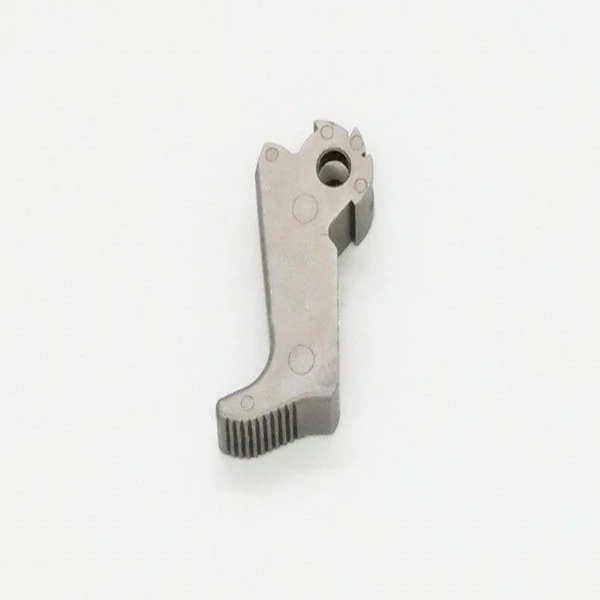
Pistols, as firearms, have high requirements for the precision, strength, and durability of their components. Titanium alloys, with their low density, high strength, and corrosion resistance, are ideal for pistol manufacturing, reducing overall weight and improving portability and durability.
Overview of Lost-Wafer Casting of Titanium Alloy for Pistols
Pistols, as firearms, have high requirements for the precision, strength, and durability of their components. Titanium alloys, with their low density, high strength, and corrosion resistance, are ideal for pistol manufacturing, reducing overall weight and improving portability and durability. Lost-wafer casting, also known as investment casting, is a precision casting method that can produce complex, high-precision components, making it an ideal manufacturing process for products like pistols with intricate structures.
Pistol Titanium Alloy Lost-Wafer Casting Process
• Design and Modeling: First, based on the design requirements of the pistol components, precise models are created using professional 3D design software. For example, for components such as the slide and trigger, their function, dimensional accuracy, and fit with other parts must be considered. After the design is completed, accurate 3D model data is generated.
• Wax Model Forming: Using 3D printing technology or traditional injection molding methods, wax is used to create a wax model that perfectly matches the shape of the pistol components. If 3D printing is used, wax can be layered according to the 3D model data to form the wax model. This method is suitable for small-batch production of wax models with complex shapes. Traditional injection molding involves injecting molten wax into a mold cavity, which then cools to create a wax model, suitable for mass production.
• Wax Model Finishing: The finished wax model is carefully inspected and finished, removing burrs, flash, and other defects to ensure dimensional accuracy and surface quality meet requirements. Multiple wax models are then combined to form a wax model assembly for subsequent casting operations.
• Coating: The wax model assembly is immersed in a specially formulated refractory coating, evenly covering the surface with a layer of coating. The coating typically consists of refractory materials (such as silica sand, zirconium sand, etc.) and a binder. Its function is to form a shell during the subsequent high-temperature casting process, protecting the casting and ensuring its shape and dimensional accuracy.
• Sand Application: Immediately after coating, the wax model assembly is placed in sand, allowing the sand to adhere to the coating layer and form a sand layer of a certain thickness. The particle size and material of the sand are selected based on the requirements of the casting and the characteristics of the process.
• Drying and Hardening: After multiple dip-coating and sand-spreading operations to form a multi-layered mold shell, the shell is dried and hardened. Drying removes moisture from the shell, while hardening causes a chemical reaction in the binder, improving the shell's strength and stability. The drying and hardening time and conditions are controlled based on the characteristics of the coating and sand particles.
• Steam Dewaxing: The wax mold assembly with the shell is placed in a high-pressure steam dewaxing kettle. High-temperature steam melts the wax mold, causing it to flow out of the shell. Steam dewaxing offers advantages such as fast speed, high efficiency, and preservation of the shell's integrity.
• Hot Water Dewaxing: Alternatively, the shell can be placed in hot water, causing the wax mold to melt and float on the surface, thus achieving dewaxing. Hot water dewaxing is suitable for small, simple wax molds and is relatively simple to operate, but it takes longer.
• High-Temperature Firing: The dewaxed mold shell is placed in a firing furnace for high-temperature firing. The firing temperature is typically between 800-1200℃, with the specific temperature determined based on the mold shell material and casting requirements. The purpose of firing is to further remove residual wax and moisture from the mold shell, improve its strength and permeability, and simultaneously stabilize its microstructure.
• Heating and Cooling: After reaching the predetermined firing temperature, the mold shell is held at that temperature for a certain period to ensure complete sintering. Then, the mold shell is slowly cooled to prevent cracking due to excessively rapid cooling.
• Titanium Alloy Melting: Titanium alloy raw materials are melted using equipment such as a vacuum induction melting furnace. During the melting process, the melting temperature, time, and furnace atmosphere must be strictly controlled to ensure uniform chemical composition of the titanium alloy and prevent the introduction of impurities and gases.
• Casting: The molten titanium alloy is rapidly poured into the fired mold shell at high temperature. During the pouring process, attention must be paid to the pouring speed, temperature, and location to ensure the molten titanium alloy completely fills the mold cavity, avoiding defects such as incomplete filling and porosity.
• Shell Removal: After the titanium alloy casting has cooled and solidified, the mold shell is removed using methods such as mechanical vibration or sandblasting. Care must be taken to avoid damaging the casting surface during shell removal.
• Cutting and Grinding: The casting is cut from the gating system, and the surface is ground to remove burrs, flash, etc., resulting in a smooth and flat surface.
• Heat Treatment: Appropriate heat treatment, such as annealing or quenching, is applied to the casting to improve the microstructure and properties of the titanium alloy, increasing the casting's strength, hardness, and toughness.
• Surface Treatment: Surface treatments, such as electroplating or spraying, are applied to the casting according to the pistol's usage requirements and appearance design to improve its corrosion resistance and aesthetics.
Advantages of Lost-Wafer Casting of Titanium Alloy for Pistols
High Precision
Lost-wafer casting can produce pistol parts with complex shapes and high dimensional accuracy, meeting the stringent precision requirements of pistol components.
High Performance
The excellent properties of titanium alloys result in pistol parts with high strength, low density, and corrosion resistance, improving the overall performance and service life of the pistol.
Flexibility
Pistol parts of various shapes and sizes can be quickly manufactured according to different design requirements, suitable for new product development and small-batch production.
Challenges of Lost-Wafer Casting of Titanium Alloy for Pistols
High Cost
The price of titanium alloy raw materials is relatively high, and the equipment and material costs for the lost-wafer casting process are also high, resulting in a high overall cost for lost-wafer casting of titanium alloy for pistols.
High Process Difficulty
The melting and casting processes of titanium alloys have strict process requirements and are prone to defects such as porosity and cracks, requiring precise control of process parameters and operating procedures.
High Quality Control Requirements
As a weapon, pistols have extremely high requirements for the quality and reliability of their components, necessitating a strict quality control system to ensure that every casting meets quality standards.


Send Inquiry
