



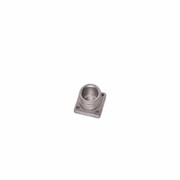
Lost-wax Casting Movable Φ16 Wire Rope End Fitting Assembly
The cast movable Φ16 wire rope end fitting assembly is a critical load-bearing component used for connecting and securing the ends of steel wire ropes. It is widely used in elevators, lifting machinery, construction, and other fields.
Products Description
The cast movable Φ16 wire rope end fitting assembly is a critical load-bearing component used for connecting and securing the ends of steel wire ropes. It is widely used in elevators, lifting machinery, construction, and other fields. Its core function is to safely connect a Φ16 (16mm diameter) steel wire rope to the equipment's load-bearing structure through a mechanical connection, while also providing a degree of adjustability to accommodate dynamic loads and installation errors in working conditions. The product is manufactured using a one-piece casting process, featuring high structural strength, easy installation, and strong adaptability, making it an important component for ensuring the stability and safety of the wire rope transmission system.
Structural Composition
Rope Head Casing
Made of ductile iron or cast steel, manufactured using sand casting or investment casting. It features an internal channel for the wire rope and a locking groove, and an external connecting flange or bolt holes for fixing to the main body of the equipment. The casing is generally conical or cylindrical, with uniform wall thickness, and critical areas (such as load-bearing contact surfaces) are rounded to prevent stress concentration.
Rope Clamp/Locking Mechanism
Contains a high-strength alloy steel rope clamp or wedge-shaped locking block, which secures the wire rope within the casing using bolt pre-tensioning or eccentric compression. The surface of the rope clamp is machined with anti-slip teeth to increase friction with the wire rope and prevent slippage; the clearance between the locking mechanism and the casing is precisely controlled to 0.1-0.3mm to ensure no radial movement after locking.
Movable Adjustment Mechanism
A spherical bearing or universal joint structure is installed at the bottom or top of the casing, allowing the wire rope to swing within a ±5° range, accommodating dynamic displacement during equipment operation and reducing bending fatigue of the wire rope.
Protective Components
The casing is equipped with a dust cover and sealing ring to prevent dust and moisture from entering and affecting the locking performance; some models also integrate a buffer pad to absorb impact loads and protect the wire rope and connecting components.
Technical Parameters
| Applicable wire rope diameter | Φ16mm (allowable deviation ±0.1mm) |
| Rated load | ≥200kN (safety factor ≥5) |
| Material | Rope head housing (QT450-10 ductile iron), rope clamp (40Cr alloy steel, heat treatment HRC35-40) |
| Range of motion | ±5° (axial), ±3° (radial) |
| Operating temperature | -20℃~80℃ |
| Installation method | Flange connection (4-M16 bolt holes, hole spacing 120mm) or threaded connection (M48×2 external thread) |
| Weight | Approximately 8.5kg (single unit) |
Working Principle
The end of the Φ16 steel wire rope is passed through the central channel of the rope head housing, with an exposed length of ≥10 times the rope diameter (i.e., 160mm). The steel wire rope is pressed into the locking groove on the inner wall of the housing by a rope clamp or wedge-shaped locking block. The fixing bolts are tightened to generate radial pressure on the rope clamp, achieving mechanical locking of the steel wire rope.
During equipment operation, the tensile force on the steel wire rope is transferred to the rope head housing through the friction between the rope clamp and the housing, and then transferred to the equipment's load-bearing frame through the housing flange or threaded structure, forming a complete force flow path.
When the equipment vibrates or there are minor installation deviations, the motion adjustment mechanism (spherical bearing/universal joint) allows the steel wire rope to swing freely within the designed angle, avoiding stress concentration caused by rigid connections and ensuring the stability of load transfer.
The tooth pattern design of the locking groove and rope clamp ensures that the steel wire rope does not slip relative to the housing when subjected to the rated load; the limited range of motion and cushioning components further reduce the impact of dynamic loads on the system, extending its service life.
Application Scenarios
Elevator Systems
Used for connecting elevator traction steel wire ropes to the car and counterweight, suitable for passenger elevators or freight elevators with a rated load capacity of 1000kg~2000kg.
Lifting Machinery
Used as a wire rope fixing end component for crane hooks and booms, suitable for bridge cranes, gantry cranes, and other equipment.
Construction
Used for wire rope end connections in construction hoists and material lifts, adapting to complex working conditions on construction sites.
Mining Equipment
Applied to wire rope transmission systems of heavy equipment such as mine hoists and rock drills, resistant to dust, vibration, and other harsh environments.
Installation and Maintenance
● Clean the wire rope end, remove burrs and oil stains, ensuring no damage;
● Insert the wire rope into the rope head housing, exposing the specified length according to the markings, and adjust the position of the rope clamps to ensure even distribution (at least 3 rope clamps, spacing ≥ 100mm);
● Pre-tighten the rope clamp bolts (torque 45-50 N·m), using a diagonal step-by-step tightening method to ensure even force distribution on each rope clamp;
● Fix the rope head assembly to the equipment's load-bearing structure through flanges or threads, and check that the moving parts are flexible and free from jamming;
● Install the dust cover and protective components. After completion, perform a no-load test run to confirm that there are no abnormal noises or looseness.
● Regular inspection (recommended monthly): Check the torque of the rope clamp bolts, wire rope wear, flexibility of moving parts, and sealing of protective components;
● Apply grease (lithium-based grease GB/T 7324) to the moving joints every six months to ensure smooth movement;
● If broken wires, deformed rope clamps, or cracks in the housing are found, immediately stop using the component and replace it;
● Avoid using the component under conditions exceeding the rated load or temperature range to prevent material performance degradation.
Product Advantages
High Strength and Reliability
The casting process ensures a dense housing structure, and key components are made of alloy steel and heat-treated, meeting the requirements of heavy-duty working conditions, and passing 100,000 fatigue tests without failure.
01
Flexible Adaptability
The adjustable mechanism reduces the impact of installation errors on the system, and is compatible with Φ16 wire ropes of different brands and models, offering strong versatility.
02
Easy Installation
Modular design allows for installation and disassembly without special tools, shortening construction time.
03
Long Service Life
Protective components combined with wear-resistant materials effectively resist corrosion and wear, with an average service life of ≥5 years (under normal maintenance conditions).
04
Safety Assurance
Complies with GB/T 5972-2016 "Maintenance, Repair, Installation, Inspection and Scrapping of Steel Wire Ropes for Cranes" standard, and has passed load testing and safety certification by a third-party authoritative institution.
05
Precautions
● Strictly prohibit use beyond the rated load to avoid direct impact loads on the rope end assembly;
● During installation, ensure that the steel wire rope is free of knots and twists, and that the rope clamp is correctly oriented (U-bolt clamps the short end of the rope);
● When used outdoors or in humid environments, the anti-corrosion coating should be checked regularly, and anti-rust paint should be reapplied if necessary;
● When replacing the steel wire rope, the inside of the rope end assembly should also be checked for wear and cracks. Do not replace the steel wire rope alone while neglecting the condition of the connecting components.
Through the above design and features, the cast movable Φ16 rope end assembly provides a safe, efficient, and durable connection solution for steel wire rope transmission systems, and is an indispensable key component in various lifting and hoisting equipment.




Send Inquiry
