



FGE38-17 Ductile Iron Castings
In the aspect of high strength and low alloy ductile iron, besides copper and molybdenum, nickel and niobium are also studied. Although the performance of medium manganese ductile iron is not stable enough, the systematic research and production application for many years have achieved remarkable economic benefits.
Product Introduction
|
FGE38-17 Ductile iron castings |
|||||||
|
Item |
Material |
Production Process |
Sintering Temperature |
Mold |
Custom |
||
|
FGE38-17 Ductile iron castings |
FGE38-17 |
Molten mold casting |
1380℃ |
To be customized |
Yes |
||
|
Available Materials |
Carbon steel, alloy steel, aluminum alloy, low -carbon stainless steel, titanium alloy (TI, TC4), copper alloy, high temperature alloy (718, 713) |
||||||
|
Smoothness |
Dimensional accuracy |
Product density |
Appearance treatment |
Appropriate weight |
|||
|
Roughness 1~5μm |
(±0.1%~±0.5%) |
7.3-7.6/CM³ |
According to customer requirements |
0.03g~40kg |
|||
FGE38-17 lost wax investment casting of ductile iron
Chinese ductile iron process
Rare earth is added to improve performance
In the aspect of high strength and low alloy ductile iron, besides copper and molybdenum, nickel and niobium are also studied. Although the performance of medium manganese ductile iron is not stable enough, the systematic research and production application for many years have achieved remarkable economic benefits.
The effect of total amount of Si+Al on the growth resistance of rare earth magnesium nodular cast iron was systematically studied in addition to medium silicon nodular cast iron. The service life of RQTAL5Si5 heat-resistant cast iron developed in China is 3 times that of gray cast iron, 2 times that of ordinary heat-resistant cast iron, and the service life of Japanese Cr25Ni13Si2 heat-resistant steel is equivalent.
High nickel austenitic ductile iron has also made progress, it has been successfully applied in oil mining machinery, chemical equipment, industrial furnace devices.
In terms of acid-resistant ductile iron, the rare earth high silicon ductile iron produced in China is smaller, uniform and dense than the ordinary high silicon cast iron, thus, the corrosion resistance is improved by 10% to 90%, and its mechanical strength is also significantly improved.
Rare earth can spheroidize graphite. Since H. Morrogh first used cerium to obtain nodular cast iron, many people have studied the nodulating behavior of various rare earth elements, and found that cerium is the most effective nodulating element, and other elements also have varying degrees of nodulating ability.
China has carried out a lot of research and development on the spheroidization of rare earth elements. It is found that rare earth elements are difficult to obtain spheroidal graphite as complete and uniform as magnesium ductile iron for the commonly used ductile iron components (C3.6 ~ 3.8wt%, Si2.0 ~ 2.5wt%). Moreover, when the amount of rare earth is too high, there will be a variety of deformed graphite, and the white mouth tendency will increase, but if it is a high carbon hypereutectic composition (C>4.0wt%), and the residual amount of rare earth is 0.12 ~ 0.15wt%, good spherical graphite can be obtained.
Due to the poor iron quality, high sulfur content (cupola smelting) and low iron extraction temperature in China, the addition of rare earths is necessary. Magnesium is the dominant element in the nodulating agent, and rare earth can promote the nodulating of graphite on the one hand; On the other hand, it is also necessary to overcome the influence of sulfur and impurity elements to ensure spheroidization.
Rare earths prevent interfering elements from destroying spheroidization. The research shows that when the total amount of interfering elements such as Pb, Bi, Sb, Te and Ti is 0.05wt%, adding 0.01wt% (residual amount) of rare earth can completely neutralize the interference and inhibit the production of deformed graphite. Most of China's pig iron contains titanium, and some pig iron contains titanium as high as 0.2 ~ 0.3wt%, but rare earth magnesium nodule agent can make the residual amount of rare earth in iron up to 0.02 ~ 0.03wt%, so it can still ensure that the graphite nodule is good. If 0.02 ~ 0.03wt%Bi is added to ductile iron, the spherical graphite is almost completely destroyed. If 0.01 ~ 0.05wt%Ce is subsequently added, the original spheroidization state is restored, which is because Bi and Ce form stable compounds.
Nucleation of rare earth. Studies since the 1960s have shown that cerium-containing inoculants can increase the number of pellets in the liquid iron throughout the retention period, resulting in more graphite pellets in the final tissue and a smaller white tendency. The results also show that the inoculant containing rare earth can improve the inoculant effect of nodular cast iron and significantly increase the ability to resist decay. The reason why the number of graphite spheres increased with the addition of rare earth can be attributed to: rare earth can provide more nucleus, but the nucleus composition is different from that provided by FeSi inoculation; Rare earths can make the previously inactive nuclei (present in liquid iron) grow, resulting in an increase in the total number of nuclei in liquid iron.
Matters needing attention
(a) Strict requirements for chemical composition, the carbon silicon content of the original iron liquid is higher than that of gray cast iron, and the content of manganese, phosphorus and sulfur in ductile cast iron is reduced.
(2) The temperature of liquid iron is higher than that of gray cast iron to compensate for the loss of liquid iron temperature during spheroidization and inoculation.
(3) spheroidizing treatment, that is, adding a spheroidizing agent to the liquid iron.
(4) Adding inoculant for inoculation treatment.
(5) The flow of ductile iron is poor, the shrinkage is large, so the need for higher pouring temperature and larger pouring system size, reasonable application of riser, cold iron, the use of sequential solidification principle.
(6) Heat treatment.
① Annealing. The ferritic matrix is obtained, the plasticity and toughness are improved, the stress is eliminated and the cutting performance is improved.
② Normalizing. The pearlite matrix is obtained to improve the strength and wear resistance.
③ Tempering. The matrix structure of tempered sorbite and good comprehensive mechanical properties, such as main shaft, crankshaft, connecting rod, etc., are obtained.
④ isothermal quenching. Make the parts with complex shape and high comprehensive performance requirements obtain the matrix structure of lower bainite, as well as the comprehensive mechanical properties of high strength, high hardness, high toughness, etc., to avoid cracking during heat treatment, such as spindle, crankshaft, gear and so on.
Zhongwei Precision has the following services
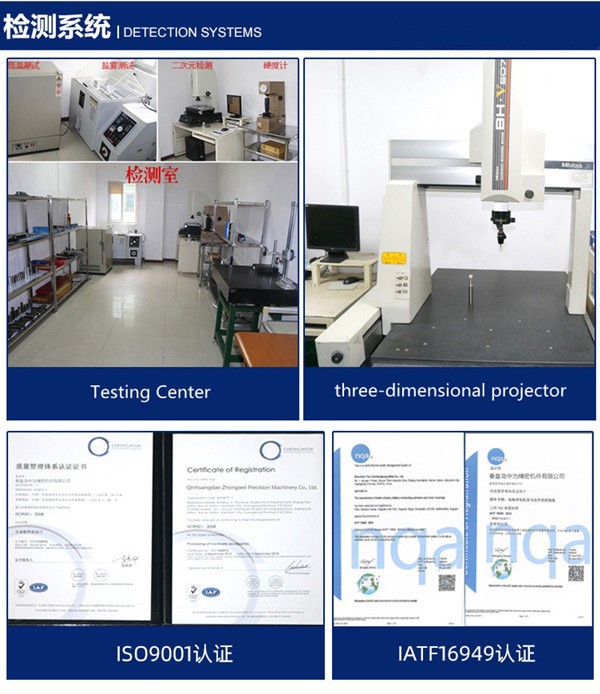
Detection Systems
Copper Silica Sol Investment Casting


We are the manufacturer of "FGE38-17 Ductile iron castings", if you need more information please contact us!


Send Inquiry
