



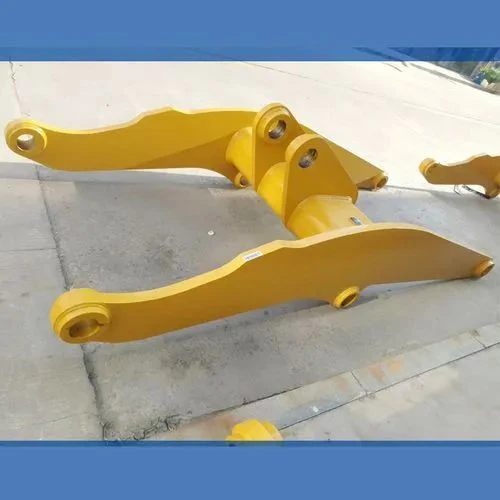

Earthmoving Bucket Bracket Water Glass Investment Casting
Earthmoving bucket bracket water glass investment casting is a process that uses water glass as a binder during the investment casting process to create durable and strong bucket brackets for heavy earthmoving equipment. This casting method ensures the highest level of precision and accuracy in the final product, with a smooth surface finish and uniform dimensions.
Product Introduction
|
Earthmoving bucket bracket water glass investment casting |
|||||||
|
Item |
Material |
Production Process |
Sintering Temperature |
Mold |
Custom |
||
|
Earthmoving bucket bracket |
Investment casting |
1380℃ |
To be customized |
Yes |
|||
|
Available Materials |
Carbon Steel, Alloy Steel, Aluminum Alloy, Low Carbon Stainless Steel, Titanium Alloy (Ti, TC4), Copper Alloy, Superalloy (718, 713) |
||||||
|
Smoothness |
Dimensional accuracy |
Product density |
Appearance treatment |
Appropriate weight |
|||
|
Roughness Ra1-5μm |
(±0.1%~±0.5%) |
7.3-7.6/CM³ |
According to customer requirements |
0.03g~400gg |
|||
Earthmoving bucket bracket water glass investment casting is a process that uses water glass as a binder during the investment casting process to create durable and strong bucket brackets for heavy earthmoving equipment. This casting method ensures the highest level of precision and accuracy in the final product, with a smooth surface finish and uniform dimensions.
The application of water glass investment casting of earthwork bucket supports is widely used in the construction and mining industries. Bucket supports are important components of earthmoving equipment used in heavy-duty operations such as excavation and loading. These racks are designed to withstand rigorous operating conditions, such as exposure to harsh weather, extreme temperatures, and heavy loads.
One of the main advantages of water glass investment casting of earthmoving bucket supports is the ability to create complex shapes and complex geometries that are difficult to produce using other casting methods. These brackets are made of high-quality materials such as steel, stainless steel and other alloys ensuring maximum strength, durability and wear resistance.
Investment Casting
It can be used to cast special steel, alloy cast steel to meet special needs, there are many varieties, usually containing one or more high-volume alloying elements to obtain a certain special property. For example, high-manganese steel containing 11%~14% manganese can resist impact wear and tear, and is mostly used for rust-resistant parts of mining machinery and construction machinery; various stainless steels with chromium or chromium-nickel as the main alloying element are used for parts that work under corrosive or high temperature conditions above 650 °C, such as valve bodies, pumps, containers or steam turbine housings of large-capacity power stations for chemical industry.
Investment casting, also known as lost-wax casting, includes wax pressing, wax trimming, tree formation, slurry, wax melting, molten metal casting and post-treatment. Lost wax casting is to use wax to make a wax model of the parts to be cast, and then the wax model is coated with mud, which is a clay mold. After the clay mold is dried, it is then roasted into a pottery mold. Once roasted, all the wax molds melted down and lost, leaving only the pottery molds. Generally, when making mud molds, the pouring port is left, and then the metal melt is poured from the pouring port, and after cooling, the required parts are made.
Water Glass Investment Casting
The most common binder used in investment casting is silicate colloidal solution (referred to as silicate sol), such as ethyl silicate hydrolysate, water glass and silica sol. The substances that make them up are mainly silicic acid (H2SiO3) and solvents, and sometimes stabilizers, such as NaOH in silica sol. Ethyl silicate hydrolysate is the earliest and most common binder used in the silicate sol mold casting obtained by hydrolysis of ethyl silicate; However, in China, when the production accuracy requirements are more carbon steel castings and non-ferrous alloy castings with lower melting point, water glass is still widely used in production; the stability of silica sol is good, it can be stored for a long time, and there is no need for special hardener when making the shell, but the wetting of the silica sol to the investment mold is slightly poor, and the hardening process of the shell is a drying process, which takes a long time.
Detection Systems

Copper Silica Sol Investment Casting



Send Inquiry
