


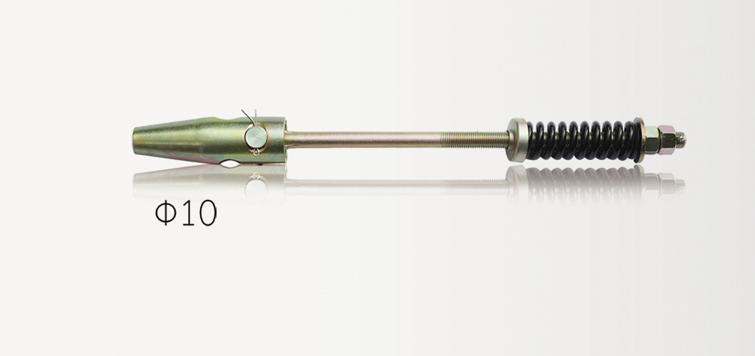
Babbitt Metal Φ10 Rope Head Assembly
The Babbitt metal Φ10 rope head assembly is a critical connecting component used in elevators, lifting machinery, and other applications. It is primarily used for fixing and connecting steel wire ropes to related load-bearing structures, ensuring the stable operation of the transmission system.
The Babbitt metal Φ10 rope head assembly is a critical connecting component used in elevators, lifting machinery, and other applications. It is primarily used for fixing and connecting steel wire ropes to related load-bearing structures, ensuring the stable operation of the transmission system.
The following provides a detailed introduction to its structural composition, material characteristics, performance advantages, and application scenarios:
Structural Composition
The Babbitt metal Φ10 rope head assembly typically consists of a Babbitt metal casting, a rope head cone sleeve, a spring, a nut, and a cotter pin.
As the core load-bearing component, a Φ10 steel wire rope (10mm in diameter) is inserted into the cone sleeve, and Babbitt metal (such as tin-based or lead-based alloy) is cast at high temperature to ensure a tight bond between the alloy and the steel wire rope, forming a strong overall connection. This ensures even load distribution during load transfer, preventing localized stress concentration in the steel wire rope.
Mostly made of metal (such as cast iron or steel), the inner wall is designed with a conical structure, which works in conjunction with the Babbitt metal casting to ensure that the force is transmitted from the steel wire rope through the cone sleeve to the external connecting structure (such as the elevator car or counterweight frame) when under tension.
The spring is fitted outside the cone sleeve, and the preload force is adjusted by the nut. This absorbs shocks and vibrations during mechanical operation, reducing fatigue damage to the steel wire rope; the nut is threaded to the cone sleeve, used to fix the overall structure and adjust the rope head length to suit different installation requirements.
Installed in the pinhole at the top of the nut, it prevents the nut from loosening under long-term vibration, improving the safety of the connection.
Material Characteristics
Babbitt metal: Low-melting point (approximately 200-300℃) tin-based Babbitt alloy (such as ZChSnSb11-6) or lead-based alloy is selected. It has excellent wear resistance, friction reduction, and embedding properties. During casting, it can fully fill the gaps between the strands of the steel wire rope, forming a metallurgical bond with the steel wire, ensuring high load-bearing capacity (typically the rated load can reach several tons, the specific value needs to be designed according to the working conditions).
Wire Rope: Uses Φ10 high-strength galvanized or bright steel wire rope, mostly with a multi-strand twisted structure (such as 6×19W+FC), possessing high tensile strength (≥1570MPa) and good flexibility, suitable for repeated bending and stretching conditions.
Metal Components (Tapered Sleeve, Nut, etc.): Made of high-quality carbon steel (such as Q235 or 45 steel), heat-treated for high strength and impact resistance, ensuring the rigidity and durability of the overall structure.
Performance Advantages
High Connection Strength
The metallurgical bonding method between the Babbitt metal and the steel wire rope allows the breaking tensile force of the rope end assembly to reach more than 90% of the breaking tensile force of the steel wire rope itself, far exceeding traditional rope clamp fixing methods (approximately 70%), resulting in more reliable safety.
01
Even Stress Distribution
The conical structure design allows the load to be evenly transmitted through the tapered sleeve, avoiding localized compression damage to the steel wire rope and extending its service life.
02
Shock Absorption and Buffering
The spring component can absorb impact loads during mechanical operation (such as the inertial force during elevator starting and stopping), reducing the dynamic stress on the steel wire rope and reducing the risk of fatigue fracture.
03
Convenient Installation
Formed in one piece through a casting process, installation only requires adjusting the nut for fixing, without the need for complex tools. Maintenance is also convenient; the spring compression can be observed to determine the elongation of the steel wire rope, facilitating timely adjustments.
04
Strong Adaptability
Suitable for various harsh environments (such as damp, dusty, high and low temperatures). The corrosion resistance of Babbitt metal and galvanized steel wire rope ensures long-term stable operation.
05
Application Scenarios
Elevator Industry
Primarily used for connecting elevator cars to traction steel wire ropes and fixing counterweight rope ends. It is a core component of the elevator suspension system and must meet the stringent requirements of GB 7588 "Safety Code for the Manufacture and Installation of Elevators".
Lifting Machinery
Suitable for steel wire rope terminal fixing in equipment such as bridge cranes and gantry cranes, especially for large-span, high-frequency lifting conditions. • Mining and Construction: Used in equipment such as mine hoists and construction tower cranes, serving as a connection point between the wire rope and the drum or lifting device, bearing heavy and impact loads.
Installation and Maintenance Key Points
Before installation
The surface of the wire rope needs to be cleaned of oil and rust, and the inner surface of the tapered sleeve needs to be roughened to enhance alloy adhesion; the temperature must be controlled during Babbitt metal casting to avoid high-temperature damage to the mechanical properties of the wire rope.
After installation
Check whether the spring compression amount meets the design requirements (usually compressed to 1/3-1/2 of its free length), and the nut must be tightened and a cotter pin inserted to prevent loosening.
Routine maintenance
Regularly check the Babbitt metal for cracks, the wire rope for broken strands or corrosion, and whether the spring is malfunctioning. Any abnormalities should be replaced promptly to ensure safe operation.
Applicable Standards
Production and inspection must comply with national standards "GB/T 10051.1-2010 Lifting Hooks Part 1: Mechanical Properties, Lifting Capacity, Stress and Materials", "GB 8918-2006 Steel Wire Ropes for Important Uses" and industry specifications (such as elevator rope head assemblies needing to meet TSG T7001 "Rules for Supervision and Periodic Inspection of Elevators"), ensuring product quality compliance.
Through the above design and characteristics, the Babbitt alloy Φ10 rope head assembly becomes a safe and efficient wire rope connection solution in elevators, lifting equipment, and other fields, providing crucial assurance for the stable operation of mechanical systems.


Send Inquiry
