


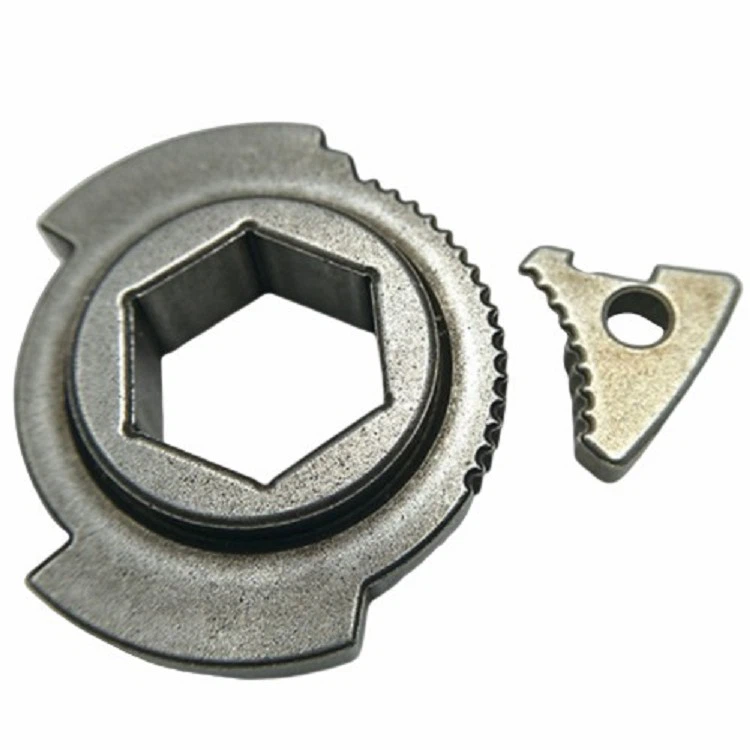


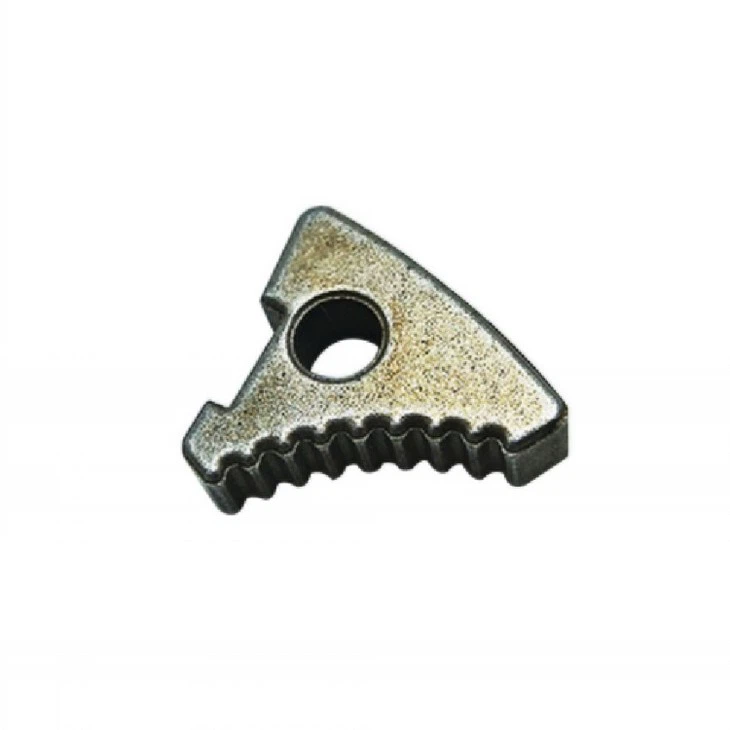
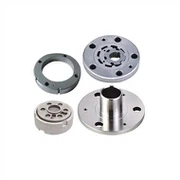
Ratchet Pawl PM Sintered Part
In the ratchet mechanism, the function of the Ratchet pawl PM sintered part stop pawl is to prevent the ratchet from reversing. Ratchet pawl PM sintered part ratchet mechanism, a one-way intermittent motion mechanism composed of ratchet and pawl. The teeth of the ratchet usually use one-way teeth, and the pawl is hinged on the rocker. When the rocker swings counterclockwise, the driving pawl is inserted into the ratchet teeth to push the ratchet to rotate in the same direction.
Product Introduction
|
Ratchet pawl PM sintered part |
||||||
|
Item |
Material |
Production Process |
Sintering Temperature |
Mold |
Custom |
|
|
Ratchet Pawl Powder |
45 steel |
Powder metallurgy pressing |
1280℃ |
To be customized |
Yes |
|
|
Chemical composition |
C:0.42~0.50; Cr:≤0.25; Mn:0.50~0.80; Ni:≤0.25; P:≤0.035; S:≤0.035; Si:0.17~0.37 |
|||||
|
Available Materials |
Low carbon stainless steel, titanium alloy (Ti, TC4), copper alloy, tungsten alloy, hard alloy, high temperature alloy (718, 713) |
|||||
Product advantages
|
Smoothness |
Dimensional accuracy |
Product density |
Appearance treatment |
Appropriate weight |
|
Roughness 1~5μm |
(±0.1%~±0.5%) |
92~95% |
According to customer requirements |
0.03g~400g) |
|
Mechanical behavior |
σb\MPa:≥600 σs\MPa:≥355 δ5\%:≥16 ψ\%:≥40 hardness\HB:≤197 The recommended heat treatment temperature for 45 steel stipulated in GB/T699-1999 standard is 850°C for normalizing, 840°C for quenching, and 600°C for tempering, and the performance achieved is yield strength ≥ 355MPa The GB/T699-1999 standard stipulates that the tensile strength of 45 steel is 600MPa, the yield strength is 355MPa, the elongation is 16%, and the reduction of area is 40%. |
|||
Function
In the ratchet mechanism, the function of the Ratchet pawl PM sintered part stop pawl is to prevent the ratchet from reversing.
Ratchet pawl PM sintered part ratchet mechanism, a one-way intermittent motion mechanism composed of ratchet and pawl. The teeth of the ratchet usually use one-way teeth, and the pawl is hinged on the rocker. When the rocker swings counterclockwise, the driving pawl is inserted into the ratchet teeth to push the ratchet to rotate in the same direction.
When the rocking bar swings clockwise, the ratchet slides over the ratchet wheel, and the ratchet wheel stops rotating. When the ratchet is working, it is subjected to the thrust of the pawl. Simultaneously, ratchet also can be subjected to the reaction force of ratchet.
Extended information:
1. Working principle
When the rocker of the active part swings counterclockwise, the driving pawl is inserted into the tooth groove of the ratchet, and the ratchet is pushed to turn through an angle. At this time, the stop pawl slides on the tooth back of the ratchet.
When the rocking bar of the active part swings clockwise, the stop pawl prevents the ratchet from rotating clockwise, but the drive pawl can slide over the tooth back of the ratchet, so the ratchet remains motionless.
Like this, when rocking bar is done continuous reciprocating swing, ratchet just makes one-way intermittent motion. Wherein, the reciprocating swing of the active part can be obtained by the cam mechanism of the swing follower, the crank rocker mechanism, or by hydraulic transmission and electromagnetic devices.
2. Main types
1. Toothed ratchet (mechanism)
Single-acting ratchet mechanism, double-acting ratchet mechanism, reversible ratchet mechanism. There are rigid gear teeth on the outer edge or inner edge; the ratchet rotation angle can only be a multiple of the central angle between two adjacent teeth, and can only be adjusted in stages. The structure is simple, the manufacture is convenient, and the movement is reliable, but it is easy to cause noise and tooth tip wear, and the transmission stability is poor. It is often used in the transverse feed device of the worktable in the planer.
2. Friction ratchet (mechanism)
The movement is transmitted through the friction force between the pawl and the ratchet wheel to realize the stepless intermittent movement of the ratchet wheel. It is also commonly used as a stopper or brake on the feeding mechanism of machine tools and automatic machines.
3. Transcendent ratchet (mechanism)
In addition to being commonly used to achieve intermittent motion, it can also achieve overrunning motion, that is, the driven part can rotate beyond the active part. Used on the rear axle of bicycles.
Features and types of ratchet pawls
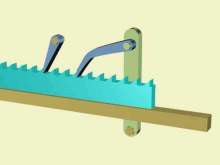
Toothed ratchet mechanism
There are several types of ratchet mechanisms:
By structure
The ratchet mechanism can be classified into a toothed ratchet mechanism and a friction ratchet mechanism according to the structural form.
The toothed ratchet mechanism has a simple structure and is easy to manufacture; the time ratio between moving and stopping can be realized by selecting a suitable driving mechanism. The disadvantage of this mechanism is that the stroke can only be adjusted in steps; the noise, impact and wear are relatively large, so it is not suitable for high speed.

Friction ratchet mechanism
The friction ratchet mechanism uses eccentric sector wedges to replace the ratchet in the toothed ratchet mechanism, and replaces the ratchet wheel with toothless friction. It is characterized by stable transmission and no noise; the stroke can be adjusted steplessly. However, due to the transmission by friction, there will be slippage. Although it can play a role in safety protection, the transmission accuracy is not high. Suitable for low speed and light load occasions.
By engagement
The ratchet mechanism can be classified into an external meshing ratchet mechanism and an internal meshing ratchet mechanism according to the meshing method.
The pawls or wedges of the external ratchet mechanism are installed outside the ratchet, while the pawls or wedges of the internal ratchet mechanism are inside the ratchet.

Internal ratchet mechanism
Due to the convenience of processing, installation and maintenance, the external meshing ratchet mechanism is widely used. The internal meshing ratchet mechanism is characterized by compact structure and small external dimensions.
According to the movement form of the follower
According to the movement form of the follower, the ratchet mechanism can be divided into single-acting ratchet mechanism, double-acting ratchet mechanism and bidirectional ratchet mechanism.
The single-acting ratchet mechanism can only push the ratchet to rotate when the active part swings in a certain direction.
The double-action ratchet mechanism drives two pawls respectively during the reciprocating swing of the active rocker in two directions, and pushes the ratchet wheel twice.
The double-acting ratchet mechanism is often used in situations where the load is large, the size of the ratchet is limited, the number of teeth is small, and the swing angle of the active swing is smaller than the tooth pitch of the ratchet.
The ratchet mechanism described above can only do one-way intermittent movement in one direction. The two-way ratchet mechanism can realize the rotation of the ratchet in two directions by changing the swing direction of the ratchet. The figure shows two forms of two-way ratchet mechanism, and the two-way ratchet mechanism must adopt a symmetrical tooth shape.
|
Hook head double action ratchet mechanism |
Direct push double action ratchet mechanism |
|
Reversible ratchet mechanism |
Reversible ratchet mechanism |


Metal Injection Molding Process

Detection Systems


Send Inquiry
