




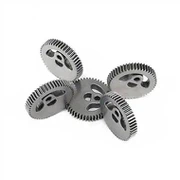
Electric Vehicle PM Sintered Part
The temperature-programmed gas-solid reaction method: using tungstic acid as the tungsten precursor, methane as the carbon source and reducing gas, prepared ultra-fine tungsten carbide powder. Among them, in the temperature-programmed carbonization method, the heating program is to raise the temperature to 500°C within 30 minutes, the heating rate is 18°C·min-1, and then rise from 500°C to 800°C in 20 minutes, and the heating rate is 10°C·min-1, Reacted at the set temperature for 12h, and naturally dropped to room temperature under the protection of methane.
Product Introduction
|
Electric vehicle gear PM sintered part |
||||||
|
Item |
Material |
Production Process |
Sintering Temperature |
Mold |
Custom |
|
|
Electric vehicle powder metallurgy |
Tungsten carbide |
Powder metallurgy |
1550℃ |
To be customized |
Yes |
|
|
Chemical composition |
|
|||||
|
Available Materials |
Low carbon stainless steel, titanium alloy (Ti, TC4), copper alloy, tungsten alloy, hard alloy, high temperature alloy (718, 713) |
|||||

Product advantages
|
Smoothness |
Dimensional accuracy |
Product density |
Appearance treatment |
Appropriate weight |
|
Roughness 1~5μm |
(±0.1%~±0.5%) |
92~95% |
mirror reflection |
0.03g~400g) |
Preparation
1. The temperature-programmed gas-solid reaction method: using tungstic acid as the tungsten precursor, methane as the carbon source and reducing gas, prepared ultra-fine tungsten carbide powder. Among them, in the temperature-programmed carbonization method, the heating program is to raise the temperature to 500°C within 30 minutes, the heating rate is 18°C·min-1, and then rise from 500°C to 800°C in 20 minutes, and the heating rate is 10°C·min-1, Reacted at the set temperature for 12h, and naturally dropped to room temperature under the protection of methane.
2. Reductive carbonization two-step method: first prepare W powder from tungsten-containing precursors, and then carbonize with carbon-containing substances to generate WC powder. Table 3 - Method for preparing ultrafine WC powder by reduction carbonization two-step method

3. Reductive carbonization one-step method: that is, the precursor containing tungsten (such as WO3) is directly reduced and carbonized to generate WC powder. This method generally requires the preparation of a highly active tungsten precursor. The continuous process of direct reduction carbonization can shorten the process flow, improve the efficiency of ultrafine tungsten carbide powder generation, and at the same time, the obtained ultrafine tungsten carbide and its alloy powder have better uniformity and smaller particle size. Table 4 - Method for preparing ultrafine WC powder by one-step reduction carbonization

4. Add 0.3g tungsten powder to the mixture of 30% H2O2, isopropanol and water by intermittent microwave heating, overnight, add 0.7gXC-72 carbon powder, ultrasonic treatment can get a uniform mixture liquid, dry, using intermittent Methods Tungsten carbide nanocrystals can be obtained by heating in a microwave oven for a few minutes.
5. Gas phase method:
(1) Chemical vapor deposition method: Plasma enhanced chemical vapor deposition equipment is used, tungsten fluoride (WF6), methane (CH4) and hydrogen (H2) are used as raw material gases, and argon (Ar) is used as carrier gas. The flow rates are controlled by separate flowmeters. The substrate is made of metal nickel sheet. The substrates are ultrasonically cleaned with acetone, deionized water, ethanol and deionized water, and put into the reaction chamber after drying. Before chemical vapor deposition, 100mL hydrogen gas was passed through for 30min in a hot atmosphere to remove oxides on the surface of the substrate. The samples after chemical vapor deposition were annealed in the furnace in nitrogen. Using tungsten fluoride and methane as precursors, a spherical nano-tungsten carbide film with a diameter of 20-35nm was prepared by plasma-enhanced chemical vapor deposition.
(2) Fixed bed chemical vapor phase method: Weigh an appropriate amount of nano-WO3 powder, place it evenly in a quartz reaction boat, and place the quartz reaction boat in a high-temperature stainless steel tubular reactor (ψ90cm), and then react the stainless steel placed in a tubular resistance furnace. The temperature rises from 540°C to 660°C, and this is the stage of H2 reducing nano-WO3. When the temperature gradually rises to 660°C in the heat preservation stage, the H2 flow rate should be adjusted to increase. Increasing the H2 flow rate is beneficial to take away the water vapor and make the reaction process go smoothly. After the reaction was held at 660°C for 1.5 hours, the nano-WO3 powder in the quartz reaction boat was completely reduced to nano-α-W powder. At this time, the H2 flow is reduced, the acetylene gas valve is opened, the acetylene flow is controlled, and the reaction enters the carbonization stage. Raise the temperature to 800°C and keep it at 800°C for 4h. After the carbonization process is over, the nano-α-W powder in the quartz reaction boat is basically transformed into a nano-WC powder. At this time, the acetylene valve is closed and the H2 flow rate is reduced. Continuously feed a trace amount of high-purity H2 until the stainless steel reactor is cooled to room temperature.
(3) Chemical vapor condensation method: Pass the high-purity CO carrier gas through the evaporator containing the W(CO)6 precursor, the carrier gas flow rate is 1200mL/min, the evaporator temperature is controlled at 120°C, and then the carrier gas carries the precursor vapor in the Under the temperature range of 600~800℃ in the tubular reactor, CO gas is decomposed into CO2 and C, and W and C are combined at about 1000℃ to form nano-tungsten carbide, and finally WC can be obtained in the collection chamber.
(4) Gas-phase carbonization method: use WO3 as raw material and methanol as carbon source. Under the action of Co/Fe catalyst, nanoscale WC can be obtained by reacting at a temperature of 450-950°C for 1.5-4 hours. Low-temperature catalytic cracking of methanol is adopted, and methanol enters the preheating pipe through a liquid pump flowmeter, and the temperature of the preheating pipe is controlled at 300-420°C. After methanol is preheated and vaporized, it is sent to the catalytic cracker, and the methanol gas can be cracked at 420-550°C to obtain the desired reaction atmosphere CO and H2; CO and H2 react with nano WO3 powder for 1.5-4 hours to remove oxygen atoms , to generate nano-WC.
6. Liquid phase method:
Take pure multi-walled carbon nanotubes with openings (average inner diameter 50nm, outer diameter 100nm, length about 200μm), immerse in 20mL ammonium paratungstate pentahydrate solution [(NH4Chemicalbook) 10W12O41•5H2O] (pH≈5), stir vigorously at 80°C After 20 min, the resulting solution evaporated naturally at room temperature. Then it was left overnight, the temperature was controlled at 120°C for further drying, and finally it was calcined at 350°C for 2 hours to form a tungsten carbide precursor. Under vacuum conditions, the temperature is controlled at 1000~1300°C to process the precursor to obtain a one-dimensional tungsten carbide nanostructure material.
7. Solid phase method
(1) Supercritical CO2 heat treatment method: Put 1.0g tungsten powder (purity 99%, average diameter 2μm), 2.3g metallic sodium (purity 98%), and 10.0g dry ice (purity>99%) into the autoclave respectively. Then put the sealed autoclave into a heating furnace, raise the temperature to 600°C at a rate of 10°C/min, and then keep the temperature constant for 20h, then cool the autoclave to room temperature to obtain a black solid product, and treat the black solid product with dilute hydrochloric acid Sodium carbonate, and then heat-treated to obtain NaOH solution, and finally the sample was washed with distilled water and dried at 80°C for 2 hours to obtain 0.2 g of the product.
(2) Combustion method: Mix the raw materials blue tungsten, sodium azide and carbon black. The reactants were ground uniformly in a ceramic mortar and then pressed into a stainless steel cylinder. The diameter of the steel plate cylinder is 50mm, the wall thickness is 1mm, and the height is 60mm. The reaction ball weighs about 150~170g. The combustion reaction laboratory is usually carried out under the pressure of 2.5MPa argon. Put the reaction ball in the reactant, and then ignite the Ni-Cr metal wire on the top cover of the ball to carry out the combustion reaction.
(3) Spray heat conversion method: using the temperature 250~350℃, high pressure 2.5~3.5MPa ultra-speed air spray heat conversion method, first make nano-scale WO3 oxide powder, and reduce it to WO2.9 blue tungsten with hydrogen at 420~500℃ powder, and then use an ultra-high-speed interlayer shearing crusher to further crush the blue tungsten particles, and carry out particle size classification through a high-speed hydrocyclone classifier, and separate the nano-blue tungsten particle slurry with a continuous centrifuge to settle and separate large particles of blue tungsten The powder returns to the ultra-high-speed interlayer shearing machine to continue shearing and crushing; during the blue tungsten shearing and crushing process, a phenolic resin release agent is added to cover the nano-blue tungsten particles, and H2 is fed into both ends, and the reduction furnace is pumped and drained in the middle Restore tungsten powder with an average particle size of ≤80nm at 700-740°C, then mix nano-scale tungsten powder with nano-carbon black powder, add phenolic resin release agent, and mix in an ultra-high-speed interlayer shearing machine to make carbonized material Slurry, after being centrifugally dried, carbonized at a low temperature of 980-1000°C, after being released from the furnace, the bridging aggregates are broken by a high-speed interlayer shearing machine, and then the hydrocyclone is classified, continuous centrifugal sedimentation, centrifugal separation of alcohol, drying, and power frequency airflow vibration Sieve, through a 15μm sieve, can be made into WC powder with an average particle size of ≤90nm, and the particle shape is nearly spherical.
(4) Catalytic method: Heat zeolite-HX, -NaX, sample KX and WO3 sample in a He (99.99%) atmosphere at 200°C for 2h, then use CO (99.99%) at 100mL/min and He (99.99%) 20mL/ Min at 300 ~ 750 ℃ for reductive carbonization reaction with the sample. In this way, CO and WO3 can generate WC at a lower temperature.
(5) Direct reduction carbonization method: use WO3 powder and carbon powder to directly reduce carbonization in a reducing atmosphere. The reaction was carried out in an alumina embedding device.
8. Thermal decomposition method:
It is a relatively simple method that does not require a template to prepare a precursor in a certain surfactant, and then roast the precursor at an appropriate temperature to decompose it to obtain a one-dimensional nanomaterial. For example: mix PW (H3PW12O40) aqueous solution and CTAB (C13H33N (CH3) 3Br) aqueous solution to obtain white precipitate [C21.95H41.19N1.33] 3PW12O40. The precipitate was directly thermally decomposed at 1000°C for 10 h to obtain WC nanorods and WC nanosheets.
9. Magnetron sputtering method:
A method in which a carrier gas is excited as a plasma bombarding a target to grow a specific nanostructure on a substrate. For example, the WCX film deposited by magnetron sputtering on the Si(110) substrate is subjected to heat treatment to obtain W2C nanowires.
Explosive heating method: a special method to obtain nanostructures by controlling the heating rate to raise the reactants from low temperature to high temperature in a very short time. For example: control the mixed powder of graphite and tungsten powder to be heated in a radiation furnace at a very fast heating rate (from room temperature to 1900 °C in one second) and kept for 30 minutes, and finally cooled to room temperature
Metal Injection Molding Process

Detection Systems


Send Inquiry
