




Bicycle Disc Brake PM Sintered Part
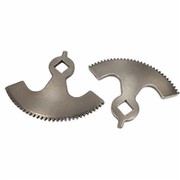
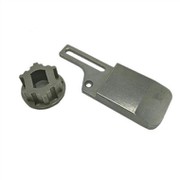
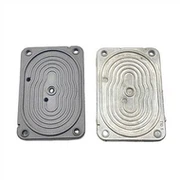
Bicycle disc brake PM sintered part The sintering process in the production and processing of powder metallurgy parts is one of the most basic processes of powder metallurgy, which plays a decisive role in the physical and mechanical properties of powder metallurgy parts. Sintering is a high-temperature heat treatment, which involves the knowledge of sintering furnace, sintering atmosphere, selection and control of sintering conditions, etc.
Product Introduction
|
Bicycle disc brake PM sintered part |
||||||
|
Item |
Material |
Production Process |
Sintering Temperature |
Mold |
Custom |
|
|
Bicycle disc brake powder |
440c |
Powder metallurgy |
1550℃ |
To be customized |
Yes |
|
|
Chemical composition |
C :0.95~1.20 Si: ≤1.00 Mn: ≤1.00 S : ≤0.030 P : ≤0.035 Cr:16.00~18.00 Ni:allowed to contain ≤0.60 |
|||||
|
Available Materials |
Low carbon stainless steel, titanium alloy (Ti, TC4), copper alloy, tungsten alloy, hard alloy, high temperature alloy (718, 713) |
|||||
Product advantages
|
Smoothness |
Dimensional accuracy |
Product density |
Appearance treatment |
Appropriate weight |
|
Roughness 1~5μm |
(±0.1%~±0.5%) |
92~95% |
Mirror reflection |
0.03g~400g) |
|
Mechanical properties |
Hardness: annealed, ≤269HB; Quenching and tempering, ≥58HRC Mechanical behavior: Internal stress (250 N/mm2) Tensile strength (560 N/mm2) EL(18%) HB(250) |
|||
|
Heat treatment |
1) Annealing, slow cooling at 800~920℃; 2) Quenching, oil cooling at 1010~1070℃; 3) Tempering, rapid cooling at 100-180°C; 4. Preheating temperature, 649°C-816°C. |
|||
Production Process
Bicycle disc brake PM sintered part The sintering process in the production and processing of powder metallurgy parts is one of the most basic processes of powder metallurgy, which plays a decisive role in the physical and mechanical properties of powder metallurgy parts.
Sintering is a high-temperature heat treatment, which involves the knowledge of sintering furnace, sintering atmosphere, selection and control of sintering conditions, etc. Therefore, sintering is a very complicated process. At the same time, sintering is a special process with high energy consumption, high equipment investment, and insufficient measurement of product quality characteristics, so it is one of the most important links affecting the quality and cost of powder metallurgy parts. The sintering process is very critical and must be strictly controlled to ensure the quality of sintered parts. Therefore, operators need to carry out special technical training, fully understand and master the basic principles of sintering, sintering process (such as materials, temperature and time, sintering atmosphere, environment, etc.), the role of sintering atmosphere, and factors affecting the quality of sintered products, etc. In order to master the sintering operation skills proficiently and improve the ability to analyze problems.
Bicycle disc brake PM sintered part How is the compact of powder metallurgy parts sintered? Sintering is the heat treatment of powders or compacts at temperatures below the melting point of the main components. The purpose is to produce a metallurgical bond between the powder particles, that is, the mechanical bond between the powder particles is transformed into a grain boundary bond between atoms.
The purpose of compact sintering of powder metallurgy parts is that although the compact obtained by pressing has the shape and size of mechanical parts, its strength is very low and cannot meet the requirements of use. Before sintering, the compact is only a mixture of powder particles in contact with the interface, rather than a real atomically bonded material. Therefore, sintering is necessary to make the compact into a material in the sense of metallurgy, and to endow powder metallurgy parts with the required mechanical and physical properties. After the iron powder compact is sintered, the strength and elongation are greatly improved. If the temperature is sintered at 1200 ° C, the tensile strength can be increased from zero to 200MPa, and the elongation can be increased from zero to 8%.
Requirements for compact sintering of powder metallurgy machinery parts.
1.Accuracy requirements for size and shape. The size and shape accuracy of sintered parts, including surface roughness, must meet the design requirements. Sintering causes the sintered body to shrink or expand, and the sintered body is also deformed due to uneven density distribution of the compact and uneven furnace temperature, so the size and shape of the sintered product will change through sintering. This requires strict control of sintering conditions in order to ensure the size and shape accuracy requirements of sintered products.
2. Density requirements. In sintering, since sintering between powder particles occurs, and shrinkage or expansion of the sintered product occurs, the density, porosity, and voids of the sintered product change along with the shape. Relative density and porosity characterize the density of powder metallurgy parts. As a self-lubricating powder metallurgy oil-impregnated bearing, there is also a requirement for connecting gaps.
3. Organizational requirements. Powder metallurgy parts are the same as other materials, and their intrinsic performance depends on the structure. Factors characterizing the structure of powder parts are: grain size, phase structure, phase distribution, distribution of alloy components, and porosity, pore size and porosity. shape. The formation and change of the microstructure of powder metallurgy parts mainly occurs during the sintering process.
4. Requirements for mechanical properties and physical properties. The final sintered parts must achieve the required mechanical properties and physical properties. Mechanical properties include strength, hardness, elongation and impact toughness, etc.; physical properties include density, electrical conductivity, thermal conductivity, and magnetic properties.
The sintering of powder metallurgy parts is divided into solid phase sintering and liquid phase sintering. Solid phase sintering is simply the sintering of metallurgical bonding between powder metallurgy particles, and liquid phase sintering is the sintering of certain molecular particles in powder metallurgy at a temperature higher than the melting point to produce a liquid state. The sintering process of powder metallurgy compact parts can be divided into pre-sintering grease removal-high temperature sintering-cooling.
Metal Injection Molding Process

Detection Systems



Send Inquiry
