



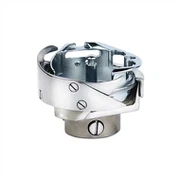
Strap Head MIM Parts
The specific gravity of titanium and titanium alloys is almost half of that of iron metals. They have low density, good corrosion resistance, high specific strength and satisfactory biocompatibility. They are widely used in aviation, aerospace, chemical industry, biomedicine and other fields. , and bring huge economic benefits to human society, especially when human implants replace failed bones, such as dentures, tooth roots, artificial limbs and other bone reinforcements, it is a good material that can benefit human beings.
Product Introduction

Product Category: Watch and Jewelry Industry
Product keywords: MIM, watch accessories, Strap Head MIM Parts
Material: Stainless Steel 316L 304 17-4PH Titanium
Surface treatment requirements: polishing, brushing, sandblasting, electroplating
Dimensional tolerance range: customized
Product size: 10mm±0.02-0.04mm
Strap MIM Parts | |||||||||
Item | Material | Production Process | Sintering Temperature | Mold | Custom | ||||
Strap grain | Titanium alloy | Metal Injection Molding | 1350°C | To be customized | Yes | ||||
Available Materials | Low carbon stainless steel, titanium alloy (Ti, TC4), copper alloy, tungsten alloy, hard alloy, high temperature alloy (718, 713) | ||||||||
Finish | Dimensional Accuracy | Product Density | Appearance Treatment | Appropriate Weight | |||||
Roughness 1~5μm | (±0.1%~±0.5%) | 92~95% | Mirror Reflection | 0.03g~400g) | |||||
Standard performance | Standard performance (O≤0.3%, N≤0.007%, σ=451617MPa, σ0.2≥343MPa, δ≥18%). | ||||||||
Titanium Injection Molding Process
1. Introduction
The specific gravity of titanium and titanium alloys is almost half of that of iron metals. They have low density, good corrosion resistance, high specific strength and satisfactory biocompatibility. They are widely used in aviation, aerospace, chemical industry, biomedicine and other fields. , and bring huge economic benefits to human society, especially when human implants replace failed bones, such as dentures, tooth roots, artificial limbs and other bone reinforcements, it is a good material that can benefit human beings.
However, the biggest problem for titanium and titanium alloys in powder metallurgy technology is how to reduce or avoid the occurrence of oxidation. According to the observation of the standard formation free energy-temperature diagram of oxides drawn by Gibbs Free Energy, If you want to restore the oxidized titanium or titanium alloy to metal, the price you pay is extremely high and not in line with economic benefits. This is also the disadvantage of titanium and titanium alloys in the powder metallurgy process. Compared with iron-based materials, they lose their processing cost advantage. It is no wonder that the advantages of titanium and titanium alloys in traditional bulk processing are much higher than those of powder metallurgy, which is the first thing powder metallurgy practitioners need to know.
2. Points to note
In order to succeed in powder injection molding products of titanium and titanium alloys, it must proceed in the following way:
●To control the oxygen content of the starting powder, the oxygen content of the powder must be controlled below 3000 ppm, preferably less than 1000 ppm; only the powder with low oxygen content can produce good products.
●Attention must be paid to the chance of reaction with oxygen during the process, the mixing powder and binder must be carried out under a protective atmosphere, the injection molding should minimize the heating and holding time, and the degreasing process should use reducing gas protection or switch to reducing Oxalic acid degreasing, vacuum or protective atmosphere sintering immediately after degreasing;
●The design of the sintering setter and support system uses zirconia plates that are not easily robbed of oxygen by titanium, and small pieces of sponge titanium sacrificial decorations to help reduce the oxygen content in the sintering system;
●Add oxygen-robbing components, such as magnesium, to the material powder system, but this may cause variation in the composition of titanium and titanium alloys, and the strength of titanium and titanium alloys will deteriorate after sintering.
2.1 Selection of powder raw materials
The use of powder with low oxygen content is the first choice for injection molding of titanium and titanium alloys, which means that it is more suitable to use the spherical powder of the gas atomization method. The gas atomization powder is pressurized and cooled by inert gas, and the powder particles are relatively large. And round, the oxygen content is low, at present, Carpenter in the United States and Sandvik in the United Kingdom are the main ones, and the particle size of the powder is preferably d50=10~12um. Too small powder is easy to oxidize, and the process is more dangerous; water The atomization method is too fine and rough, and the particles of the mechanical crushing method are too large, which are not suitable for the injection molding process; another school of thought supports the use of titanium hydride powder to remove hydrogen, and high energy such as plasma crushing to round the powder, although the cost of obtaining raw materials is very high. Low, but patent disputes and investment in control equipment are quite high, and it has not yet been popularized.
2.2 Binder formulation
There are two kinds of feeding systems for blending titanium and titanium alloys. It is suggested that the following table 1 shows that the formula ratio is better in the range of shrinkage ratio 1.166~1.220. These formulations are all publicly available on the market.
Table 1. Formula deployment table of titanium and titanium alloys
M:B (Volume ratio) | Metal volume ratio | Binder volume ratio | ||
OSF=1.166 (Min.) | 63 vol% | 37 vol% | ||
OSF=1.220 (Max.) | 55 vol% | 45 vol% | ||
Feedstock system | Wax base/Weight ratio | POM base/Weight ratio | ||
Major filler | PW/PE Wax | 55 wt% | POM | 85 wt% |
H.T. Skelton | PP/PE | 42 wt% | PP/PE | 12 wt% |
L.T. Skelton | EVA | 2 wt% | EVA | 2 wt% |
Dispersant | EBS | 0.5 wt% | EBS | 0.5 wt% |
Lubricant/Activator | SA | 0.5 wt% | SA | 0.5 wt% |
Explanation of Polymer Abbreviations | ||||
Due to the oxidation of titanium and titanium alloys, it is recommended that the volume of metal in the formula ratio should not be higher than 63% to avoid the possibility of friction between the powder during feeding and injection molding. Once the friction temperature is too high, the possibility of oxidation will increase.
2.3 Precautions for feeding and mixing
Special attention should be paid to controlling the input material sequence and temperature control of mixed feeding, please refer to the description in Table 2. Mixing program recommendations for both feeds. Note that oxygen must be excluded in a protective atmosphere during the mixing process, and all polymer binder particles or powder must be dried to ensure that there is no moisture, low-molecular binders such as wax and stearic acid that are difficult to dry, it is recommended Remove moisture by low temperature vacuum.
Table 2. Recommended Mixing Procedures for Feedstock.
Wax base process | °C | Holding minutes | RPM | P.G. |
Pre-heat and de- water | 105 | 20 | 5 | N2 |
Low polymer input | 105 | 20 | 10 | N2 |
Major filler input | 120 | 20 | 10 | N2 |
Skeleton polymer input | 150 | 20 | 10 | N2 |
Pressure and mixing | 160 | 40 | 10~15 | N2 |
Cooling down | 130 | 20 | 10 | N2 |
Plastic base process | °C | Holding minutes | RPM | P.G. |
Pre-heat and de- water | 105 | 20 | 5 | N2 |
Low polymer input | 105 | 20 | 15 | N2 |
Skeleton polymer and major filler input | 190 | 20 | 15 | N2 |
Pressure and mixing | 200 | 20 | 15~20 | N2 |
Cooling down | 165 | 40 | 10 | N2 |
.G.=Protection Gas |
3. Main process
Once the feeding is completed until the injection molding, this is the safest state of the whole powder, and it can be exposed to the air without any harm, but during the heating of the injection process, care must be taken not to let the feed stay in the barrel for too long. Once the injection plastic base feeding process breaks down and the machine is adjusted, the temperature of the nozzle and the highest temperature area must be set at 10 minutes without working, and the temperature should be cut off so that the feeding temperature is lower than 150°C.
After injection molding of titanium and titanium alloys, the green body is no different from the feeding of general metal materials, and can be placed in the air. After the titanium and titanium alloy powder is coated with the binder, the binder can effectively block the oxygen in the air. Then after degreasing, whether it is solvent degreasing or reductive oxalic acid degreasing (it is not recommended to use strong oxidative nitric acid degreasing), first of all, ensure that the temperature leaving the furnace body is lower than 50°C to ensure that oxidation does not occur. Degreasing The finished brown billet is porous and very easy to react with oxygen in the air, please pay attention. The shorter the time the brown billet is placed outside, the better, and enter the sintering system as soon as possible.
The design of the sintered setter and sintering box is important. Due to the high oxygen affinity of titanium and titanium alloys, they can even capture the oxygen in alumina at high temperatures. Therefore, it is recommended to use zirconia plates for ceramic setters, but Do not choose carbonized or nitrided materials. Titanium and titanium alloys also like carbon and nitrogen. In the past sintering experience, placing sponge titanium in the sintering box as a sacrificial block for grabbing oxygen is effective but reduces the efficiency of the sintering furnace, and consumes a lot of sponge titanium each time, occupying space and consuming Heat is all negative.
The above is the experience sharing in the production of titanium and titanium alloy powder injection molding. Operators must be cautious. The fine powder state of pure titanium is highly dangerous. These non-ferrous metals (density <4.5g/c.c.) all have the risk of dust explosion. Although titanium and titanium alloys have been regarded as the least active non-ferrous metals.
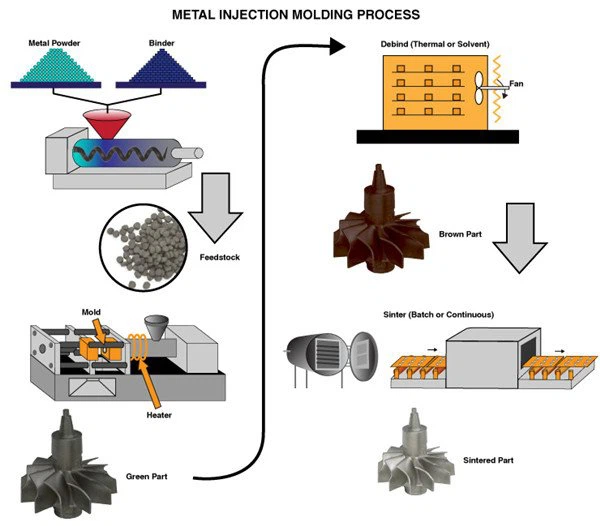
Metal Injection Molding Process
Detection Systems


Send Inquiry
