




Copper Tinplate Inlay Castings
Copper alloy is an alloy with pure copper as the matrix and one or several other elements added. According to the method of material formation, it can be divided into cast copper alloy and deformed copper alloy. Cast copper alloy cannot be deformed by forging, extrusion, deep drawing and drawing.
Product Introduction
|
Copper tinplate inlay castings |
|||||||
|
Item |
Material |
Production Process |
Sintering Temperature |
Mold |
Custom |
||
|
Copper tinplate inlay castings |
copper alloy |
investment casting |
1380℃ |
To be customized |
Yes |
||
|
chemical composition |
Customized service |
||||||
|
Available Materials |
Low Carbon steel, alloy steel, aluminum alloy, low -carbon stainless steel, titanium alloy (TI, TC4), copper alloy, high temperature alloy (718, 713) |
||||||
|
Smoothness |
Dimensional accuracy |
Product density |
Appearance treatment |
Appropriate weight |
|||
|
Roughness 1~5μm |
(±0.1%~±0.5%) |
7.3-7.6g/CM³ |
According to customer requirements |
0.03g~400g |
|||
Copper alloy inlay casting
Copper alloy is an alloy with pure copper as the matrix and one or several other elements added. According to the method of material formation, it can be divided into cast copper alloy and deformed copper alloy. Cast copper alloy cannot be deformed by forging, extrusion, deep drawing and drawing. Cast copper alloy and wrought copper alloys can be subdivided into pure copper, brass, bronze and white copper for casting. Most cast copper alloy can't be pressure-worked, such as cast beryllium bronze and cast tin bronze (Cu5Sn5Zn5Pb), which are extremely poor in plasticity and can't be pressure-worked.
Brief introduction
Pure copper, commonly known as red copper, has excellent electrical conductivity, thermal conductivity, corrosion resistance and plasticity, but its strength and hardness are low and expensive. Therefore, it is rarely used to make parts. Copper alloy is widely used in machinery.
Brass is a copper alloy with zinc as the main element. With the increase of zinc content, the strength and plasticity of the alloy increase significantly, but its mechanical properties will decrease significantly after exceeding 47%, so the zinc content of brass is less than 47%. In addition to zinc, cast brass often contains alloying elements such as silicon, manganese, aluminum and lead. The mechanical properties of cast brass are higher than that of bronze, but the price is lower than that of bronze. Cast brass is often used for wear-resistant parts such as bearing bush, bushing, gear and corrosion-resistant parts such as valves .
Performance
The alloy composed of elements other than copper and zinc is collectively called bronze. Among them, the alloy of copper and tin is the most common bronze, called tin bronze. The linear shrinkage of tin bronze is low, and it is not easy to produce shrinkage cavity, but it is easy to produce microscopic shrinkage porosity. Adding zinc, lead and other elements to tin bronze can improve the compactness and wear resistance of castings, save tin consumption, and add phosphorus for deoxidation. Its wear resistance and corrosion resistance are better than brass, but it is easy to cause micro-shrinkage, so it is suitable for wear-resistant and corrosion-resistant parts with low compactness requirements. Except tin bronze, aluminum bronze has excellent mechanical properties, wear resistance and corrosion resistance, but poor castability, so it is only used for important wear-resistant and corrosion-resistant parts
Classify
Copper alloys can be divided into cast copper alloy and deformed copper alloys according to the method of material formation. In fact, many copper alloys can be used for both casting and deformation. Usually, wrought copper alloys can be used for casting, but many cast copper alloy cannot be wrought, extruded, deep drawn and drawn. Cast copper alloy and wrought copper alloys can be subdivided into pure copper, brass, bronze and white copper
Application
Cast beryllium bronze is mainly used as explosion-proof tools, molds, structural parts of submarine cable repeaters, welding electrodes, etc. Cast tin bronze, cast aluminum bronze, cast brass is mainly used as bearing bush, shaft sleeve, bushing, bearing, gear, pipe fittings and so on. Cast copper alloy is widely used in arts and crafts, and ancient bronzes are a typical example.
We are the manufacturer of Copper tinplate inlay castings , if you need more information please contact us!
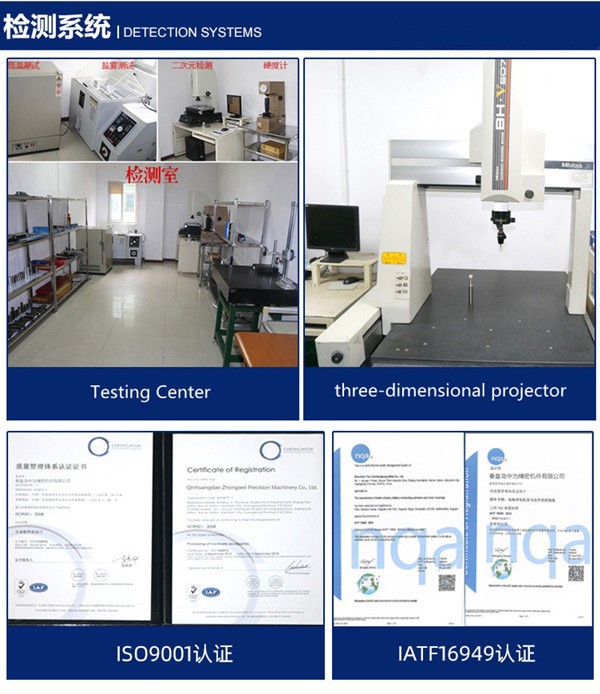
Detection Systems
Copper Silica Sol Investment Casting


Send Inquiry
