




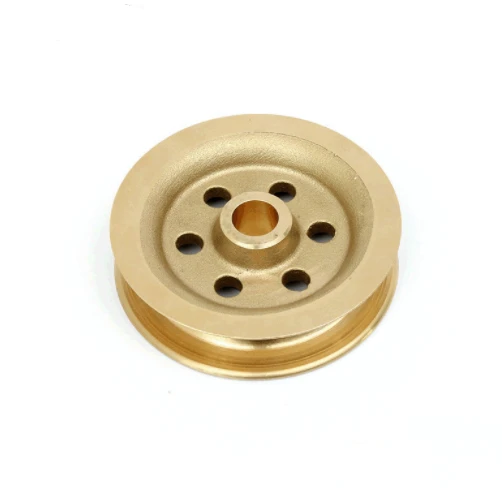
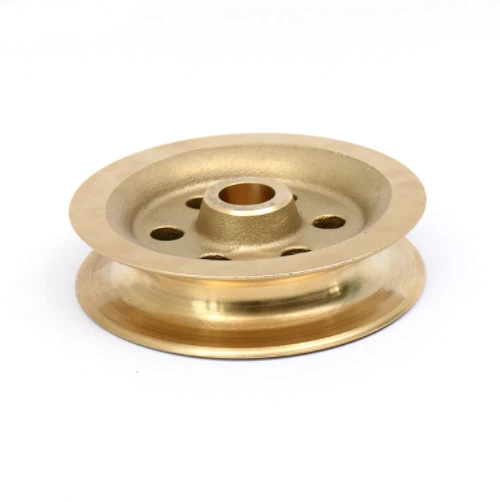
Aluminum Bronze Wheel Body Lost Wax Castings
A wheel is a rotating component that bears the load between a tire and an axle, and usually consists of two main components, a rim and a spoke (GB/T 2933-2009). Rim is the part that mounts and supports tires on wheels, and spokes are the supporting parts between axles and rims on wheels. In addition to the above components, wheels sometimes include hubs.
Product Introduction
|
Aluminum bronze wheel body lost wax castings |
|||||||
|
Item |
Material |
Production Process |
Sintering Temperature |
Mold |
Custom |
||
|
Aluminum bronze wheel body lost wax castings |
investment casting |
1380℃ |
To be customized |
Yes |
|||
|
Available Materials |
Low Carbon steel, alloy steel, aluminum alloy, low -carbon stainless steel, titanium alloy (TI, TC4), copper alloy, high temperature alloy (718, 713) |
||||||
|
Smoothness |
Dimensional accuracy |
Product density |
Appearance treatment |
Appropriate weight |
|||
|
Roughness 1~5μm |
(±0.1%~±0.5%) |
7.3-7.6g/CM³ |
According to customer requirements |
0.03g~400g |
|||
Lost wax investment casting of aluminum bronze wheel body
Introduction to wheel use
Wheel parts

A wheel is a rotating component that bears the load between a tire and an axle, and usually consists of two main components, a rim and a spoke (GB/T 2933-2009). Rim is the part that mounts and supports tires on wheels, and spokes are the supporting parts between axles and rims on wheels. In addition to the above components, wheels sometimes include hubs.
Classification
1. According to the structure of spokes: wheels can be divided into spoke-plate wheels and spoke wheels.
2. According to the wheel material: it can be divided into steel, aluminum alloy, magnesium alloy and other wheels.
3. Install one or two tires according to one end of the axle: it can be divided into single wheels and double wheels.
Spoke wheels are widely used in cars and trucks. In addition, there are split wheels, assembled rim wheels, reversible wheels, and adjustable wheels.
Deep groove rim
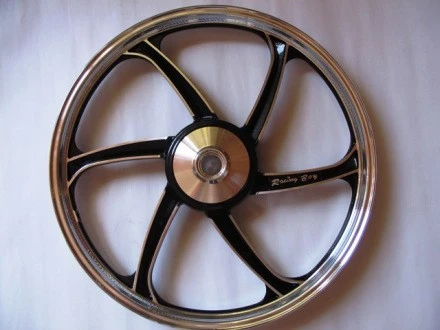
This kind of rim is integral with a deep groove in the middle of its section, which is mainly used for cars and light off-road vehicles. It has a flange with shoulders, which is used to place the bead of the outer tire. Its shoulders are usually slightly inclined to the middle, and its inclination angle is generally 5 degrees soil L degrees. The maximum diameter of the inclined part is called the engagement diameter between the tire bead and the rim. The middle of the section is made into a deep groove to facilitate the disassembly and assembly of the tire. The deep groove rim is simple in structure, high in rigidity and light in weight, which is most suitable for small-sized tires with high elasticity. However, larger and harder tires are difficult to fit into such an integral rim.
Flat rim
There are many structural forms of this kind of rim, as shown in Figure 20-18b, which is a common form of freight cars in China. The retaining ring L is integral, and an open elastic locking ring 2 is used to prevent the retaining ring from coming out. When installing the tire, first put the tire on the rim, then put the retaining ring on it, and push it inward until it crosses the annular groove on the rim, and then insert the open elastic locking ring into the annular groove. Both Dongfeng EQl090E and Jiefang CAl091 automobile wheels adopt this kind of rim.
Split rim
This kind of rim is composed of inner and outer parts, and the width of the inner and outer rims can be equal or unequal, and the two are connected into a whole by bolts. When dismounting the tire, just remove the nut. Retaining ring 3 is removable. Some do not have retaining rings, but instead of retaining rings, the inner rim and the web are welded together. Dongfeng EQ2080 and Yan 'an SX2150 models: automobile wheels, that is, rims in this form.
Because the rim is the assembly and fixing foundation of the tire, when the tire is put into different rims, its deformation position and size also change. Therefore, it is best to match the specified standard rim for each type of tire, and if necessary, it can also match the rim (allowable rim) with specifications similar to the standard tire. If the rim is not selected properly, it will cause early tire damage, especially when it is used on an excessively narrow rim.
In recent years, in order to meet the needs of improving tire load capacity, wide rims have been adopted. The test shows that the use of wide rims can improve the service life of tires and improve the passability and driving stability of automobiles.
Tire use skills
1. Check the tire. If the tire cut position is worn (the depth is less than 2mm) at the side of the tire or the depth of the groove on the wheel surface, which is too serious to be repaired, it is necessary to replace it with a new one.
2. You can't change the size of the tire at will, so you need to choose the tire that matches your car.
3. Because the sealing performance of the tire and the wheel hub is very good, it is necessary to use professional instruments to separate the tire from the wheel hub; Rotate the tire evenly, so as to avoid damaging the wheel hub by hard disassembly.
4. Remove the tire from the wheel hub completely. When the tire is removed, check whether the wheel hub is damaged. If the damaged wheel hub is fitted with tires, it will not only leak air, but also break and cause danger.
5. Yellow dots and red dots are specially designed on the tire, because when the wheel rotates, it has a center of gravity, and the yellow dot is lighter on one side and the red dot is more important. Therefore, when installing, pay attention to aim the yellow point at the valve.
6. If the installation is difficult, you can moisten the tire with clear water. After the new tire is installed, pump enough air to prepare for the subsequent balance.
7. The installed new tires must be dynamically balanced. During driving, if the tire position is unbalanced, it will cause the steering wheel to shake, and the faster the speed, the greater the vibration; Moreover, unbalanced tires can also cause wear. The measurement of dynamic balance has a certain value. When rotating, the weight difference can be measured. According to the machine test, the tire has a difference of 15 grams on the left and 11 grams on the right.
Tire identification
Tyre size: tyre size is usually represented by a set of numbers. The former number represents the tire section width and the latter number represents the rim diameter, in inches. For example, 165/70R14 indicates a tire width of 165 mm, a flat rate of 70, and a rim diameter of 14 inches. The letters or symbols in the middle have special meanings: "X" stands for high-pressure tire; "R" and "Z" represent radial tires; "One" means a low-pressure tire.
Level: Level refers to the nominal number of plies in the tire rubber layer, which is not completely consistent with the actual number of plies, and is an important indicator of tire strength. Levels are marked in Chinese, such as 12 levels; Use English signs, such as "14P.R", that is, 14 levels.
Rim specification: indicates the rim specification matched with the tire. Convenient for practical use, such as "standard rim 5.00F".
Speed class: the highest speed at which a tire can bear a specified load under specified conditions. The letters A to Z represent the certified speed grades of tires from 4.8km/h to 300 km/h.. Common speed grade: Q: 160 km/h; R:170km/h; S:180km/h; T:190km/h; H:210km/h; V:240km/h; W:270km/h; Y:300km/h; Z: Zr velocity is higher than 240 km/h.
We are the manufacturer of Aluminum bronze wheel body lost wax castings , if you need more information please contact us!
Detection Systems
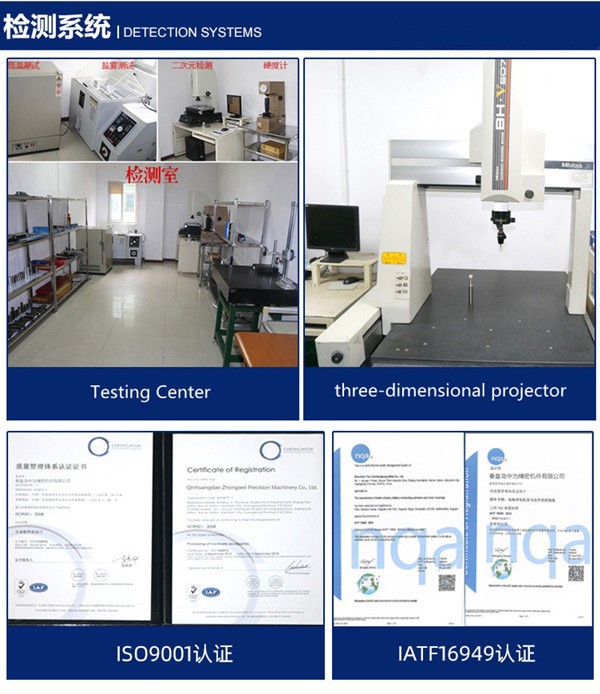
Copper Silica Sol Investment Casting


Send Inquiry
