



Snow Racing Threaded Anti-skid Spikes Metal Injection Molding Parts
The threaded anti-skid spikes for perforated tires are complete in series such as standard threaded anti-skid spikes, large threaded anti-skid spikes, and racing threaded anti-skid spikes.

There are many types of anti-skid spikes, including anti-skid shoes and car tires.
The 6.5-1 series is universal for anti-skid shoes.
There are many types of snow tire anti-skid spikes. The flat head anti-skid spikes universal for perforated tires are 8-1 series, 9-1 series, 12-1 series, 8-11-2 series, 9-11-2 series and other series.
The threaded anti-skid spikes for perforated tires are complete in series such as standard threaded anti-skid spikes, large threaded anti-skid spikes, and racing threaded anti-skid spikes.
Metal injection molding technology is suitable for preparing high-precision products with complex shapes, uniform organizational structures and high performance. It can realize automated continuous production with high efficiency and material utilization rate close to 100%. High-density tungsten alloy products have more and more extensive uses in military, medical and other industries. The shape requirements for parts are becoming more and more complex, the processing is difficult, and the production cost is high. The injection molding process can solve this problem well.
The process of manufacturing high-density tungsten alloy using metal powder injection molding technology (MIM) includes:
1. Ingredients: Provide granular tungsten alloy feed with a moisture content of ≤0.2%, the tungsten alloy feed is mixed with high-density tungsten alloy powder and organic binder, the tungsten alloy includes at least W, Ni, Cu, Fe, and Co, wherein W accounts for ≥85% of the mass percentage of the tungsten alloy, so that the density of the tungsten alloy reaches 16.5-19.0g/cm3.
2. Molding: Inject the tungsten alloy feed into the mold under the conditions of injection temperature of 100-195℃, injection pressure of 600-1800bar, and injection speed of 30-140mm/s, and the preferred injection cycle is 25s. The mold temperature of the mold is preferably selected at 35℃, and the holding pressure therein is selected from 750bar, 750bar, and 100bar in turn, and the corresponding holding time is 0.2s, 0.8s, and 0.1s in turn. According to the actual size of different products, the injection cycle, holding pressure and holding time need to be adjusted to form a defect-free tungsten alloy green body.
3. Solvent degreasing: The tungsten alloy green body is placed in a water bath at a temperature of 25-45℃ for solvent degreasing for 8-24h, and the degreasing agent is n-heptane.
4. Atmosphere thermal degreasing: The tungsten alloy green body after solvent degreasing is placed in ammonia decomposition gas, and the pusher furnace with a maximum degreasing temperature of 600-1000℃ is used for thermal degreasing for 10-28h at a pusher speed of 20-45min/boat.
5. Atmosphere sintering: The tungsten alloy green body after thermal degreasing is placed in ammonia decomposition gas, and the pusher furnace with a maximum sintering temperature of 1400-1500℃ and a pusher speed of 20-45min/boat is used for sintering for 10-28h, and a high specific gravity tungsten alloy is obtained after cooling.
The high-density tungsten alloy sintered by MIM has high density, high hardness, non-magnetic properties, low sintering temperature, and low thermal expansion coefficient. It can meet the requirements of high temperature, high humidity, salt spray, etc., and has physical, chemical and mechanical properties close to those of forgings.
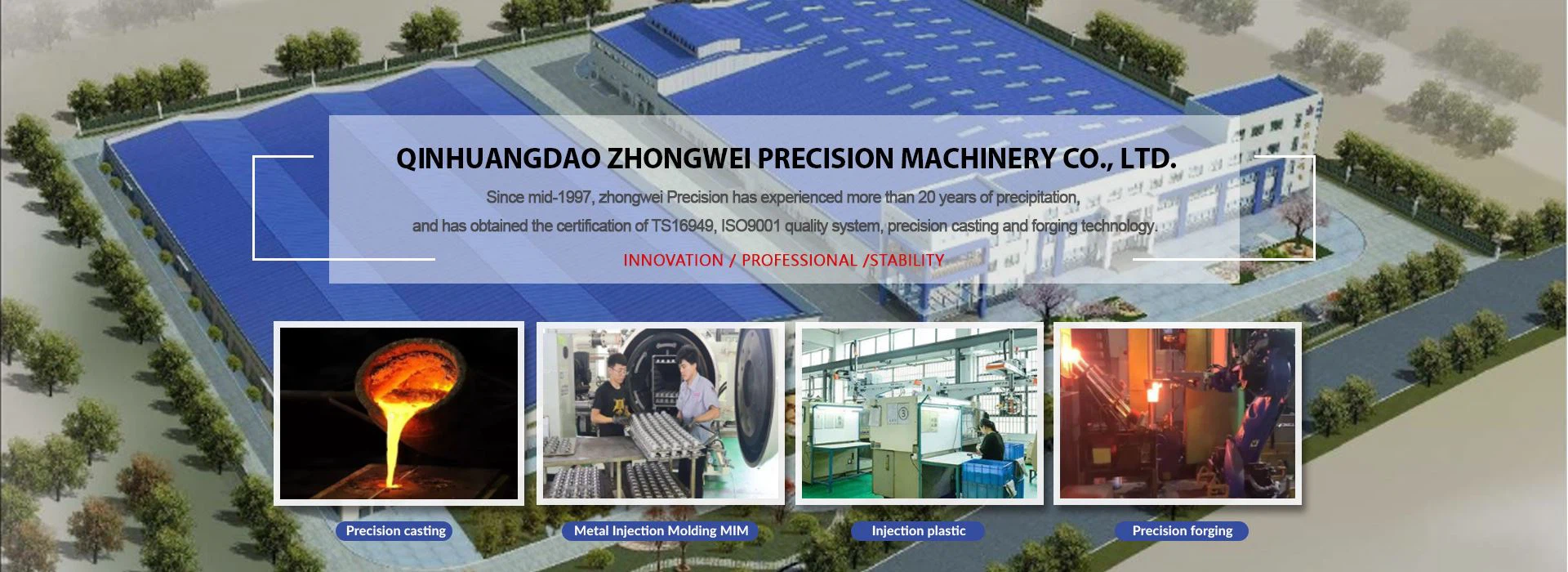
MIM is the abbreviation of Metal Injection Molding. It is a near-net-shape molding technology that injects metal powder into a mold after mixing and kneading with a binder. Zhongwei Precision MIM Project was established in 2003, mainly engaged in the research and development and production of tungsten alloy MIM and titanium alloy MIM. As the project continues to grow and develop, production lines for metals such as stainless steel have been added. At present, the project has MIM and processing platforms and production lines for tungsten alloys, stainless steel, iron-based alloys, copper alloys, soft magnetic materials, non-magnetic steel and other materials, and has sintering equipment such as atmosphere-protected push plate furnaces and vacuum furnaces, with a monthly production capacity of more than 50 million pieces.
 Metal Injection Molding 14AL Snow Tire Anti-skid Spikes
 GT10 Powder Metallurgy, Metal Injection Molding MIM ...
 Export Carbide Anti-skid Spikes Metal Injection Mold...
 Carbide Anti-skid Shoe Spikes Metal Injection Molding
 Automobile Tire Anti-skid Spikes Metal Injection Mol...
 1911 Anti-skid Repair Threaded Nails Metal Injection...
Send Inquiry
