



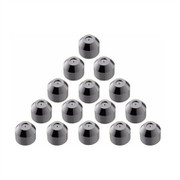
Anti-skid Shoe Spikes 10-8.5mm Metal Injection Molding Parts
Threaded anti-skid spikes range from standard threaded anti-skid spikes to large threaded anti-skid spikes to racing threaded anti-skid spikes.


Threaded anti-skid spikes range from standard threaded anti-skid spikes to large threaded anti-skid spikes to racing threaded anti-skid spikes.
Anti-skid shoes are commonly used in the 6.5-1 series, JX100, JX110, JX300A, JX300B, etc.
Tires are commonly used in the 8-1 series, 9-1 series, 12-1 series, 8-11-2 series, 9-11-2 series, etc.
Racing cars, ice and snow drift races are commonly used in the 6-20, 6-25, 6-27, etc., all-steel and tungsten steel nail cores are available!
Surface Treatment Process Of Metal Injection Molding Parts Mim Parts
Polishing treatment
Use mechanical, chemical or electrochemical effects to reduce the surface roughness of the workpiece to obtain a bright and smooth surface processing.
Electroplating treatment
The process of using electrolysis to attach a layer of metal film to the surface of metal or other material parts. Electroplating can prevent metal oxidation (such as rust), improve wear resistance, conductivity, reflectivity, corrosion resistance (copper sulfate, etc.) and enhance aesthetics.
PVD treatment
The process of transferring atoms or molecules from the source to the surface of the substrate by physical process. Its function is to spray certain particles with special properties (high strength, wear resistance, heat dissipation, corrosion resistance, etc.) on the mother body with lower performance, so that the mother body has better performance.
Blackening treatment
It is a very common chemical treatment method to produce an oxide film on the metal surface to isolate the air and achieve the purpose of rust prevention. Blackening treatment can be used when the appearance requirements are not high. The main components of the blackening liquid are sodium hydroxide and sodium nitrite.
Phosphating treatment
It is a process of forming a phosphate film by chemical and electrochemical reactions. The main purpose of phosphating is:
1) To provide protection for the base metal and prevent the metal from being corroded to a certain extent;
2) To be used as a primer before painting to improve the adhesion and corrosion resistance of the paint film.
Spraying treatment
The coating method of applying the uniform and fine droplets to the surface of the object to be coated by means of pressure or centrifugal force through a spray gun or a disc atomizer.
In short:
1) Polishing and phosphating are mainly pretreatments to prepare for other post-treatments;
2) Electroplating and PVD are two types of treatment technologies that are widely used;
3) Blackening and spraying will have a greater change on the surface of the product and are more suitable for large workpieces.
Applicable Materials And Application Fields:
MIM is widely used, including daily necessities such as automobiles, aerospace industry, mobile phones, watches, household appliances, cameras and power tools equipped with MIM parts. MIM technology can be applied to any material that can be made into powder. The main MIM material systems currently used are:
Stainless steel, iron-based alloy, magnetic material, tungsten alloy, cemented carbide, fine ceramics and other series.
MIM is the abbreviation of Metal Injection Molding, which is a near-net-shape molding technology that injects metal powder into a mold after mixing and kneading with a binder. Zhongwei Precision MIM Project was established in 2003, mainly engaged in the research and development and production of tungsten alloy MIM and titanium alloy MIM. As the project continues to grow and develop, production lines for metals such as stainless steel have been added. At present, the project has MIM and processing platforms and production lines for tungsten alloy, stainless steel, iron-based alloy, copper alloy, soft magnetic material, non-magnetic steel and other materials, and has sintering equipment such as atmosphere-protected push plate furnace and vacuum furnace, with a monthly production capacity of more than 50 million pieces.



Send Inquiry
