


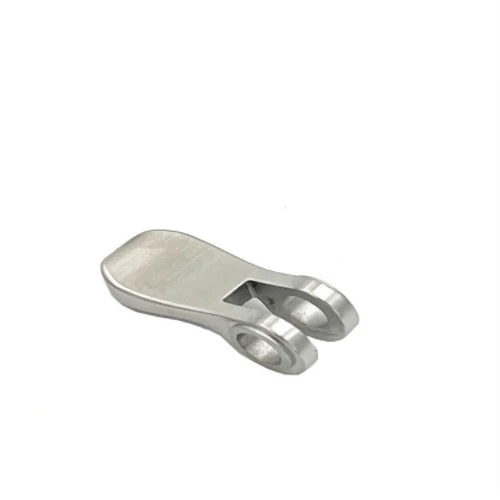



Flow Meter Handle Titanium Alloy Wax Casting
The flowmeter handle is produced using titanium alloy wax casting technology. Titanium alloy has the advantages of low density, high strength, and good corrosion resistance, making it suitable for manufacturing flow meter handles that require strength and corrosion resistance. Lost wax casting can achieve precise shaping of complex shapes, meeting the complex design requirements that flow meter handles may have.
Project Overview
The flowmeter handle is produced using titanium alloy wax casting technology. Titanium alloy has the advantages of low density, high strength, and good corrosion resistance, making it suitable for manufacturing flow meter handles that require strength and corrosion resistance. Lost wax casting can achieve precise shaping of complex shapes, meeting the complex design requirements that flow meter handles may have.
Raw material selection
Titanium alloy
Choose the appropriate titanium alloy grade based on the usage environment and performance requirements of the flowmeter handle. Common materials such as Ti-6Al-4V have good comprehensive mechanical properties, high strength and toughness, and can withstand certain pressure and impact forces. At the same time, it has good corrosion resistance in various chemical media and is suitable for flow meters in most industrial environments.
Wax material
Medium temperature wax material is selected, which has good fluidity, dimensional stability, and strength. After heating and melting, it can accurately fill the mold cavity, maintain the shape accuracy of the handle after cooling, and completely melt and remove impurities during the subsequent dewaxing process without affecting the quality of the casting.
process flow
Mold design and manufacturing: Design and manufacture molds based on the three-dimensional model of the flowmeter handle. The mold adopts high-precision processing technology to ensure the dimensional accuracy and surface quality of the mold cavity, in order to ensure the dimensional accuracy and surface smoothness of the wax mold.
Wax injection: Heat the medium temperature wax material to the appropriate temperature to give it good fluidity, and then inject the wax material into the mold cavity through an injection machine. During the injection process, it is necessary to control the injection pressure, speed, and temperature to ensure that the wax material completely fills the mold cavity and avoid defects such as pores and shrinkage.
Wax mold assembly: Assemble individual wax molds into wax modules through welding or bonding for subsequent batch casting. During the assembly process, it is necessary to ensure the relative positional accuracy between the wax molds to avoid dimensional deviations during the casting process.
Coating slurry: Immerse the wax mold group into a slurry composed of refractory materials (such as zircon sand, mullite sand, etc.) and binders (such as water glass, silica sol, etc.), so that the surface of the wax mold is uniformly covered with a layer of slurry. Then sprinkle a layer of refractory sand on its surface to increase the thickness and strength of the shell.
Drying and hardening: Place the wax mold group coated with slurry and sand into a drying chamber, and control the temperature, humidity, and ventilation conditions to cause the binder in the slurry to undergo a hardening reaction, forming a shell with a certain strength. Generally, multiple coating and drying hardening processes are required to obtain a shell with sufficient thickness and strength.
Dewaxing: Place the mold shell into a dewaxing furnace, heat it to melt the wax material and flow out of the mold shell, thereby forming a cavity inside the mold shell with the same shape as the handle. The dewaxing process should control the heating speed and temperature well to avoid cracking of the shell due to excessive thermal stress.
Titanium alloy melting: Vacuum consumable arc furnace or induction furnace is used to melt titanium alloy raw materials. During the melting process, it is necessary to strictly control the vacuum degree and temperature inside the furnace to ensure the uniformity and purity of the chemical composition of the titanium alloy, and to avoid the mixing of impurities.
Pouring: Quickly pour the melted titanium alloy liquid into the preheated shell at high temperature. The pouring process should control the pouring speed and temperature to ensure that the titanium alloy liquid can fill the shell and cavity, while avoiding defects such as insufficient pouring and cold insulation.
Cleaning shell: Using mechanical vibration or sandblasting methods to remove the shell on the surface of the casting. During the shell cleaning process, attention should be paid to avoiding damage to the surface of the casting.
Heat treatment: Heat treatment is applied to castings to improve their microstructure and mechanical properties. Common heat treatment processes include solution treatment and aging treatment. By controlling the temperature and time of heat treatment, titanium alloys can achieve the best strength and toughness matching.
Machining: According to the design requirements of the flowmeter handle, the castings are machined, such as turning, milling, drilling, etc., to achieve the required dimensional accuracy and surface roughness.
Surface treatment: Surface treatment of the machined handle, such as anodizing, passivation, etc., to improve its corrosion resistance and appearance quality.
quality control
Size inspection
High-precision measuring equipment such as coordinate measuring instruments are used to inspect the key dimensions of the flowmeter handle to ensure that it meets the design requirements. The detection frequency should be reasonably set according to the production batch and quality stability. Generally, a certain proportion of sampling should be conducted for each batch of products.
Non destructive testing
Non-destructive testing of castings is carried out using equipment such as ultrasonic testing, X-ray testing, etc., to detect whether there are defects such as cracks and pores inside the castings. Non destructive testing should cover the entire production process, including raw material testing before melting and casting testing after pouring.
Mechanical performance testing
Cut samples from castings and conduct mechanical performance tests such as tensile testing and hardness testing to evaluate whether the mechanical properties of castings meet the requirements for use. Mechanical performance testing should be conducted in accordance with relevant standards and specifications to ensure the accuracy and reliability of the test results.
work safety
Smelting and pouring process
Operators should wear protective equipment such as high-temperature protective clothing, protective gloves, goggles, etc. to prevent burns from high-temperature metal liquid. At the same time, it is necessary to strictly follow the operating procedures of melting and pouring equipment to avoid equipment failures and safety accidents.
The manufacturing process of the shell
When using chemical binders and refractory materials, attention should be paid to ventilation and air exchange to prevent harmful gases from causing harm to the human body. At the same time, to avoid dust flying, operators should wear protective equipment such as dust masks.
Post processing process
During machining and surface treatment, attention should be paid to the safe operation of equipment to prevent accidents such as mechanical injury and chemical corrosion. At the same time, it is necessary to dispose of waste in a reasonable manner to avoid polluting the environment.


Send Inquiry
