



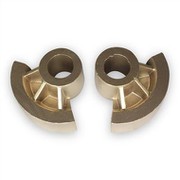
Bluetooth Earphone Case Titanium Alloy Wax Casting
Titanium alloy has a high strength to weight ratio. For Bluetooth earphone cases, high strength means that in daily use, such as accidental dropping or squeezing, the earphone case can better protect the internal electronic components and reduce the risk of damage. At the same time, the lightweight feature makes Bluetooth earphones more comfortable to wear, without causing too much burden on the user's ears, especially suitable for long-term wear.

The advantage of using titanium alloy wax casting for Bluetooth earphone case
1. High strength and lightweight
Titanium alloy has a high strength to weight ratio. For Bluetooth earphone cases, high strength means that in daily use, such as accidental dropping or squeezing, the earphone case can better protect the internal electronic components and reduce the risk of damage. At the same time, the lightweight feature makes Bluetooth earphones more comfortable to wear, without causing too much burden on the user's ears, especially suitable for long-term wear.
2. Corrosion resistance
Titanium alloy has good corrosion resistance and can resist the erosion of sweat, rainwater, and chemical components in the air. During the use of Bluetooth earphones, they may come into contact with sweat and other secretions from the human body, which may cause rusting and discoloration of the earphone case made of ordinary materials. However, the earphone case made of titanium alloy material can maintain its appearance as new for a long time, extending the product's service life.
3. Biocompatibility
Titanium alloy is a material with excellent biocompatibility and good affinity with human tissues. For Bluetooth earphones worn directly on the ear, this feature can reduce the possibility of users experiencing discomfort such as allergies due to wearing the earphones, and improve the user experience.
1. High precision molding
Lost wax casting can achieve very high dimensional accuracy and complex shape forming. Bluetooth earphone cases typically have complex exterior designs, including various curves, grooves, and holes, to meet the functional and aesthetic needs of the earphones. The lost wax casting process can accurately replicate the shape of the mold, ensuring that the dimensional accuracy of the headphone case is within a very small error range, ensuring product consistency and interchangeability.
2. Good surface quality
The surface of the Bluetooth earphone case produced by wax casting is smooth and does not require excessive subsequent processing. This not only improves production efficiency, but also ensures the appearance quality of the headphone case, giving it a better texture and glossiness. Good surface quality also helps to enhance the overall quality and market competitiveness of the product.
3. High material utilization rate
During the wax loss casting process, the utilization rate of materials is relatively high. Compared with some traditional processing methods, it can reduce material waste and lower production costs. For titanium alloys, which are relatively expensive materials, improving material utilization has important economic significance.
Process flow of wax loss casting of titanium alloy for Bluetooth earphone case
1. Design and Carving
According to the design requirements of the Bluetooth earphone case, computer-aided design (CAD) software is used for 3D modeling, and then a master mold is made based on the model. The master mold can be made from materials such as plastic or metal through mechanical processing or rapid prototyping technology. Next, use carving tools to finely carve the master mold, ensuring a smooth surface, accurate dimensions, and compliance with design requirements.
2. Wax pattern replication
Inject the melted wax material into the master mold, wait for the wax material to cool and solidify, and then remove it from the master mold to obtain a wax mold with the same shape as the master mold. To improve production efficiency, multiple wax molds can be made simultaneously using multi cavity molds. In the process of wax mold replication, it is necessary to control parameters such as wax material temperature, injection pressure, and time to ensure the quality of the wax mold.
3. Wax pattern trimming
Inspect and repair the finished wax mold, removing surface defects such as flaws and burrs. At the same time, measure and adjust the size of the wax mold to ensure that it meets the design requirements. The repaired wax mold needs to be cleaned and dried to remove surface oil and moisture, in preparation for subsequent processes.
1. Apply fire-resistant coating
Immerse the repaired wax mold into the refractory coating to evenly cover the surface of the wax mold with a layer of coating. Refractory coatings are usually composed of refractory materials (such as quartz powder, bauxite, etc.), binders (such as water glass, silica sol, etc.), and additives. The number and thickness of coating depend on the requirements of the product and process conditions, and generally require 3-5 layers of coating.
2. Sprinkle sand
After applying the refractory coating, immediately place the wax mold into the sand box and sprinkle a layer of refractory sand to firmly adhere the sand particles to the coating layer. The purpose of sanding is to increase the strength and breathability of the shell. The particle size and material of sand particles depend on the requirements of the product and process conditions, and different particle sizes are generally used for multiple sanding.
3. Drying and hardening
The wax mold after coating and sanding needs to be dried and hardened to solidify the adhesive in the shell and improve the strength and stability of the shell. There are various methods for drying and hardening, such as natural drying, heating drying, chemical hardening, etc. During the drying and hardening process, it is necessary to control parameters such as temperature, humidity, and time to ensure the quality of the shell.
4. Dewaxing
Place the dried and hardened shell into the dewaxing equipment, and melt the wax mold by heating or steam to flow out of the shell. The purpose of dewaxing is to remove the wax mold from the shell and form a cavity with the same shape as the Bluetooth earphone shell. During the dewaxing process, it is necessary to control the temperature and time to ensure that the wax mold is completely melted and flows out, while avoiding shell cracking.
1. Melting of titanium alloy
Place titanium alloy raw materials into a vacuum induction melting furnace for melting. During the melting process, it is necessary to control parameters such as vacuum degree, temperature, and melting time inside the furnace to ensure that the chemical composition and quality of the titanium alloy meet the requirements. Due to the high chemical reactivity of titanium alloys, they are prone to react with elements such as oxygen and nitrogen in the air. Therefore, vacuum or inert gas protection is required during the melting process.
2. Pouring
Inject the melted titanium alloy liquid into the cavity of the mold shell through the pouring system. During the pouring process, it is necessary to control parameters such as pouring temperature, pouring speed, and pouring pressure to ensure that the titanium alloy liquid can fill the mold cavity and avoid defects such as porosity and slag inclusion. At the same time, in order to improve the quality of castings, some special pouring processes can be used, such as low-pressure pouring, gravity pouring, etc.
1. Sand cleaning and cutting
After cooling the poured shell to room temperature, remove the sand particles and impurities on the surface of the shell. Then, use cutting equipment to cut the castings from the sprue and riser. During the sand cleaning and cutting process, attention should be paid to avoiding damage to the surface of the casting.
2. Heat treatment
Heat treat the cut Bluetooth earphone case to improve its organizational structure and performance. The heat treatment process includes annealing, quenching, tempering, etc. The specific process parameters depend on the composition of the titanium alloy and the requirements of the product. Heat treatment can improve the strength, hardness, and toughness of Bluetooth earphone cases.
3. Surface treatment
To improve the appearance quality and corrosion resistance of Bluetooth earphone cases, surface treatment can be applied. Common surface treatment methods include polishing, electroplating, spraying, etc. Polishing can make the surface of Bluetooth earphone case smoother and improve its glossiness; Electroplating can deposit a layer of metal or alloy on the surface of the Bluetooth earphone case to enhance its corrosion resistance and decorative properties; Spraying can apply a layer of paint on the surface of the Bluetooth earphone case to improve its appearance and feel.
4. Quality inspection
Conduct quality inspection on the surface treated Bluetooth earphone case, including size measurement, appearance inspection, hardness testing, metallographic analysis, etc. Only products that have passed inspection can enter the next process or be sold after leaving the factory. The purpose of quality inspection is to ensure that the quality of Bluetooth earphone cases meets design requirements and relevant standards.
Possible challenges and solutions for wax loss casting of Bluetooth earphone case titanium alloy
1. Titanium alloy has high activity
Titanium alloys have high chemical activity at high temperatures and are prone to react with elements such as oxygen, nitrogen, and hydrogen in the air, forming impurities such as oxides, nitrides, and hydrides, thereby reducing the performance of titanium alloys.
Solution: Use a vacuum induction melting furnace for melting, maintain high vacuum inside the furnace during the melting process, and avoid contact between titanium alloy and air. At the same time, inert gas (such as argon) is used for protection during the pouring process to prevent the titanium alloy liquid from being oxidized during the pouring process.
2. Difficulty in controlling melting temperature
The melting point of titanium alloy is relatively high, and precise temperature control is required during the melting process. Excessive temperature can cause coarse grains in titanium alloys, reducing their performance; If the temperature is too low, it will lead to a decrease in the fluidity of the titanium alloy liquid, which is prone to defects such as insufficient pouring.
Solution: Adopt advanced temperature control system to monitor and control the temperature inside the melting furnace in real time. Meanwhile, according to the composition of titanium alloy and the requirements of the product, adjust the melting temperature and pouring temperature reasonably.
1. Insufficient shell strength
Insufficient strength of the shell may lead to shell fracture during casting, thereby affecting the quality of the casting. The reasons for insufficient shell strength may be poor quality of refractory coatings, improper coating and sanding processes, insufficient drying and hardening time, etc.
Solution: Choose high-quality refractory coatings and binders, optimize coating and sanding processes, and ensure the thickness and uniformity of the shell. At the same time, extending the drying and hardening time improves the strength and stability of the shell.
2. Poor breathability of the shell
The poor breathability of the shell can lead to the inability of gas to be discharged in a timely manner during the casting process, resulting in defects such as porosity in the casting. The reason for poor breathability of the shell may be due to inappropriate particle size of refractory sand, excessive coating layers, etc.
Solution: Select refractory sand with appropriate particle size, optimize the number of coating layers and process parameters, and improve the breathability of the shell. At the same time, exhaust holes can be installed on the shell to assist in gas discharge.
1. High cost of raw materials
Titanium alloy is a relatively expensive material, and its price is much higher than that of ordinary metal materials. Therefore, the cost of raw materials is one of the main costs for wax casting of titanium alloy for Bluetooth earphone cases.
Solution: Establish long-term stable cooperative relationships with suppliers and strive for more favorable procurement prices. At the same time, optimize design and process, reduce the use of titanium alloy, and improve the utilization rate of materials.
2. Complex production process
The process of wax loss casting of titanium alloy for Bluetooth earphone case is complex, requiring the use of multiple equipment and processes, with a long production cycle and high cost.
Solution: Optimize production process flow, improve production automation level, reduce manual operation and production cycle. At the same time, strengthen production management and reduce production costs.
1. Dimensional accuracy control
The dimensional accuracy requirements for Bluetooth earphone cases are high, and they are easily affected by various factors during the casting process, such as shrinkage of the shell and solidification shrinkage of the titanium alloy, which can lead to dimensional deviations in the casting.
Solution: Use high-precision molds and measuring equipment to precisely control the dimensions of wax molds and shells. At the same time, through simulation analysis and other methods, the shrinkage rate of the casting is predicted, and the mold size is compensated to ensure the dimensional accuracy of the casting.
2. Surface quality control
The surface quality of Bluetooth earphone case directly affects the appearance and market competitiveness of the product. During the casting process, defects such as high surface roughness, porosity, and slag inclusion are prone to occur.
Solution: Optimize the shell making process and melting casting process to improve the surface quality of the shell and the purity of the titanium alloy liquid. At the same time, strengthen the treatment and inspection of the surface of castings, and promptly detect and repair surface defects.



Send Inquiry
