




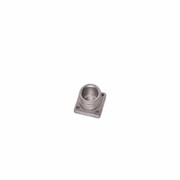
Automobile Transmission Shaft Water Glass Investment Casting
The transmission shaft is composed of a shaft tube, a telescopic sleeve and a universal joint.
DriveShaft is a circular object that connects or assembles various accessories and can be moved or rotated. They are generally made of alloy steel pipes that are lightweight and have good torsion resistance.
Product Introduction
|
Automobile transmission shaft water glass investment casting |
|||||||
|
Item |
Material |
Production Process |
Sintering Temperature |
Mold |
Custom |
||
|
Automobile transmission shaft |
X2CrNi189 |
Investment casting |
1380℃ |
To be customized |
Yes |
||
|
Available Materials |
Carbon Steel, Alloy Steel, Aluminum Alloy, Low Carbon Stainless Steel, Titanium Alloy (Ti, TC4), Copper Alloy, Superalloy (718, 713) |
||||||
|
Smoothness |
Dimensional accuracy |
Product density |
Appearance treatment |
Appropriate weight |
|||
|
Roughness Ra1-5μm |
(±0.1%~±0.5%) |
7.3-7.6/CM³ |
According to customer requirements |
0.03g~400gg |
|||
The transmission shaft is composed of a shaft tube, a telescopic sleeve and a universal joint.
DriveShaft is a circular object that connects or assembles various accessories and can be moved or rotated. They are generally made of alloy steel pipes that are lightweight and have good torsion resistance. For front-engine rear-wheel drive cars, it is the shaft that transmits the rotation of the transmission to the main reducer. It can be several sections connected by universal joints. It is a rotating body with high speed and few supports, so its dynamic balance is crucial. Generally, the drive shaft must undergo a dynamic balancing test before leaving the factory, and be adjusted on the balancing machine.
Effect
The transmission shaft is an important component in the vehicle transmission system that transmits power. Its function is to transmit the engine's power to the wheels together with the gearbox and drive axle, so that the vehicle can generate driving force.
Application
Automobile transmission shaft water glass investment casting special automobile transmission shaft is mainly used in oil tank trucks, fuel trucks, sprinkler trucks, sewage suction trucks, fecal suction trucks, fire trucks, high-pressure cleaning trucks, road tow trucks, aerial work trucks, garbage trucks Waiting for the car model.
Structure
The transmission shaft is composed of a shaft tube, a telescopic sleeve and a universal joint. The telescopic sleeve can automatically adjust the change in the distance between the transmission and the drive axle. The universal joint ensures the change of the angle between the two axes of the transmission output shaft and the drive axle input shaft, and achieves equal angular speed transmission of the two axles.
Universal Joint
The universal joint is a key component on the automobile drive shaft. A car is a moving object. In a rear-drive car, the engine, clutch and transmission are installed on the frame as a whole, and the drive axle is connected to the frame through elastic suspension. There is a distance between the two and needs to be connected. When the car is running, the road surface is uneven and causes bounce.
1. Function
Generally, the universal joint consists of a cross shaft, a cross bearing and a flange fork. The universal joint is a key component on the automobile drive shaft. On front-engine, rear-wheel drive vehicles, the universal joint drive shaft is installed between the transmission output shaft and the drive axle main reducer input shaft; while in front-engine, front-wheel drive vehicles, the drive shaft is omitted and the universal joint is installed Between the front axle half-shaft and the wheels, which are responsible for both driving and steering. When the vehicle is running, uneven road surface will cause bounce, load changes or differences in the installation positions of the two assemblies, which will cause the angle and distance between the transmission output shaft and the drive axle main reducer input shaft to change. Therefore, a "changer" must be used. "Strain" device is used to solve this problem, so there is a universal joint.
2. Transmission characteristics
In cars with front-engine rear-wheel drive (or all-wheel drive), due to suspension deformation during the movement of the car, there is often relative movement between the input shaft of the main reducer of the drive shaft and the output shaft of the transmission (or transfer case). In addition, in order to effectively avoid certain mechanisms or devices (which cannot achieve linear transmission), there must be a device to achieve normal transmission of power, so universal joint transmission appeared. Universal joint transmission must have the following characteristics:
a. Ensure that power can be transmitted reliably when the relative positions of the two connected shafts change within the expected range;
b. Ensure that the two connected axes can operate evenly. The additional load, vibration and noise caused by the angle of the universal joint should be within the allowable range;
c. The transmission efficiency should be high, the service life should be long, the structure should be simple, it should be easy to manufacture and maintain. For automobiles, since the output shaft of a cross-shaft universal joint rotates at unequal speed relative to the input shaft (with a certain angle), double universal joints (or multiple universal joints) must be used for transmission. And arrange the two universal joint forks connected to the transmission shaft on the same plane, and make the angles between the two universal joints equal. This is very important. The included angle of the universal joint should be minimized during design.
Detection Systems

Copper Silica Sol Investment Casting






Send Inquiry
