



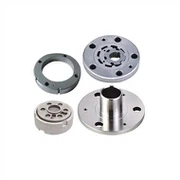
Transplanting Needle Gear PM Sintered Part
This involves the professional field of powder metallurgy, because the density, porosity, material, and heat treatment method of powder metallurgy gears directly affect the hardness and strength. High density means high hardness, small pores have high density, good material, high alloy elements and high hardness. Heat treatment methods generally include carburizing and quenching, carbonitriding, high-frequency quenching, low-frequency quenching, oil quenching, etc. A stable and qualified quenching process keeps the hardness of heat treatment stable.
Product Introduction
|
Transplanting needle gear PM sintered part |
||||||
|
Item |
Material |
Production Process |
Sintering Temperature |
Mold |
Custom |
|
|
Rice transplanter bushing |
45# |
Powder metallurgy pressing |
1180℃ |
To be customized |
Yes |
|
|
Chemical composition |
C:0.42~0.50; Cr:≤0.25; Mn:0.50~0.80; Ni:≤0.25; P:≤0.035; S:≤0.035; Si:0.17~0.37 |
|||||
|
Available Materials |
Low carbon stainless steel, titanium alloy (Ti, TC4), copper alloy, tungsten alloy, hard alloy, high temperature alloy (718, 713) |
|||||
Product advantages
|
Smoothness |
Dimensional accuracy |
Product density |
Appearance treatment |
Appropriate weight |
|
Roughness 1~5μm |
(±0.1%~±0.5%) |
7.3-7.6g/CM³ |
heat treatment/grinding |
0.03g~400g) |
|
Mechanical behavior |
σb\MPa:≥600 σs\MPa:≥355 δ5\%:≥16 ψ\%:≥40 hardness\HB:≤197 The recommended heat treatment temperature for 45 steel stipulated in GB/T699-1999 standard is 850°C for normalizing, 840°C for quenching, and 600°C for tempering, and the performance achieved is yield strength ≥ 355MPa The GB/T699-1999 standard stipulates that the tensile strength of 45 steel is 600MPa, the yield strength is 355MPa, the elongation is 16%, and the reduction of area is 40%. |
|||
|
heat treatment |
Heat treatment process of 45# steel and 40Cr steel quenched and tempered Quenching and tempering is a double heat treatment of quenching and high temperature tempering, the purpose of which is to make the workpiece have good comprehensive mechanical properties. There are two types of quenched and tempered steel: carbon quenched and tempered steel and alloy quenched and tempered steel. Whether it is carbon steel or alloy steel, the carbon content is strictly controlled. If the carbon content is too high, although the strength of the quenched and tempered workpiece is high, the toughness is not enough. If the carbon content is too low, the toughness is increased but the strength is insufficient. In order to obtain good comprehensive performance of the quenched and tempered parts, the carbon content is generally controlled at 0.30~0.50%. During tempering and quenching, the entire cross-section of the workpiece is required to be hardened, so that the workpiece can obtain a microstructure dominated by fine needle-shaped quenched martensite. Through high-temperature tempering, a microstructure dominated by uniformly tempered sorbite is obtained. It is impossible for small factories to conduct metallographic analysis for each furnace, and generally only do hardness testing, that is to say, the hardness after quenching must reach the quenching hardness of the material, and the hardness after tempering should be checked according to the requirements of the diagram. |
|||
Comparison of powder metallurgy gear parts and 45 steel machined gears, Qinhuangdao Zhongwei Precision Machine Parts Co., Ltd. powder metallurgy gear manufacturing.
What is the hardness and strength of powder metallurgy gear parts? Can it be the same as the 45 steel material for machining gears?
This involves the professional field of powder metallurgy, because the density, porosity, material, and heat treatment method of powder metallurgy gears directly affect the hardness and strength. High density means high hardness, small pores have high density, good material, high alloy elements and high hardness. Heat treatment methods generally include carburizing and quenching, carbonitriding, high-frequency quenching, low-frequency quenching, oil quenching, etc. A stable and qualified quenching process keeps the hardness of heat treatment stable.
Heat treatment hardness control of general powder metallurgy products:
Ordinary atomized powder (including carbon steel and copper-carbon alloy steel), the density is above 6.9, and the quenching hardness can be controlled to about HRC30.
Generally pre-alloyed powder (AB powder), the density is above 6.95, and the quenching hardness can be controlled to about HRC35.
High pre-alloyed powder (AE powder), the density is above 6.95, and the quenching hardness can be controlled to about HRC40.
The density and material of the powder metallurgy products of the above materials are stable, and the heat treatment hardness meets the corresponding requirements, so their tensile strength and compressive strength will reach a good peak.
Can the heat treatment hardness of powder metallurgy reach the heat treatment hardness of No. 45 steel?
The answer is: yes!
However, because the density of powder metallurgy products is not as high as that of No. 45 steel, the density of powder metallurgy pressed parts is generally up to 7.2 g/cm³, while the density of No. 45 steel is 7.9 g/cm³. The forced carburizing or high-frequency heat treatment of powder metallurgy exceeds HRC45, which will make the Powder metallurgy products are brittle due to high hardening, resulting in lower strength of powder metallurgy products.
Below we will make a comparison between powder metallurgy molded gears and machining hobbing.
1. The material utilization rate is high, up to 95% or more
2. No or only a small amount of machining is required
3. Parts have good size consistency, stability and high precision.
4. Comparison of strength. Professional powder metallurgy manufacturers design and optimize powder metallurgy molds, and the tensile and compressive strength of the produced gears are close to those of hobbed gears, such as those of automobile gearboxes with relatively high transmission strength. The driven gear is also a powder metallurgy gear. It can be seen that powder metallurgy gears are widely used.
5. Powder compacting adopts mold forming, which can produce complex shapes that cannot be produced by other cutting and hobbing processes.
6. Because it is suitable for mass production, the production efficiency is high and the cost is lower than cutting processing.
7. Suitable for mass production, so the price is absolutely competitive.
Metal Injection Molding Process

Detection Systems




Send Inquiry
