




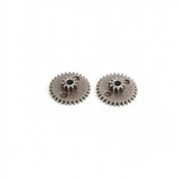
Piston PM Sintered Part
As the output power of the diesel engine continues to increase, the thermal stress and mechanical stress on the piston also increase accordingly, resulting in cracking and ablation of the surrounding wall of the combustion chamber on the top of the piston. The hard oxidized oxide film can effectively improve the heat resistance of the top surface of the aluminum piston. It has an extremely good inhibitory effect on thermal cracking, especially on the tendency of thermal cracking at the edge of the direct injection diesel engine combustion chamber. For this reason, high-power pistons generally need to be anodized.
Product Introduction
|
Piston PM sintered part |
||||||
|
Item |
Material |
Production Process |
Sintering Temperature |
Mold |
Custom |
|
|
Piston powder metallurgy |
40rc |
Powder metallurgy |
1180℃ |
To be customized |
Yes |
|
|
Chemical composition |
C:0.37~0.44 Si:0.17~0.37 Mn:0.50~0.80 Cr:0.80~1.10 Ni:≤0.30 P:≤0.035 S:≤0.035 Cu:≤0.25 Mo:≤0.10 |
|||||
|
Available Materials |
Low carbon stainless steel, titanium alloy (Ti, TC4), copper alloy, tungsten alloy, hard alloy, high temperature alloy (718, 713) |
|||||
Product advantages
|
Smoothness |
Dimensional accuracy |
Product density |
Appearance treatment |
Appropriate weight |
|
Roughness 1~5μm |
(±0.1%~±0.5%) |
92~95% |
According to customer requirements |
0.03g~400g) |
|
mechanical properties |
Sample blank size (mm): 25 heat treatment: Heating temperature for the first quenching (℃): 850; coolant: oil Second quenching heating temperature (°C):- Tempering heating temperature (°C): 520; Tensile strength (σb/MPa): ≥810 (when the actual hardness is 25HRC) Yield point (σs/MPa): ≥785 Elongation after break (δ5/%): ≥9 Reduction of area (ψ/%): ≥45 Impact absorption energy (Aku2/J): ≥47 Brinell hardness (100/3000HBW) (annealed or high temperature tempered state): ≤207 |
|||
As the output power of the diesel engine continues to increase, the thermal stress and mechanical stress on the piston also increase accordingly, resulting in cracking and ablation of the surrounding wall of the combustion chamber on the top of the piston. The hard oxidized oxide film can effectively improve the heat resistance of the top surface of the aluminum piston. It has an extremely good inhibitory effect on thermal cracking, especially on the tendency of thermal cracking at the edge of the direct injection diesel engine combustion chamber. For this reason, high-power pistons generally need to be anodized.
Judge
When the engine is running, the piston knocks on the cylinder partly. The abnormal sound of the piston knocking on the cylinder occurs on the upper part of the cylinder, which is a rhythmic "click" sound similar to hitting the concrete floor with a small hammer. When the engine is idling, the sound is distinct and clear. Especially when the engine is running at low temperature, the sound is obvious. After the temperature rises, the sound decreases or even disappears.
Judgment method of piston knocking cylinder:
(1) Oil cut off cylinder by cylinder. Take the method of cutting off the oil cylinder by cylinder to determine the position of the knocking cylinder. If the oil is cut off to a certain cylinder, the sound decreases or disappears obviously, and when the oil supply is restored, you can hear the obvious "click" sound, indicating that the cylinder The piston hits the cylinder.
(2) In order to further confirm that the piston of the cylinder knocks the cylinder, the fuel injector of the cylinder can be removed, and a small amount of CD-grade supercharged engine oil can be added to the cylinder (for sealing), and then the fuel injector can be installed to start the engine. , the knocking sound disappears or weakens, and the knocking sound reappears after running for a while, it is undoubtedly that the piston of the cylinder is knocking on the cylinder.
The main reasons for the piston knocking on the cylinder are as follows:
The gap between the piston and the cylinder wall is too large. The standard clearance between piston skirt and cylinder of WD615 series engine is 0.143-0.182, and the maximum wear limit is 0.35-0.40.
(2) After the engine has been running for a period of time, the piston of the cylinder is worn, and the lubrication is not good. The fit gap between the piston and the cylinder increases due to wear, and a serious step appears slightly below the first air ring, causing the piston to knock Hit the cylinder to make abnormal noise.
(3) After the piston skirt and the cylinder have been in operation for a period of time, they are severely worn, resulting in severe out-of-roundness and knocking on the cylinder.
(4) Individual connecting rods are deformed due to various reasons, resulting in eccentric wear of the piston, enlarged clearance and knocking on the cylinder. Piston knocking on the cylinder will lead to high fuel consumption of the engine, engine oil leakage, high oil consumption and poor economy. When the piston hits the cylinder severely, it will also break the piston and damage the cylinder, so that the connecting rod will break and the cylinder block will be damaged.
Deal With
The following methods can be used to deal with the piston knocking cylinder:
(1) After the engine is started, there is a knocking sound when it is running at low temperature. After the temperature is normal, the sound disappears. You can not deal with it temporarily and continue to run.
(2) When the engine temperature is normal, there is obvious knocking sound, try to avoid high-speed operation, and disassemble and repair as soon as possible.
(3) After removing the cylinder head and pulling out the piston, if the cylinder is found to be seriously out of round, strained, or the gap between the piston and the cylinder is too large, it should be replaced, and the cylinder liner, piston and piston ring should be replaced.
(4) If the connecting rod is found to be deformed, it should be replaced as much as possible.
Piston connecting rod assembly
The main points of assembly of diesel generator piston connecting rod group are as follows:
1. Press-fit the copper sleeve of the connecting rod. It is best to use a press when installing the copper sleeve of the connecting rod, and it can also be done with a vise. Do not hit it hard with a hammer; the oil hole or oil groove on the copper sleeve should be aligned with the oil hole on the connecting rod to ensure its lubrication.
2. Assemble the piston and connecting rod. When assembling the piston and connecting rod, attention should be paid to their relative position and direction.
3. Install the piston pin skillfully. The piston pin and the pin hole are an interference fit. When installing, put the piston in water or engine oil and heat it evenly to 90°C~100°C. After taking it out, put the tie rod at an appropriate position between the holes of the piston pin seat, and then install the piston pin coated with engine oil in the predetermined direction. Insert it into the piston pin hole and the copper sleeve of the connecting rod.
Fourth, the installation of the piston ring. When installing piston rings, pay attention to the position and sequence of each ring.
5. Install the connecting rod group
Metal Injection Molding Process

Detection Systems



Send Inquiry
