


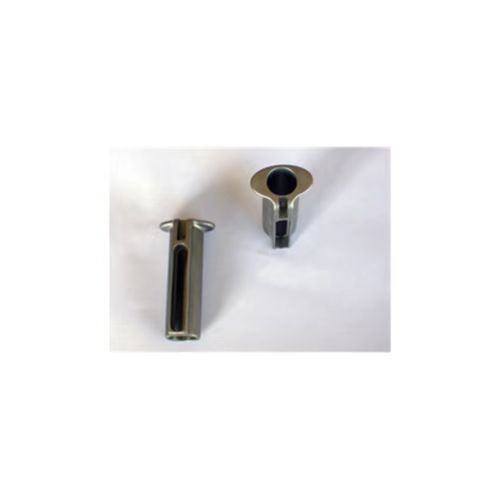
Kovar MIM Parts
The performance test samples for the expansion coefficient and low temperature microstructure stability specified in the standard are heated to 900℃±20℃ in a hydrogen atmosphere, kept for 1h, then heated to 1100℃±20℃, and kept for 15min, at a temperature not greater than 5℃/min The speed is cooled to below 200 ℃.
Introduction of Kovar Metal Injection Molded Parts
Kovar MIM Parts | |||||||||
Item | Material | Production Process | Sintering Temperature | Mold | Custom | ||||
Kovar alloy | Kovar alloy | Metal Injection Molding | 1550℃ | To be customized | Yes | ||||
Chemical Composition | C≤0.03% Mn≤0.50% Si≤0.30% P≤0.020% S≤0.020% Cu≤0.20% Cr≤0.20% Mo≤0.20% | ||||||||
Heat treatment system | The performance test samples for the expansion coefficient and low temperature microstructure stability specified in the standard are heated to 900℃±20℃ in a hydrogen atmosphere, kept for 1h, then heated to 1100℃±20℃, and kept for 15min, at a temperature not greater than 5℃/min The speed is cooled to below 200 ℃. | ||||||||
Available Materials | Low carbon stainless steel, titanium alloy (Ti, TC4), copper alloy, tungsten alloy, cemented carbide, high temperature alloy (718, 713) | ||||||||
Finish | Dimensional Accuracy | Product Density | Appearance Treatment | Appropriate Weight | |||||
Roughness 1~5μm | (±0.1%~±0.5%) | 95~100% | Grinding | 0.03g~400g) | |||||
Qinhuangdao Zhongwei Precision Machinery Co., Ltd. is a collection of copper alloy metal injection molding, iron-based metal injection molding, stainless steel-based metal injection molding, aluminum alloy metal injection molding, nickel alloy metal injection molding, cobalt alloy metal injection molding, tungsten alloy metal injection molding A comprehensive high-tech enterprise integrating R&D, production and sales of injection molding, cemented carbide metal injection molding, and powder metallurgy structural parts.
Product Introduction
1. Implementation standards: the company strictly implements ISO9001, ISO14001, IATF16949 certification, and products have passed ROHS, FDA EU certification, etc.
2. Kovar MIM Parts material standards: ISO, GB, ASTM, SAE, EN, DIN, BS, AMS, JIS, ASME, DMS, TOCT, GB
3. Main process: metal injection molding MIM, powder metallurgy PM, investment casting, die-casting aluminum
4. Available materials for powder metallurgy:
Copper alloys, iron bases, titanium alloys, stainless steel bases, aluminum alloys, nickel alloys, cobalt alloys, tungsten alloys, cemented carbides, hydroxy alloys, soft magnetic materials and 3D printing can be customized according to customer requirements.
4J29 alloy is also known as Kovar alloy. The alloy has a linear expansion coefficient similar to that of borosilicate hard glass at 20-450°C, a higher Curie point, and good low-temperature microstructure stability.
Advantages: good low temperature tissue stability
Applicable instruments: instruments containing mercury discharge
Material grade: 4J29
Technical standard: "Fe-Ni-Co glass sealing alloy 4J29 and 4J44 technical conditions"
4J29 alloy is also known as Kovar alloy. The alloy has a linear expansion coefficient similar to that of borosilicate hard glass at 20-450°C, a higher Curie point, and good low-temperature microstructure stability. The oxide film of the alloy is dense and can be well wetted by glass. It does not interact with mercury, and is suitable for use in meters containing mercury discharge. It is the main sealing structure material of electric vacuum devices.
●Similar grades
Russia United States United Kingdom Japan France Germany
29HК Kovar Nilo K KV-1 Dilver P0 Vacon 12
29HК-BИ Rodar KV-2
Techallony Glasseal 29-17 Telcaseal KV-3 Dilver P1 Silvar 48
●Technical standard
YB/T 5231-1993 "Fe-Ni-Co glass sealing alloy 4J29 and 4J44 technical conditions".
●Chemical composition
C≤0.03% Mn≤0.50% Si≤0.30% P≤0.020% S≤0.020% Cu≤0.20% Cr≤0.20% Mo≤0.20%
Ni=28.5~29.5% Co=16.8~17.8%
Fe = surplus
Under the condition that the average linear expansion coefficient reaches the standard, the content of nickel and cobalt is allowed to deviate from the range specified in Table 1-2. The content of aluminum, magnesium, zirconium and titanium should not exceed 0.10% each, and the total amount should not exceed 0.20%.
●Heat treatment regime
The performance test samples for the expansion coefficient and low temperature microstructure stability specified in the standard are heated to 900℃±20℃ in a hydrogen atmosphere, kept for 1h, then heated to 1100℃±20℃, and kept for 15min, at a temperature not greater than 5℃/min The speed is cooled to below 200 ℃.
●Application overview
The alloy is a typical Fe-Ni-Co hard glass sealing alloy commonly used in the world. It has been used for a long time in the aviation factory with stable performance. It is mainly used for glass sealing of electric vacuum components such as launch tubes, oscillator tubes, ignition tubes, magnetrons, transistors, sealed plugs, relays, integrated circuit lead wires, chassis, shells, brackets, etc. In the application, the selected glass should be matched with the expansion coefficient of the alloy. Strictly test its low temperature tissue stability according to the use temperature. Appropriate heat treatment should be carried out during processing to ensure that the material has good deep drawing properties. When using forgings, their air tightness should be strictly checked.
●Organizational structure
After the alloy is treated according to the heat treatment system specified in 1.5, and then frozen at -78.5 ℃, martensitic structure should not appear for more than or equal to 4h. However, when the alloy composition is not appropriate, different degrees of austenite (γ) to acicular martensite (α) transformation will occur at room temperature or low temperature, and the transformation will be accompanied by volume expansion. The expansion coefficient of the alloy increases accordingly, resulting in a sharp increase in the internal stress of the sealing part, and even partial damage. The main factor affecting the low temperature microstructure stability of the alloy is the chemical composition of the alloy. It can be seen from the Fe-Ni-Co ternary phase diagram that nickel is the main element to stabilize the γ phase, and a high nickel content is conducive to the stability of the γ phase. As the total deformation rate of the alloy increases, its microstructure tends to be more stable. Alloy composition segregation may also cause localized γ→α transformation. In addition, the coarse grains will also promote the γ→α transformation.
In the electronics industry, the packaged chips and some components need to be electrically connected to other circuits through lead frames. With the development of large-scale integrated circuits and ultra-large-scale integrated circuits, the wiring density of circuits is getting higher and higher. The requirements for the shape and density of the lead frame (line width and line spacing) are becoming more and more complex and sophisticated. According to the purpose and object of use, it is often necessary to carry out electroplating treatment on the surface of 4J29 alloy parts. The selection of specific plating species and the determination of electroplating process should be determined to meet the specific use requirements. For 4J29 alloy as a lead frame, more It is electroplating Ni/Au or Ni/Pd/Au process.
The main purpose of this research is to solve the technical problem that has plagued an enterprise for a long time, that is, 4J29 alloy thin lead frame often occurs in the process of electroplating Ni/Au. The product rate reaches 60%. Through the production site investigation, it was found that the thin line fracture of the plated parts and the local cracking of the coating mainly occurred in the nickel electroplating link. After preliminary analysis, it is determined that the main reason for the above-mentioned quality problems may be the adverse effects caused by "internal stress". On the basis of reviewing a large number of literatures, this research group minimizes the internal stress of the coating by changing the pre-plating treatment process, the composition and process conditions of the electroplating solution, especially the selection and use of additives. The test successfully solved the above-mentioned quality problems, and also indirectly proved that "internal stress" is the main reason for the cracking of the coating. After the actual production and application of the enterprise, the effect is remarkable, and the defective rate is stably controlled below 2%.
1. The experiment adopts the method of comparison, carefully observe the appearance quality of the thin lead coating before and after the process change or adjustment through a 200 times magnifying glass, and then go through the single-piece bending experiment to observe whether the thin wire is broken or cracked. The number of thin lines is counted, and the defective rate is calculated. The defective rate = the number of defective thin lines per batch of experiments / the total number of thin lines in each batch of experiments. 1.1 Material preparation and process experiment The 4J29 alloy lead frame original sheet used in the experiment is provided by a company, the size of a single sheet is 1.5 cmx1.2 cm, the lead frame line width is 0.1 ~ 0.2 mm, and the line spacing is 1.5 cm x 1.2 cm. for O. 33 ~ 0.38 mm, the thickness is 0.2 mm, and the number of single-piece lines is 24. The company purchased 4J29 sheets by itself and sent it to an etching factory for etching. The etched thin lead frames were returned to the company for self-plating. After on-site investigation, the etching plant was made by photochemical pattern transfer and acid etching technology. The production process is as follows: 4J29 sheet - rinsing - filming - exposure - developing - etching - touching - rinsing - drying.
The chemical materials used in the experiments are all electroplating grades. The electroplating process is: frame - heat treatment - ultrasonic degreasing - water washing - electrolytic degreasing - water washing - water washing - etching - water washing - nickel electroplating - water washing - activation - water washing - gold electroplating - sealing - water washing - drying - inspection
1.2 Electroplating process specification See the process specification for heat treatment of the original sheet.
The purpose of ultrasonic degreasing is to remove all kinds of dirt on the surface of the parts. The composition and process conditions of the working fluid are: trisodium phosphate 15.0-20.0 g/L, sodium carbonate 10.0-15.0 g/L , OP-10 0.5-1.0 g/L, sodium dodecylbenzene sulfonate 0.5-1.0 g/L, temperature 45-50 ℃, time 10-15 min, ultrasonic frequency 30 kHz . Electrochemical degreasing is carried out on the basis of ultrasonic degreasing, in order to achieve the purpose of completely removing the dirt on the surface of the parts. In order to prevent the occurrence of "hydrogen embrittlement" from affecting the stress of the workpiece, this process directly adopts anodic electrolytic degreasing. By selecting appropriate additives and controlling the anode current density, the oxygen (or oxygen) generated by anodic electrolytic degreasing can prevent the parts from being over-oxidized. corrosion.
Its working fluid composition and process conditions are: sodium hydroxide 20.0-25.0 g/L, sodium metasilicate pentahydrate 10.0-15.0 g/L, sodium dodecyl sulfate O. 5~1.0 g/L, water softener 3.0~5.0 g/L, temperature 40~50℃, current density 2.0~5.0 A/dm, time 20~30 s, anode material It is a stainless steel sheet. The electroplating solution with nickel sulfamate as the main salt is used.
Using cyanide weak acid gold plating solution, the composition and process conditions of gold plating solution are: potassium gold cyanide 12.0-15.0 g/L, potassium dihydrogen phosphate 2.0-4.0 g/L, lemon Potassium acid 20~25 g/L, antimony potassium tartrate 5.0-6.0 g/L, pH value 5-6, temperature 40-50 ℃, cathode current density 0.2-1.0 A/dm, anode The material is platinum titanium mesh.
Thoroughly clean with pure water or hot pure water to eliminate residual salts on the surface of the coating, and if necessary, chemical passivation can be performed to prevent discoloration.
2. Results and discussion 2.1 The influence of heat treatment of the original sheet on the quality of the coating The characteristics of lead frame materials include primary and secondary characteristics. Primary properties refer to the physical, mechanical and chemical properties of materials. Secondary properties refer to stamping, etching, electroplating, brazing, encapsulation and corrosion resistance properties. After the lead frame sheet is processed by stamping, etching, etc., the surface residual stress value is large and uneven, which is the key to causing poor secondary characteristics.
In this study, one of the methods to improve the existing 4J29 alloy frame electroplating nickel-gold (or nickel-palladium-gold) process of an enterprise is to heat treatment before the 4J29 alloy frame electroplating, in order to eliminate the residual machining stress in the parts after the parts are formed. And the effect of "hydrogen embrittlement" stress on parts that may occur during acid etching ll . The selection principle of the heat treatment temperature is: on the premise of ensuring that the purpose of the treatment is achieved, the grains will not grow too much. After the cold alloy is annealed at 700-1000 ℃, the mechanical properties will change l1. Therefore, the 4J29 alloy frame in this study is not The stress heat treatment temperature is 420~450℃, and the heat preservation is 120 rain. The test results are shown in Table 3. There are 10 single pieces and 240 thin leads, and the number of the following studies is the same.
The experimental results show that after the heat treatment of the frame is nickel-plated, the fracture of the thin lines is basically eliminated, the local cracks in the electroplated nickel layer are also significantly reduced, and the crack width is narrowed, but the problem of product quality cannot be effectively solved.
2.2 The influence of the composition of the electroplating solution on the quality of the coating
2.2.1 The influence of the type of electroplating solution on the quality of the coating There are many types of nickel-plating electroplating solutions, commonly used are sulfate type, sulfate monochloride type, chloride type and sulfamate type, among which sulfamate Nickel acid coatings are much less stressed than other types of nickel coatings [02]. The sulfamate-type nickel plating process designed in this study was used to conduct a comparative experiment with the existing Watt-type nickel plating process of an enterprise. The experimental results show that when the sulfamate type electroplating solution with relatively small internal stress of the coating is selected to replace the Watt type electroplating solution, the defective rate of the product is correspondingly reduced.
2.2.2 The influence of the types of additives on the quality of the coating, the other components and working conditions of the sulfamate electroplating solution are unchanged, and the influence of the types of the additives on the quality of the coating is studied. The experimental results show that the other conditions remain unchanged. Under the following conditions, 1,5-naphthalene disulfonic acid thiourea or saccharin is selected as the additive plating solution, and the defective rate of fine lines is relatively low. Comparing the brightening effect of the nickel-plated layer, the brightening effect of using saccharin as an additive is significantly higher than that of other additives.
2.2.3 Influence of additive content on coating quality The other components and working conditions of the sulfamate electroplating solution in Table 2 were fixed, and the influence of the content of the electroplating additive saccharin on the coating quality was studied. Under the condition that other conditions remain unchanged, the effect of saccharin concentration on the quality of nickel-plated layer is obvious. With the increase of concentration, the defective rate decreases and appears to a minimum value. When the mass concentration increases from 0.4 g/L to 0 .5 g/L, the defective rate increases again. Therefore, the mass concentration of saccharin should be 0.3-0.4 g/L.
2.3 Influence of electroplating working conditions on coating quality 2.3.1 Influence of cathode current density on coating quality The composition, concentration and working conditions of the sulfamate electroplating solution in Table 2 remain unchanged, among which the additives (saccharin) ) mass concentration of 0.3-0.4 g/L, the influence of current density on the coating quality was studied, and the results are shown in Table 7 and Figure 2. It can be seen from Fig. 2 that under the condition that other conditions remain unchanged, the influence of current density on the quality of nickel plating layer is more obvious. When 0 A/dm increased to 6.0 A/dm, the defective rate increased significantly. Therefore, the control current density should be 3.0-5.0 A/dm.
2.3.2 The influence of the temperature of the electroplating working solution on the quality of the coating layer The other components, contents and working conditions of the sulfamate electroplating solution in Table 2 remain unchanged, and the mass concentration of the additive (saccharin) is 0.3- 0.4 g/L, the current density is 3.0-4.0 A/dm, the effect of temperature on the coating quality is studied, and the results are shown in Table 8 and Figure 3. It can be seen from Figure 3 that under the condition that other conditions remain unchanged, the influence of the temperature of the electroplating solution on the quality of the nickel-plated layer is obvious. As the temperature increases, the defective rate decreases and appears to a minimum value. When the temperature reaches 70°C, the defective rate increases significantly. Therefore, it is appropriate to control the temperature at 50 to 60 °C.
3 Conclusions 1) A new electroplating process method was developed to prevent the fine line breakage and the cracking of the electroplating layer after electroplating of the 4J29 lead frame. 2) The best process for heat treatment is: temperature 420-450 °C, holding time 120 min, and cooling to room temperature by natural cooling. The best working conditions of nickel electroplating are: nickel sulfamate 250-350 g/L, boric acid 25-35 g/L, wetting agent (K12) 0.01 g/L, saccharin 0.3-0.4 g /L, pH value 3~5, temperature 50~60℃, current density 3.0-55.0 A/dm. 3) After the actual use of the enterprise, and sampling 10 times per single piece 90. In the bending experiment, the product defect rate of the new process is stably controlled below 2%, and other performance tests meet the product quality requirements.


Send Inquiry
