

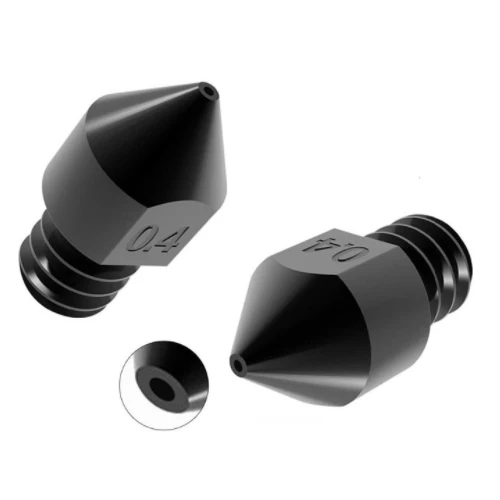


3D Printer Nozzle PM Sintered Parts
Cemented carbide is a metal material made of one or more carbides of refractory metals and binder metals by powder metallurgy. Cemented carbide sintering molding is pressing the powder into a billet, then heating it to a certain temperature (sintering temperature) in a sintering furnace, keeping it for a certain period of time (holding time), and then cooling it down to obtain a cemented carbide material with the required properties.
Product Introduction
|
3D printer nozzle PM sintered parts |
||||||||
|
Item |
Material |
Production Process |
Sintering Temperature |
Mold |
Custom |
|||
|
3D printer nozzle powder metallurgy |
Carbide |
Powder metallurgy pressing |
1380℃ |
To be customized |
Yes |
|||
|
Chemical composition |
C:0.42~0.50; Cr: ≤0.25; Mn: 0.50~0.80; Ni: ≤0.25; P: ≤0.035; S: ≤0.035; Si: 0.17~0.37 |
|||||||
|
Available Materials |
Low carbon stainless steel, titanium alloy (Ti, TC4), copper alloy, tungsten alloy, hard alloy, high temperature alloy (718, 713) |
|||||||
|
Smoothness |
Dimensional accuracy |
Product density |
Appearance treatment |
Appropriate weight |
||||
|
Roughness 1~5μm |
(±0.1%~±0.5%) |
7.3-7.6g/CM³ |
According to customer requirements |
0.03g~400g) |
||||
Parts sintering principle
Cemented carbide is a metal material made of one or more carbides of refractory metals and binder metals by powder metallurgy.
Cemented carbide sintering molding is pressing the powder into a billet, then heating it to a certain temperature (sintering temperature) in a sintering furnace, keeping it for a certain period of time (holding time), and then cooling it down to obtain a cemented carbide material with the required properties.
When manufacturing cemented carbide, the particle size of the selected raw material powder is between 1 and 2 microns, and the purity is very high. Raw materials are compounded according to the specified composition ratio, added alcohol or other media and wet-milled in a wet ball mill to make them fully mixed and crushed, after drying and sieving, adding wax or glue and other molding agents, and then drying and filtering Sift the mix. Then, the mixture is granulated and pressed, and when heated to close to the melting point of the bonding metal (1300-1500°C), the hardened phase and the bonding metal form a eutectic alloy. After cooling, the hardened phase is distributed in the grid composed of bonding metals, and they are closely connected with each other to form a firm whole. The hardness of cemented carbide depends on the hardening phase content and grain size, that is, the higher the hardening phase content and the finer the grain size, the greater the hardness. The toughness of cemented carbide is determined by the binder metal, the higher the binder metal content, the greater the flexural strength.
Four basic stages of the cemented carbide sintering process
1) In the stage of removing the molding agent and pre-sintering, the sintered body undergoes the following changes at this stage:
Removal of molding agent, as the temperature rises in the initial stage of sintering, the molding agent gradually decomposes or vaporizes, and the sintered body is excluded. The type, quantity, and sintering process vary. The oxides on the surface of the powder are reduced. At the sintering temperature, hydrogen can reduce the oxides of cobalt and tungsten. If the forming agent is removed and sintered in a vacuum, the carbon-oxygen reaction is not strong. The contact stress between powder particles is gradually eliminated, the bonded metal powder begins to recover and recrystallize, surface diffusion begins to occur, and the compact strength increases.
2) Solid phase sintering stage (800°C--eutectic temperature)
At the temperature before the liquid phase appears, in addition to continuing the process that occurred in the previous stage, the solid phase reaction and diffusion intensify, the plastic flow is enhanced, and the sintered body shrinks significantly.
3) Liquid phase sintering stage (eutectic temperature - sintering temperature)
When the liquid phase appears in the sintered body, the shrinkage is completed quickly, followed by crystallization transformation to form the basic structure and structure of the alloy.
4) Cooling stage (sintering temperature - room temperature)
At this stage, the structure and phase composition of the 3D printer nozzle PM sintered parts change with the cooling conditions. This feature can be used to heat treat the cemented carbide to improve its physical and mechanical properties.
Metal Injection Molding Process

Detection Systems




Send Inquiry
