




Brass Machine Tool Valve Body Lost Wax Castings
Material. Bronze valves are mainly composed of copper, tin, and small amounts of other elements (such as lead, zinc, aluminum, beryllium, manganese, etc.), while brass valves are mainly composed of copper and zinc.
Product Introduction
|
Brass machine tool valve body lost wax castings |
|||||||
|
Item |
Material |
Production Process |
Sintering Temperature |
Mold |
Custom |
||
|
Brass machine tool valve body lost wax castings |
Investment casting |
1380℃ |
To be customized |
Yes |
|||
|
Available Materials |
Low carbon stainless steel, titanium alloy (Ti, TC4), copper alloy, tungsten alloy, cemented carbide, high temperature alloy (718, 713) |
||||||
|
Smoothness |
Dimensional accuracy |
Product density |
Appearance treatment |
Appropriate weight |
|||
|
Roughness 1~5μm |
(±0.1%~±0.5%) |
7.3-7.6g/CM³ |
According to customer requirements |
0.03g~400g |
|||
Brass machine tool valve body and water glass investment casting parts
Materials and performance
The main difference between bronze valves and brass valves lies in their material and performance. Here is a detailed introduction:
• Material. Bronze valves are mainly composed of copper, tin, and small amounts of other elements (such as lead, zinc, aluminum, beryllium, manganese, etc.), while brass valves are mainly composed of copper and zinc.
Performance. Bronze valves, due to their high copper content, usually have higher strength and hardness, can withstand the action of high-pressure liquids or gases, and have good corrosion resistance. They are suitable for high-pressure, high-temperature, and high viscosity liquids or gases in harsh environments; Although brass valves also have certain corrosion resistance, their corrosion resistance is relatively poor, and they are suitable for low-pressure, low viscosity liquids or gases, such as cold and hot water systems, air conditioning systems, etc.
• Purpose. Bronze valves are suitable for high viscosity media, high temperature and pressure environments, and can withstand high-strength power loads and high-frequency operations; Brass valves are suitable for low-pressure pipelines, with good malleability and processing performance, lower manufacturing costs, and are suitable for manufacturing valves with low pressure and universal performance.
Tin brass has good corrosion resistance and is widely used in the manufacturing of ship parts. Aluminum in aluminum brass can improve the strength and hardness of brass, and enhance its corrosion resistance in the atmosphere. Aluminum brass is used to manufacture corrosion-resistant parts. Silicon in silicon brass can improve the mechanical properties, wear resistance, and corrosion resistance of copper. Silicon brass is mainly used in the manufacturing of ship parts and chemical machinery parts.
Bronze
Bronze originally referred to copper tin alloy, but in industry, copper alloys containing aluminum, silicon, lead, beryllium, manganese, etc. are commonly referred to as bronze. Therefore, bronze actually includes tin bronze, aluminum bronze, aluminum bronze, beryllium bronze, silicon bronze, lead bronze, etc. Bronze is also divided into two categories: pressure processed bronze and cast bronze.
(1) Tin bronze refers to a copper based alloy with tin as the main alloying element. Tin bronze used in industry has a tin content mostly between 3% and 14%. Tin bronze with a tin content less than 5% is suitable for cold working use; Tin bronze with a tin content of 5% to 7% is suitable for hot processing; Tin bronze with a tin content greater than 10% is suitable for casting. Tin bronze is widely used in industries such as shipbuilding, chemical engineering, machinery, and instrumentation, mainly for manufacturing wear-resistant parts such as bearings and shaft sleeves, elastic components such as springs, as well as corrosion-resistant and anti magnetic parts.
(2) Aluminum bronze refers to a copper based alloy with aluminum as the main alloying element. The mechanical properties of aluminum bronze are higher than those of brass and tin bronze. The aluminum content of aluminum bronze used in practical applications is between 5% and 12%, and aluminum bronze with aluminum content of 5% to 7% has good plasticity and is suitable for cold working. After the aluminum content exceeds 7% to 8%, the strength increases, but the plasticity sharply decreases, so it is mostly used in the as cast or after hot processing. The wear resistance and corrosion resistance of aluminum bronze in atmospheric, seawater, seawater carbonation, and most organic acids are higher than those of brass and tin bronze. Aluminum bronze can be used to manufacture high-strength wear-resistant parts such as gears, shaft sleeves, and worm gears, as well as high corrosion-resistant elastic components.
(3) Beryllium bronze refers to copper alloys with beryllium as the basic element. The beryllium content of beryllium bronze is 1.7% to 2.5%. Beryllium bronze has high elastic and fatigue limits, excellent wear resistance and corrosion resistance, good conductivity and thermal conductivity, as well as advantages such as no magnetism and no spark generated when subjected to impact. Beryllium bronze is mainly used to make important springs for precision instruments, clock gears, bearings and bushings for high-speed and high-pressure operation, as well as important components such as welding machine electrodes, explosion-proof tools, and navigation compasses.
We are the manufacturer of Brass machine tool valve body lost wax castings, if you need more information please contact us!
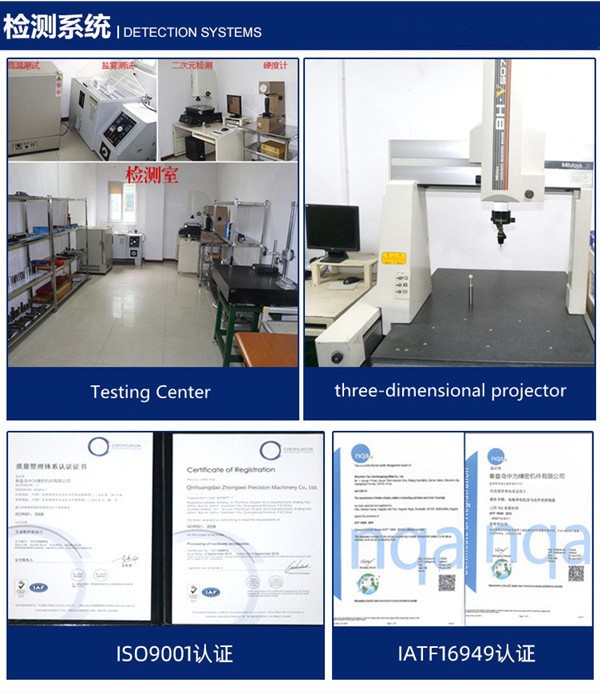
Detection Systems
Copper Silica Sol Investment Casting


Send Inquiry
