




Truck Hitch Receiver Shank Investment Casting
Trucks are an important part of modern business. Trucks use their large interior spaces to transport materials and goods across continents. These commodities are loaded and unloaded at various facilities including manufacturers, ports, distributors, retailers and end users. Large over-the-road (otr) trucks usually consist of a tractor or cab unit and a separate detachable trailer.
Product Introduction
|
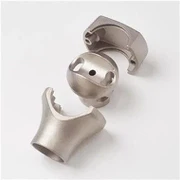
Truck Hitch Receiver Shank Investment Casting |
|||||||
|
Item |
Material |
Production Process |
Sintering Temperature |
Mold |
Custom |
||
|
Truck Hitch Receiver Shank |
Investment casting |
1380℃ |
To be customized |
Yes |
|||
|
Available Materials |
Carbon Steel, Alloy Steel, Aluminum Alloy, Low Carbon Stainless Steel, Titanium Alloy (Ti, TC4), Copper Alloy, Superalloy (718, 713) |
||||||
|
Smoothness |
Dimensional accuracy |
Product density |
Appearance treatment |
Appropriate weight |
|||
|
Roughness Ra1-5μm |
(±0.1%~±0.5%) |
7.3-7.6/CM³ |
According to customer requirements |
0.03g~400gg |
|||
Trucks are an important part of modern business. Trucks use their large interior spaces to transport materials and goods across continents. These commodities are loaded and unloaded at various facilities including manufacturers, ports, distributors, retailers and end users. Large over-the-road (otr) trucks usually consist of a tractor or cab unit and a separate detachable trailer. The trailer is detachably connected to the cab by a hitch system, in which all The hitch system is composed of a so-called fifth wheel and a kingpin. More specifically, a kingpin is formed along the front end of the trailer bottom, and the cab includes a towing seat including a pad and a receiving groove for the kingpin. Because of the curves required on the road, when connecting, the king pin steps into the slot of the towing seat in a way that allows the trailer to rotate axially relative to the cab. The cab provides power (e.g., via electric motor, pneumatic pressure source, etc.) to propel itself and the attached trailer. Therefore, a plurality of removable connections are formed between the cab and the trailer for the transmission of electrical power and pneumatic pressure. Air pressure is often used in conjunction with the cab's own (separate) braking system to operate the emergency and service brakes. Electricity powers interior lighting, exterior signal and running lights, liftgate motor, landing gear motor (if applicable), etc.
Throughout the modern era of land transportation, connecting electrical and pneumatic lines, raising and lowering the landing gear, operating the trailer's rear swing door (swingdoor), and inspecting the vehicle were all done manually by the driver. For example, when the cab and trailer need to be connected, after backing up to the trailer to connect the truck hitch to the trailer kingpin, the driver is required to leave the cab to complete all of this. More specifically, the driver must crank up the landing gear so that the kingpin drops into the tow seat to fully engage it, and climbs to the rear of the cab chassis to grab a set of retractable hoses and cables by hand from the rear of the cab. (transporting air and electricity) and fixing them to the corresponding connecting components on the front of the trailer body. When disconnecting the trailer from the cab, the process is reversed. That is, the operator must climb up and disconnect the hoses/cables, get them in place, and then crank down the landing gear to raise the kingpin to disengage the tow mount. Assuming a trailer is to be unloaded (for example, after backing into a loading dock), the driver would need to walk to the rear of the trailer to unlock the trailer's swing doors, rotate them rearward 270 degrees, and then (usually) secure each door to The side of the trailer. Depending on the type of trailer, the rear door may roll up (rather than swing open) and/or use other methods to provide access to cargo. Other features, such as loading dock alarm systems, stops that prevent the trailer from accidentally rolling, and locking mechanisms that lock the trailer to the dock, all require human operation and monitoring to ensure proper functionality and safety. When trucks and trailers are reversing, their large length, width, and height create large blind spots and present many similar safety hazards.
A further challenge for trucking lies in intermodal operations, where yard trucks are used to move containers between various modes of transportation. More specifically, in rail yards, containers must be moved between rail cars and trailers in a specific order and direction (front to back when the door is at the rear). Likewise, sequence and direction are important when working in terminal yards where containers are unloaded from ships.
Over the years, many solutions have been proposed to automate one or more of the above processes, thereby reducing driver labor. However, no matter how effective these solutions are in theory, the trucking industry still relies on the manual methods described above to connect and disconnect trailers and tractors/cabs.
With the advent of self-driving vehicles, there is a desire to further automate many functions that have traditionally been performed manually or out of convenience.
Detection Systems

Copper Silica Sol Investment Casting



Send Inquiry
