


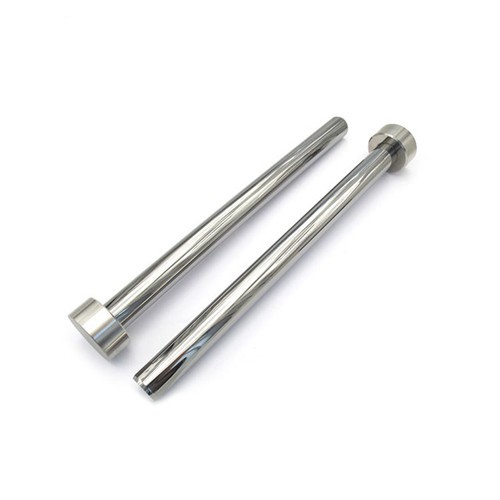


Hard Alloy Strong Valve Stem PM Sintered Parts
A tungsten carbide valve stem, as the name implies, is a valve stem made of carbide material, and the valve stem is an important part of the valve, which requires sufficient strength and good impact toughness. For transmission, the upper part is connected to the actuator or the handle, and the lower part directly drives the valve core to move or rotate, so as to realize the valve switch or adjustment function.
Product Introduction
|
Hard alloy strong valve stem PM sintered parts |
||||||||
|
Item |
Material |
Production Process |
Sintering Temperature |
Mold |
Custom |
|||
|
Carbide Strong Stem Powder Metallurgy |
Carbide |
Powder metallurgy pressing |
1680℃ |
To be customized |
Yes |
|||
|
Available Materials |
Low carbon stainless steel, titanium alloy (Ti, TC4), copper alloy, tungsten alloy, hard alloy, high temperature alloy (718, 713) |
|||||||
|
Smoothness |
Dimensional accuracy |
Product density |
Appearance treatment |
Appropriate weight |
||||
|
Roughness 1~5μm |
(±0.1%~±0.5%) |
7.3-7.6g/CM³ |
According to customer requirements |
0.03g~400g) |
||||
A tungsten carbide valve stem, as the name implies, is a valve stem made of carbide material, and the valve stem is an important part of the valve, which requires sufficient strength and good impact toughness. For transmission, the upper part is connected to the actuator or the handle, and the lower part directly drives the valve core to move or rotate, so as to realize the valve switch or adjustment function.
The valve stem is not only a moving part, a stressed part but also a sealing part during the opening and closing process of the valve. At the same time, it is impacted and corroded by the medium and also has friction with the filler. Therefore, when selecting the material of the valve stem, it must be ensured that it has sufficient strength, good impact toughness, scratch resistance, and corrosion resistance at the specified temperature. The valve stem is a vulnerable part, and the machining performance and heat treatment performance of the material should also be paid attention to when selecting it.
Hard alloy strong valve stem PM sintered parts can meet the requirements of wear-resistant parts, with high hardness, high strength, and strong stability. The main features of the cemented carbide valve stem are that they can be compressed, they can keep warm well, and they are not easy to corrode and rust. It has the sealing function on both sides, it is relatively resistant to wear, and its service life is relatively long.
Carbide processing valve process and technical requirements
A valve is a device used to control the direction, pressure, and flow of a fluid in a fluid system. It is a device that makes the medium (liquid, gas, powder) in the piping and equipment flow or stops and controls its flow. The application range of the valve is very wide. Therefore, it is particularly important for the cemented carbide processing of valves.
Valves used in fluid control systems, from the simplest globe valve to the various valves used in extremely complex automatic control systems, have a wide variety of types and specifications, so the statements are not completely consistent, and some are classified according to their use and function ( Cut-off valves, regulating valves, check valves, diverter valves, safety valves), some are classified according to the material of the valve body (non-metal material valves, metal material valves, metal valve body lining valves), but currently, The most commonly used classification methods in the world and in China are based on the principle, effect and structure. Generally, gate valves, globe valves, throttle valves, surface valves, plunger valves, diaphragm valves, plug valves, ball valves, butterfly valves, stop valves, etc. Return valve, pressure reducing valve, safety valve, steam trap, regulating valve, bottom valve, filter, sewage valve, etc., hard alloy processing.
No matter what kind of valve includes the above three valves, if the parts such as the valve body are purchased castings or forgings, they must be strictly inspected before entering the factory. The castings that pass the inspection will be repaired again before entering the workshop. It is to repair some shortcomings in the casting. The repaired castings enter the workshop, and the castings such as valve body, bonnet, or seal are processed on specific machine tools. Among them, seal castings are divided into hard seal and soft seal processing according to the sealing method. A hard seal means that both sides of the seal pair are made of metal materials or other hard materials. This kind of seal has poor sealing performance, but it is resistant to high temperature, wear, and tear, and has good mechanical properties; soft seal means that one side of the sealing pair is made of metal material, and the other side is made of elastic non-metallic material. This kind of seal has better sealing performance, but it is not resistant to high temperatures, is easy to wear, and has poor mechanical properties. Hard-sealed seal castings, like other castings, are directly drilled, milled, planed, inserted after turning, deburred and polished, and then cleaned and dried. After anti-rust treatment, they are put into storage and wait for assembly. After the turning process, the seal castings of the soft seal method must go through surfacing, finishing, drilling, milling, inserting, deburring and grinding, and sealing surface grinding before they can be cleaned, blown, dried, and rust-proofed, and then put into storage for assembly. The reason why the seals of the soft seal method must be surfaced is to make the surface of the seals obtain special functions of wear resistance, heat resistance, or corrosion resistance, increase the surface hardness and wear resistance, and improve the service life.
Valve body manufacturing
Step 1: valve body (casting, sealing surface surfacing)
Purchasing of castings (according to specifications) factory inspection (according to specifications) ultrasonic flaw detection of surfacing bath (according to drawings) surfacing and post-weld heat treatment finishing grinding sealing surface hardness inspection and coloring flaw detection.
Step 2: Valve trim manufacturing process
A. Internal parts that need surfacing welding sealing surface, such as valve disc, valve seat, etc.
Raw material acquisition (according to specifications) factory inspection (according to specifications) manufacturing blanks (round steel or forgings, according to the technical requirements of drawings) rough machining ultrasonic flaw detection surface (when required by drawings) rough machining surfacing welding groove surfacing welding and post-weld heat treatment finishing machining The hardness inspection of the sealing surface of each part, and the coloring flaw detection.
B. Stem
Raw material acquisition (according to specifications) incoming inspection (according to specifications) manufacturing blanks (round steel or forgings, according to drawing process requirements) hard alloy processing surfacing welding groove surfacing welding and post-weld heat treatment finishing each part Grinding outer round valve stem appearance Treatment (nitriding, quenching, chemical plating) final treatment (polishing, grinding, etc.) grinding sealing surface hardness inspection, coloring flaw detection.
C. Internal parts that do not require surfacing welding sealing surface, etc.
Purchasing of raw materials (according to the specifications) entering the factory for inspection (according to the specifications) manufacturing blanks (round steel or forgings, according to the process requirements of Hard alloy strong valve stem PM sintered parts drawings) rough machining of the ultrasonic flaw detection surface (when required by drawings) and finishing of each part.
Step 3: Fastener Fabrication
Fastener manufacturing specification DL439-1991.
Purchasing raw materials (according to the specifications) entering the factory for inspection (according to the specifications) manufacturing blanks (round steel or forgings, according to the technical requirements of the drawings), and taking samples for necessary inspections for rough machining and fine machining spectral inspection.
Carbide valve processing
1. Manufacturing materials
Because there are many types of valves, as general valves include gate valves, globe valves, check valves, ball valves, butterfly valves, and hydraulic control valves; industrial valves include solenoid valves, regulating valves, pressure-reducing valves, high temperature and high-pressure valves, low-temperature valves, and other special valves. , are used in various fields of the national economy, and their application occasions vary widely, such as high temperature and high pressure, low temperature cryogenic, flammable and explosive, highly toxic, strong corrosive media and other working conditions, which put forward strict requirements on the raw materials of the valve.
In addition, to cast iron, carbon steel, and alloy structural steel, a large number of CrNi stainless steel, CrMoAl nitrided steel, CrMoV heat-resistant steel, CrMnN acid-resistant steel, deposition hardened steel, duplex stainless steel, low-temperature steel, titanium alloy, and Monel alloy are also widely used. , Inconel alloy, Hastelloy alloy, and G0CrW cemented carbide, etc. The casting, welding, and processing performance of these high-alloy materials is very poor, which brings great difficulty to the manufacturing process. In addition, most of these materials are high-alloy, high-strength, and high-hardness precious materials, and there are many difficulties in material selection, material preparation, and procurement. Some materials are difficult to purchase and supply due to the small amount of use.
2. The structure of the casting blank
Most of the valve blanks are made of thin-shell castings with complex structures, which not only require excellent appearance quality, but also have fine internal quality and excellent metallographic structure, and must not have defects such as pores, shrinkage cavities, sand inclusions, and cracks. Therefore, its casting process is complicated and its heat treatment technology is difficult. In the mechanical industry, the casting of the pressure-bearing thin-shell casting blank of the valve is much more complicated and difficult than the casting of other mechanical components. the
3. Mechanical processing technology
Because most of the high-strength, high-hardness, and high-corrosion-resistant materials have poor cutting performance, such as high-alloy stainless steel and acid-resistant steel, have the disadvantages of high toughness, high strength, poor heat dissipation, high chip viscosity, and strong work hardening tendency. It is difficult to achieve the required dimensional accuracy and smoothness, which brings certain difficulties to the machining tool, process, and equipment of cemented carbide. In addition, the valve sealing surface has high requirements on processing accuracy, fit angle, smoothness, and matching sealing pair, which brings great difficulty to machining.
4. Process organization of valve parts
The number of main parts of the valve is small, the structure is relatively simple, the processing accuracy of most scales is not high, and the exterior is relatively rough, which gives people an image of a simple machine. In fact, the heart sealing part of the valve is extremely fine, and the "three degrees" (flatness, smoothness, hardness) of the sealing surface are very demanding, and the matching degree of the sealing pair composed of the two sealing surfaces must reach zero to zero. In order to meet the zero leakage of the airtight test. This kind of zero-to-zero requirement to ensure the fineness of the heart with a rough benchmark is a major technical difficulty in valve processing.
Metal Injection Molding Process

Detection Systems


Send Inquiry
