

Forging
Application of Precision Forging in Military Industry

1. Forging is a widely used metal processing method
1.1. Definition and classification of forging
1.1.1. Definition of forging
Forging is a process of partially or fully plastically deforming a billet or ingot under the action of pressurized equipment and tools (die) to obtain parts (or blanks) of a certain geometric size and shape and improve its structure and properties. method. After forging, the metal material has good shape and dimensional stability, uniform structure, reasonable fiber structure, and has the best comprehensive mechanical properties. The main load-bearing structures or secondary load-bearing structural parts in mechanical equipment are generally made of forgings, which are widely used in various fields of the national economy and national defense industry. The main raw materials for forging are metal bars, ingots, etc. In the process of smelting, pouring and crystallization, these raw materials will inevitably produce defects such as pores, shrinkage cavities and dendrites. Therefore, it is difficult for the casting process to produce zero-resistance products that can withstand the working environment of shock or alternating stress. Components (e.g. drive spindles, ring gears, connecting rods, track wheels, etc.). However, after the metal bar or ingot is forged, its structure and properties can be effectively improved and improved. At the same time, due to the plastic deformation and recrystallization of the metal, the coarse grains can be refined to obtain a dense metal structure, thereby improving the mechanical properties of the forging. In addition, in the design of parts, if the direction of the force and the direction of the fiber structure of the part is correctly selected, the impact resistance of the forging can also be improved. Therefore, the essence of forging is to use the plastic deformation of the metal to change the shape and properties of the metal blank to become a qualified forging process. , so as to obtain the forgings of the required shape and size, and at the same time make the mechanical properties and internal structure of the forgings meet certain technical requirements.
1.1.2, forging process classification
According to the size and shape of the forging, the structure of the tooling and die used and the forging equipment, forging can be mainly divided into free forging, die forging and ring rolling.

(1) Free forging
Free forging refers to the processing method of forgings that use simple universal tools or directly apply external force to the blank between the upper and lower anvils of the forging equipment to deform the blank to obtain the required geometry and internal quality. Free forging mainly produces forgings with small batches. Forging equipment such as forging hammers and hydraulic presses are used to form blanks to obtain qualified forgings.
(2) Die forging
Die forging refers to forgings obtained by pressing and deforming metal blanks in a forging die bore with a certain shape. Die forging is generally used to produce parts with small weight and large batches.
(3) Ring rolling
Ring rolling, also known as ring rolling, is a plastic processing process that uses a ring rolling machine to produce continuous local plastic deformation of the ring, thereby reducing the wall thickness, expanding the diameter, and forming the cross-sectional profile. The stress, strain and deformation flow during rolling and reaming are the same as those of mandrel reaming. Its characteristics are: the tool is rotated and the deformation is continuous. Generally, the reduction amount during rolling and reaming is small, so it has surface deformation. feature. Ring rolling is a continuous local plastic forming process, which is the intersection and combination of rolling technology and mechanical manufacturing technology. Compared with traditional free forging process and die forging process, ring rolling can greatly reduce equipment tonnage and investment, and has the advantages of vibration and impact. Small size, energy saving and material saving, high production efficiency, low production cost and other significant advantages, it belongs to the advanced processing technology of seamless rings, and is increasingly widely used in many industrial fields such as aviation, aerospace, shipbuilding, electric power, petrochemical and other machinery.
1.2. Forged products are widely used in many manufacturing fields
The upstream of the forging industry is mainly smelting enterprises of various metal materials, such as carbon steel, stainless steel, alloy steel, superalloy, titanium alloy, aluminum alloy, etc. The supply capacity and technical level of upstream raw materials directly affect the development level of the forging industry. The cost of raw materials accounts for a relatively high proportion of the main business cost of forging enterprises, so the fluctuation of raw material prices has a greater impact on product prices.

As a key basic component necessary for the equipment manufacturing industry, forging products are mainly used by complete equipment manufacturers in the aviation, aerospace, shipbuilding, electric power, petrochemical and other machinery industries, and are ultimately used in various related industries in the national economy and defense industry. The downstream industry's requirements for the accuracy, performance, life, reliability and other technical indicators of forging products dominate the technological trend of the forging industry. At the same time, the prosperity of the downstream industry also directly determines the demand and market capacity of the forging industry. In addition, in the fields of high-end equipment manufacturing such as aviation, aerospace, shipbuilding, electric power, and petrochemical, national policy orientation and national investment scale also have a significant impact on market demand. The market development prospects of the forging industry are closely related to the development of downstream application industries and national investment.
1.2.1. Aviation
Aviation forging products are mainly used for aircraft body structure and aero-engine part structure. In terms of aircraft body structure, the main applications of forgings include ① large aircraft, fighter fuselage structural parts; ② landing gear system structural parts; ③ helicopter structural parts, etc. The fuselage structural parts of large aircraft and fighter jets include the frame and beam structural parts of the aircraft body, specifically the door frame forgings of the aircraft door, the windshield frame forgings of the nose, the connecting parts of the wing and the fuselage, and the wing parts. Side strips, load-bearing beams, frame forgings, engine suspension system forgings, fuselage load-bearing frame forgings, and shaft beam forgings in the steering rudder. The main materials involved are titanium alloy, ultra-high strength steel, aluminum alloy, etc. The landing gear system includes the main landing gear system and the nose landing gear system of the aircraft. The landing gear system structural parts produced by the company mainly include outer cylinder, piston rod forgings, torsion arms, diagonal supports, brackets, rear brackets and other forgings. The main materials involved are ultra-high strength steel, titanium alloy and aluminum alloy. Helicopter structural parts mainly include transmission box system forgings, hub system forgings, fuselage structural forgings, landing gear forgings and weapon suspension system forgings. Mainly include transmission box transmission chuck forgings, hub central parts, hub connecting parts, hub shafts, transmission chucks, hangers, landing gear outer cylinders and piston rod forgings, etc. The main materials involved are titanium alloys, ultra-high-strength steels and aluminum alloys.
In terms of aero-engines, according to the division method of aero-engine manufacturers such as GE Aviation, forgings are mainly used in structures such as ring forgings (ring) and casing (casing). The casing is one of the important parts of the aero-engine. It is the base and the main load-bearing component of the engine. Its shape and structure are complex. Different engines and different parts of the engine have different shapes of the casing. The function of the casing is different. It determines the shape of the casing, and the basic features are the cylindrical or conical shell and the components composed of the support plate. Compared with the casing, there are more types and quantities of ring forgings on aero-engines.

1.2.2. Aerospace
Aerospace equipment includes astronautics (launch vehicles, satellites, spacecraft, space stations, space vehicles), missiles and other directions. In terms of aerospace, forging products can be used in launch vehicle engine casings, mounting edges, supports, flanges, launch vehicle fairings, launch vehicle shells, satellite brackets, etc. In terms of missiles, forging products can be used in missile engine casings, missile casings, annular connectors, loading rings, etc.
1.2.3. Other fields
Forging products are also widely used in ships, power equipment, petrochemical equipment, weapon industry, construction machinery, metallurgical machinery, paper machinery, high-speed rail equipment and other general machinery and other industries. For example, ship forgings can be mainly divided into power forgings, shafting forgings, anchor forgings and rudder forgings. Power forgings mainly include gas turbine casing, impeller, flange, etc., marine diesel engine body, base, flange, etc.; shaft forgings include thrust shaft, intermediate shaft, stern shaft, etc.; rudder forgings mainly include rudder stock, rudder post, Rudder pin, etc.; anchor forgings mainly include parts for anchor winch, etc. In the power equipment industry, forging products are mainly used in thermal power steam turbines and gas turbines, nuclear power components and wind turbines and other equipment. Forging products are mainly used in the petrochemical equipment industry for flanges, tube sheets, etc. for various petrochemical equipment. With the adjustment of my country's national economic structure, the deepening of supply-side reform, and the continuous investment in national defense construction, in the long run, the downstream industry of forging products will maintain sustainable development.
1.3. my country's forging capacity has been steadily improved, and there is still a gap with the world's leading level
From the perspective of the global forging industry, developed countries such as Germany, the United States, Russia, Japan, and the United Kingdom are in the leading position in the world in terms of raw materials, equipment level, forging technology and craftsmanship. Relying on high-end production equipment and advanced processing technology, they can It produces large-size, high-precision, high-performance products, and has long occupied the world's major high-end application markets. In recent years, with the economic development of developing countries such as China and India, the level of forging equipment has been greatly improved, the forging capacity has been steadily improved, and a market pattern that competes with developed countries has formed in some product fields. There is still a certain gap with developed countries in terms of heat treatment process and forging process, which restricts the further development of my country's forging industry. From the perspective of the domestic market, there are a large number of forging enterprises in my country, and the competition is fierce. Most of the forging enterprises are mainly engaged in the production of ordinary carbon steel, alloy steel, stainless steel and other forgings. The overall processing capacity of materials is insufficient, the technical content and added value of products are relatively low, and the technological level is relatively backward. With the development of the national economy and the country's strong support for the high-end equipment manufacturing industry and the important basic parts industry, the domestic forging industry is also gradually developing in the direction of "specialized, refined, special and new". With the development of my country's major equipment manufacturing industry, a number of domestic enterprises with strong technical advantages in specific forging fields have emerged. The high-end forgings produced by them have gradually begun to replace imports and have the ability to participate in international competition. (Report source: Future Think Tank)
1.4. In recent years, the market scale of my country's forging industry has maintained an overall growth trend
As the foundation and pillar of the equipment manufacturing industry, with the support of national policies and the promotion of market development, the scale of my country's forging industry has ranked first in the world. At the same time, with the continuous breakthrough and innovation of outstanding enterprises in the industry, my country's forging technology, especially high-end forging technology, has also performed well in recent years. In recent years, under the guidance of a series of national encouraging policies, the forging industry has adhered to the research and development path of combining foreign introduction and independent innovation, and has formed a group of high-end forging products with independent intellectual property rights. The steady improvement of the overall technical level of the forging industry has effectively promoted the development of my country's forging industry to the high-end direction. According to the data of China Forging and Pressing Association, the total output of China's forging industry in 2020 is 13.492 million tons, a year-on-year increase of 12.58% compared with 11.984 million tons in 2019, and the CAGR from 2012 to 2020 is 5.08%.
According to data from the National Bureau of Statistics, the output value of my country's forging industry in 2021 will be 133.545 billion yuan, an increase of 4.205 billion yuan from 129.34 billion yuan in 2020. Since 2016, the output value of the forging industry has increased by 29.008 billion yuan, and the CAGR from 2016 to 2021 is 5.02%.
2. Aerospace industry drives the development of high-end forging business
In recent years, with the development of the domestic aerospace industry, the market demand for high-end forging products, which are widely used in parts and components, has ushered in a good increase.
2.1. Aviation Industry Application and Demand
The aviation industry is a national strategic high-tech industry and the material basis for national defense air power and air transportation. Vigorously developing the aviation industry is the fundamental guarantee to meet the needs of national defense strategy and civil aviation transportation, and is an important means to lead scientific and technological progress, drive industrial upgrading, and enhance comprehensive national strength. As a typical representative of the aviation industry, aircraft is known as the "flower of industry" and "the locomotive of technological development". Its industrial chain is long and its coverage is wide. development and so on. According to the main purpose, aircraft are mainly divided into two categories: military aircraft and civil aircraft.
2.1.1, military aviation development status and demand analysis
The development of my country's Air Force has gone through three stages of "homeland air defense", "both offense and defense", and "strategic air force". At present, my country's air force has entered the stage of vigorously developing the "strategic air force". At the same time, with the rapid development of my country's aircraft carrier business, my country will form a certain scale of naval carrier-based aircraft fleet in the future. Up to now, there are more than a dozen aircraft models in production and research in my country, which will create a huge demand for military aviation equipment. But at the same time, it should be noted that the overall strength of my country's air force is still insufficient, and there is still a big gap with the United States and other military powers. Judging from the stock, the overall strength of my country's Air Force is still insufficient. According to the "World Air Forces 2022" report by Flying International, by the end of 2021, the number of military aircraft of various military branches in my country's army, navy and air force totaled 3,285, ranking third in the world, accounting for 6% of the world's military aircraft, while the United States has 13,246 military aircraft, which is far in number. More than Russia, China, India, Japan, South Korea, France and other countries. In addition, in terms of the number of sub-categories of military aircraft, the United States also leads my country in an all-round way, and the gap is obvious. The current international situation is murky and unclear. In order to ensure my country's national defense security, my country's military aircraft has a large room for growth in the future.
From the perspective of the structure of different generation models, there is a clear generation gap between my country's fighter jets and the United States. By the end of 2021, the fourth-generation aircraft represented by F-15, F-16, and F-18 accounted for 77% of the number of fighter jets in the US Air Force, and the fifth-generation aircraft represented by F-22 and F-35 accounted for 19%. %; while my country's fourth-generation aircraft represented by J-10, J-11, J-15, and J-16 accounted for 44%, and the fifth-generation aircraft represented by J-20 have not been installed in large numbers, and technical aspects are no longer available. Advanced second-generation and third-generation aircraft still account for a large proportion of more than 55%. Therefore, China's future fighter jets have a high demand for upgrading.
In general, the Chinese Air Force is currently transforming into a "strategic air force". Its capabilities for long-range raids, large-area patrols, and out-of-zone attacks are still limited. Fourth-generation fighter jets and large transport aircraft are in strong demand. With the development of aircraft carriers, the navy is also Carriers are in high demand. At present, my country's military aircraft are in a critical period of upgrading. In order to cope with the increasingly complex international situation, my country needs to maintain a strong air force. It is expected that the existing four generations of old aircraft will be gradually retired, such as J-10, J-16, etc. The fourth-generation aircraft will become the main force of air equipment, and the J-20 will also be installed on a certain scale. There will also be a substantial increase in the number of transport aircraft, tankers, and special mission aircraft.
2.1.2. Analysis of the development status and demand of civil aviation
Civil aviation is divided into two parts: commercial aviation and general aviation. Among them, commercial aviation, also known as transport aviation, refers to the use of aircraft to carry out commercial passenger and cargo transportation aviation activities. It forms the national transportation system together with railway, highway, waterway and pipeline transportation, and is currently the mainstream of civil aviation.
1) Overview of the global commercial aviation market
Since the 1980s, the prosperity of the global aviation industry has continued to rise, air passenger traffic has continued to rise, and the demand for aircraft in various countries has continued to grow. According to the forecast of "COMMERCIAL MARKET OUTLOOK 2021" released by Boeing, from 2019 to 2040, the compound annual growth rate of global air transport demand (revenue passenger kilometers (RPK)) will be 4.0%; the compound annual growth rate of aviation fleet size (number of aircraft) will be 3.1%. From 2021 to 2040, demand for commercial aviation aircraft is expected to increase by 43,610 units. The Asia-Pacific region is expected to become the largest aviation market in the world.
2) Overview of my country's commercial aviation market
The rapid growth of civil aviation capacity and the further improvement and optimization of the route network have created a large demand for China's civil aviation transportation aircraft. In 2021, my country's civil aviation will complete a total transportation turnover of 85.675 billion ton-km, a year-on-year increase of 7.3%; passenger turnover of 652.968 billion person-km, a year-on-year increase of 3.5%; cargo and mail turnover of 27.816 billion ton-km, a year-on-year increase of 15.8%. By the end of 2021, there will be 248 transport airports in my country (excluding Hong Kong, Macau and Taiwan). With the continuous maturity of emerging business models such as domestic aviation leasing companies and low-cost airlines, and the continuous evolution of consumer consumption patterns, China will lead the development of the world aviation market. In recent years, the number of commercial aviation aircraft in my country has steadily increased. According to "COMMERCIAL MARKET OUTLOOK 2021", China's fleet size will reach 9,630 by 2040; from 2021 to 2040, China's aviation market will receive 8,700 commercial aircraft.
In civil aircraft manufacturing, after more than 100 years of development, global aviation manufacturing resources have been concentrated in a few companies, and an oligopoly has gradually formed. Boeing and Airbus have basically monopolized the global trunk aircraft market, while Embraer and Bombardier have It has a large share in the regional aircraft market, and other aviation manufacturing companies mainly provide parts subcontracting and subcontracting services for the above companies. According to the international trade compensation agreement, the rapid increase in demand for trunk and regional aircraft in my country will help domestic parts companies to obtain more subcontracting and subcontracting orders from international aviation companies. In addition, in the context of accelerating demand for civil aircraft, the construction of my country's autonomous aircraft pedigree has begun to take shape. At present, the regional aircrafts that have been successfully developed and produced in my country include the MA series and ARJ21 (which have been officially put into operation on the route). Several domestic trunk line aircraft C919 are currently in the stage of flight test and certification.
2.1.3. Overview of the development of aircraft fuselage structural parts
Over the past 100 years, great progress has been made in aircraft design and manufacturing capabilities. In particular, the two world wars and the arms race during the Cold War have greatly promoted the development of the aviation industry and promoted the development and application of a large number of key technologies. . The ideas and principles of aircraft material selection and use are mainly affected by the evolution of the overall design of the aircraft. In the early design of aircraft, only the static strength requirements of the aircraft were considered, and a safety factor was introduced in the design, and the use load was multiplied by the safety factor as the design load. The working stress of the designed components should be lower than the allowable stress of the component selection, that is, No structural damage occurs under the design load, and no permanent deformation occurs under the service load. This static strength design idea requires structural materials to have high strength and high modulus indicators. As the requirements of aircraft flying at low altitude and high speed are getting higher and higher, the aircraft structure must have sufficient rigidity while ensuring static strength to overcome the static and dynamic aeroelasticity problems caused by high surface speed. The in-flight disintegration accident of the British "Comet" aircraft in 1954 caused a revolutionary change in aircraft design thinking. The design community changed the tendency to simply pursue the strength of materials, and began to pay attention to the fatigue properties of materials, emphasizing the toughness and stress corrosion resistance of materials. Aluminum alloys and high-strength steels can meet the static strength and stiffness requirements of the airframe structure, but titanium alloys are a better choice for toughness and stress corrosion resistance.
The use of titanium alloys is a new trend in the aircraft design and manufacturing industry in the past two decades. This revolutionary change, like the previous technological innovations in the aviation industry in history, is based on military needs to develop and apply new technologies and new materials. , and then use it in the civilian field when it matures and reaches a certain economy. The advantages of choosing titanium alloys as aircraft structural parts are as follows: ①Structural weight reduction. The weight reduction effect directly determines the overall cost of the aircraft. Titanium alloys are 40% less dense than steel of the same strength, and when titanium alloys are used instead of steel and nickel-based alloys or even high-strength steels, significant weight savings can be achieved. ②Break through the volume limit. When the structural load is relatively high and the use of aluminum alloys is limited by the structural space, titanium alloys with higher strength become more ideal materials. Very large titanium alloy forgings are used on Boeing aircraft to reduce structural bulk, such as the landing gear, frames, and beams of the Boeing 757 and 747. ③High temperature resistance. The higher operating temperature is also a big advantage of titanium alloys. Traditional aluminum alloys can only be used at 130-150 °C. In high temperature regions, titanium alloys are more suitable, which can improve structural efficiency. Steel and nickel-based alloys are also available, but both are denser than titanium alloys. ④ Corrosion resistance. Titanium alloys have excellent corrosion resistance, making them widely used in severely corroded areas. In fact, titanium alloys hardly corrode in the operating environment of civil aircraft. In corrosion-prone areas, such as floor support structures located under kitchens and bathrooms, titanium alloys can be used instead of aluminum alloys to connect seats and floors. The main factor restricting the use of titanium alloys in the early days is that the smelting cost and processing cost have remained high for a long time. Take the F22 equipped by the US Air Force, the most advanced fighter jet in the world, as an example. The US military had to reduce the number of equipment from the planned 750 to 187. With the advancement of smelting and forging technology, the use of titanium alloys has gradually expanded, and has now become the mainstream material in aircraft design and manufacturing.
2.1.4. Development status and future trend of aero-engine manufacturing industry
1) The domestic aero-engine market demand
At present, the development of my country's aviation industry is highly valued and widely concerned. The state has listed aviation equipment as a key development direction of strategic emerging industries, which provides a good opportunity for the development of aero-engine and its forging industry.
(1) Market demand for domestic military aircraft engines
The performance of the new fighter depends largely on the realization and improvement of the propulsion system. It can be said that the performance of the aero-engine determines the design concept and purpose of the fighter. Military aero-engines and their technical level are of great significance for a country to maintain its international status and defend its national defense and security. With the installation of military aircraft, the speed-up of refitting, and the continuous increase in the localization ratio of superimposed engines, my country's military engine industry will usher in a period of rapid development.
(2) Market demand for domestic commercial aircraft engines
For a long time, the development of my country's aero-engines has focused on the military field, and the development of commercial aero-engines in my country is relatively backward. The domestic civil aircraft market is basically occupied by Boeing, Airbus and other companies. Even for domestic commercial passenger aircraft, foreign aircraft engines were selected in the early stage. For example, C919 selected CFM's LEAP engine, and ARJ21 selected GE Aviation's CF34 engine. Although my country's commercial aero-engine started late, the implementation of the large aircraft special project and the two-engine special project in recent years has brought historical opportunities for the development of domestic commercial aero-engines. Domestic aero-engines provide basic demand guarantees. The domestic commercial aero-engine ring forging market mainly stems from the demand for forging products developed by domestic commercial aircraft engines. The medium and long-term market growth mainly depends on the large-scale delivery of domestic commercial passenger aircraft such as C919 and the localized replacement of domestic commercial aircraft engines. The market has huge potential for future growth. The research and development of domestic aero-engines for my country's domestic large aircraft has also achieved phased results. In December 2017, the first civil high-bypass ratio turbofan engine demonstration machine developed in my country was completed. According to the official website of China Aviation Development Corporation, the engine is expected to enter service in 2025. If the localization process of medium and long-term commercial aero-engines is carried out smoothly, and the large-scale delivery of domestic large aircraft and domestic commercial aero-engines is realized, the domestic commercial aero-engine market is expected to release huge growth potential in the future. According to the "Shanghai Civil Aviation Engine Industry Medium and Long-term Development Plan (2012-2030)", my country's commercial aviation engine demand will be about 10,000 units in the next 20 years from 2012, with a value of about 100 billion US dollars.
2) Market demand for foreign commercial aircraft engines
At present, the world civil aviation engine market is mainly monopolized by the three major aviation engine manufacturers, GE Aviation, Rolls-Royce (RR) and Pratt & Whitney (P&W). ), IAE (P&W (P&W), MTU joint venture), EA (GE Aviation, Pratt & Whitney (P&W) joint venture) occupy. The aero-engine market is mainly composed of two parts: the former market (aero-engine manufacturing/sales/leasing) and the after-market (aero-engine after-sales maintenance services, etc.). The manufacture of aero-engines is also mainly divided into two markets, one is the market of aero-engines directly installed on the aircraft, and the other is the market of aero-engines used as backup, the latter accounting for about 10% of the former. In a brand-new commercial aircraft, the value of aero-engines accounts for about 20%-25%. Therefore, in the long run, the global aviation sector will see a good growth trend in the future. Whether it is narrow-body passenger aircraft or wide-body passenger aircraft, the aero-engine market and aviation ring forgings have broad market prospects.
2.2. Application and demand of aerospace industry
The aerospace industry is a national strategic industry and an important guarantee for safeguarding national sovereignty, territorial integrity and political security. Space equipment includes not only space vehicles such as launch vehicles, satellites, spacecraft, space stations, and deep space probes, but also many fields such as ballistic missiles and related ground equipment. The level of aerospace equipment is the core symbol representing a country's aerospace capabilities, and it is also one of the important symbols for measuring a country's comprehensive national strength. After decades of hard work since the founding of the People's Republic of China, my country's aerospace industry has gradually developed from the original simple imitation to the current self-development, and is developing in the direction of low-cost, rapid-response manufacturing, and has achieved a considerable number of key process technologies in some fields. Some of the breakthroughs are close to the international advanced level. The aerospace industry is one of the few industries in China with advanced level that can compete with developed countries in the international market. (Report source: Future Think Tank)
2.2.1. Development status and future development trend of rocket industry
As a carrier that pushes satellites, spacecraft, space stations, and deep space probes into predetermined orbits, the development of launch vehicles is closely related to the development of the latter. With the smooth progress of the project, the development of my country's launch vehicles is also very rapid. As of August 2020, the "Long March" series of launch vehicles with independent intellectual property rights and strong international competitiveness have become the main force of my country's launch vehicles. The Long March series of launch vehicles have the ability to launch low, medium and high orbits and different types of satellites , has a total of four generations of 17 models in retired and active service, 12 models in active service, and many other models are under development. As of the end of 2019, my country's Long March series of carrier rockets have been launched 323 times, with more than 95% of the launch success.
According to the "National Manufacturing Power Construction Strategy Advisory Committee", by 2020, my country will form a new generation of rocket types, basically complete the national civil infrastructure with complete main functions, meet the main business needs of various fields in my country, and complete manned spaceflight and lunar exploration projects. Three-step mission, the autonomous guarantee rate of autonomous application of space information will reach more than 60%, and a relatively complete satellite and application industry chain will be formed. By 2025, build an efficient, safe and adaptable space transportation system, a national civil space infrastructure with reasonable layout, global coverage and efficient operation, and form a long-term stable and efficient space application service system with interplanetary detection capabilities, space information The application independent guarantee rate reached 80%, and the industrialization development reached the international advanced level.
2.2.2. Development status and future development trend of missile industry
A missile is a precision-guided weapon that is propelled by its own power device, guided by a guidance system, controls its flight trajectory, guides the warhead and destroys the target. It has the characteristics of long range, high speed, high precision and great power. In the modern warfare mode with systematic confrontation as the core, it assumes the role of the main attacker. Missile technology is a precision strike weapon system based on information technology such as microelectronics, computer, and photoelectric conversion as the core and based on automation technology. It is one of the most complex and fastest-growing military science and technology in the world today. At the same time, missiles are highly technology-intensive weapons and equipment, and a modern missile integrates a large number of high-tech cutting-edge military technologies; the development process of missile weapons and equipment is highly complex and difficult, involving a wide range of disciplines, long research and development cycles, and high costs. The development risk is greater than other conventional weapons, and there are only a handful of countries in the world that can independently develop and produce missile systems. Therefore, the technological level of missile development has also become one of the important indicators to measure the degree of national defense modernization of a country.
2.3. The characteristics of the military industry and aerospace industry add a moat
As the domestic civil aviation and aerospace industries are still in the process of development and the scale of related businesses is limited, most of the domestic enterprises engaged in aerospace forging business undertake the task of producing aerospace forgings in the domestic defense field. Due to the characteristics of customers and manufacturing qualifications, the domestic aerospace forging industry has become a good investment track.
2.3.1. Characteristics of military forging
(1) Buyer monopoly
Military enterprises can be divided into two categories: general assembly enterprises and supporting enterprises. Among them, general assembly enterprises produce complete equipment, and the military is their only customer; supporting enterprises produce supporting products for general assembly enterprises or other military supporting enterprises, but the military is still the only one. end customer. Therefore, the product sales of military enterprises ultimately depend on military procurement, and this industry has a relatively obvious buyer monopoly.
(2) Market exclusivity and pre-occupation
Because military products are mainly used in the military and national defense fields, and their ultimate sales targets are the military, from the perspective of maintaining national security, military product suppliers need to be included in the military product supplier list for management in principle. Moreover, once the military products are installed, if there is no major technical upgrade or product problem, the military will not easily replace such products in principle. Therefore, the military product market has certain exclusivity and pre-emptiveness.

(3) Stability and continuity of procurement
The choice of weapons and equipment is related to the construction of a country's national defense system. According to the current weapons and equipment procurement system, only products approved by the military for design and finalization can be sold in batches to the military; The period from the start of installation to the final elimination of equipment is relatively long. Once the military products are installed, if there is no major technical upgrade or product problem, the military will not easily replace such products in principle. Therefore, military procurement also has a good effect. stability and continuity.
(4) Products are mainly customized
For military products that have not yet been finalized, a large number of preliminary tests are required. During this process, suppliers need to continuously adjust the process of products according to customer requirements until they meet customer requirements, so customization features are more obvious. In addition, the same type of supporting products, according to different application fields, different complete machine equipment, and different performance requirements of each part of the same equipment, make the production of military products show an obvious "multi-specification, small batch, customized". feature.
(5) Strong demand for localization
Military equipment involves national defense and security. According to the needs of national strategies, military customers will give priority to domestic products on the premise that domestic products can ensure that the technical indicators and quality are consistent with imported products. In addition, for some military equipment, foreign developed countries have imposed strict technical blockade on my country, which also forces my country to continuously strengthen technological breakthroughs and increase the localization ratio to ensure national defense security. With the continuous improvement of the technical strength of domestic enterprises, the degree of localization of military products will continue to increase, the market demand will continue to increase, and national defense security will be further guaranteed.
2.3.2. The characteristics of military industry and aerospace are to build a moat
Since the performance and quality of forgings determine the performance and service behavior of key aerospace components to a considerable extent, defense equipment and aerospace products have very high requirements for the material, quality and performance of forgings. A few companies can develop and produce high-performance, high-precision ring forging products. There are considerable barriers for ordinary enterprises to enter the industry, mainly in terms of technology, qualifications, talents, and quality management. The high barriers to entry make the new entrants in the industry need to reserve technical talents and experienced technical workers, reserve sufficient technology and funds, and then obtain industry and customer qualification certification, improve technical processes, participate in customer new product development and product finalization batch production, from It takes a long time to enter the forging industry to have a certain competitiveness. The high barriers to entry in the industry are mainly reflected in the following:
(1) Brand and market barriers
Forging products have the characteristics of multiple specifications, varieties and customization. The development of the forging industry is inseparable from the customization needs of downstream customers. Therefore, it is necessary to establish a relatively stable partnership with major customers. In the field of civil aerospace, on the one hand, before establishing a cooperative relationship with a customer, the customer has a complicated evaluation procedure for suppliers, a long inspection period, and has specific requirements on product quality, product specifications, supply time, etc.; on the other hand, both parties have Once a cooperative relationship is established, the cooperative relationship will generally be relatively stable, and it will be difficult for other similar manufacturers to enter. In the field of military industry, the introduction of a new equipment requires a long-term design, research, test, verification, modification and other procedures for forging product manufacturers, component manufacturers, research institutes, OEMs, etc., and after inspection by the military. It can be finalized and produced; at the same time, military customers have extremely high requirements on the quality and technology of products provided by various suppliers. In order to ensure the consistency and stability of products, once the supply relationship of an equipment is confirmed, usually the supply relationship of the equipment long-term and stable. Therefore, late entrants to the industry will face certain brand and market barriers. (Report source: Future Think Tank)
(2) Technical process barriers
Difficult technical process is one of the main barriers preventing general forging enterprises from entering the field of research and development of hard-to-deform metal material ring forgings in aviation.
High performance, long life and high reliability are the eternal goals pursued by high-end equipment forgings in aerospace and other fields to meet extreme service conditions such as high temperature, high pressure, high speed, and alternating load. The use of lightweight, high-strength, high-temperature resistant and other aviation hard-to-deform metal materials, such as superalloys, titanium alloys, aluminum alloys, and high-strength steels, is an important way to achieve this goal. However, these materials have high alloying degree and complex composition, which bring many difficulties to the forging process, such as poor plasticity and easy cracking during forging; high deformation resistance and poor fluidity; narrow forging temperature range, easy to produce mixed crystals and uneven structure problems, etc.
(3) Qualification barriers
For different downstream application fields, the production and sales of forgings have different qualification requirements. In the civil field, for example, the supply of marine products requires the corresponding classification society certification, and the production of ancillary products for pressure vessels requires the "Special Equipment Manufacture License", etc. In the field of military industry, the state has stricter qualification requirements for private enterprises to participate in the supply of military products. Enterprises need to go through a series of comprehensive evaluations by the military on their product performance, quality control, technical level, and R&D capabilities and meet the requirements before they can cooperate with military enterprises to provide products for them. Therefore, higher qualification requirements create higher barriers for new entrants.

(4) Equipment and financial barriers
The forging industry has the characteristics of large investment and long construction period. It is a typical capital-intensive industry, and the rolling of ring forgings and large free forgings requires high equipment, such as forging presses, ring rolling machines and other large equipment. The unit value of imported equipment Often more than 100 million yuan, the capital requirements are relatively high. In addition, due to the characteristics of the industry, raw materials account for a large proportion of the cost composition of the main business, and the procurement of raw materials and the turnover of production and operation require a large amount of working capital. Therefore, companies involved in the forging industry must have strong financial strength or financing capabilities, forming high financial barriers to new entrants.
2.3.3. The industry structure is relatively stable. In recent years, civilian-joined military enterprises have grown rapidly
In the field of military products, enterprises in the industry mainly include large state-owned military enterprises or their subordinate enterprises, and some private supporting enterprises. Large-scale state-owned military enterprises have become the main manufacturers of military products by virtue of their technological advantages, financial strength and scale advantages, and have significant competitive advantages. With the acceleration of the marketization of the military industry, some private enterprises with military product production qualifications have risen rapidly and expanded their market shares in the field of military products.
2.4. The demand for national defense construction continues to promote the development of the industry
As my country's status as a major power has risen, the current international pattern is changing, and my country's surrounding political and economic environment has become more complex, and various unstable factors have frequently emerged. In order to establish and maintain my country's status as a major country and improve its ability to respond to changes in the surrounding environment, the Ministry of National Defense clearly pointed out in the white paper "China's Military Strategy" that building and consolidating national defense and a strong military is a strategic task of my country's modernization drive and a security guarantee for the country's peaceful development. . In recent years, my country has continuously increased its defense investment, and the growth rate of defense expenditure has been higher than that of GDP over the same period for many years, and it has continued to grow. According to the white paper "China's National Defense in the New Era", my country will step up efforts to eliminate outdated equipment and gradually form a weapon equipment system with high-tech equipment as the backbone. Therefore, it can be reasonably expected that in order to continuously improve the combat effectiveness of the troops, large-scale equipment upgrades are expected to be carried out successively in the next few years, and the national defense expenditure will maintain a certain growth rate in the next few years or even ten years. With the changes in the international pattern in recent years, in order to improve our country's ability to respond to changes in the international situation, our country needs to continue to strengthen its defense investment to ensure my country's modernization drive and national security. The increase in national defense investment will increase the demand for military equipment, thereby driving the development of the military forging industry.
3. Analysis of key companies
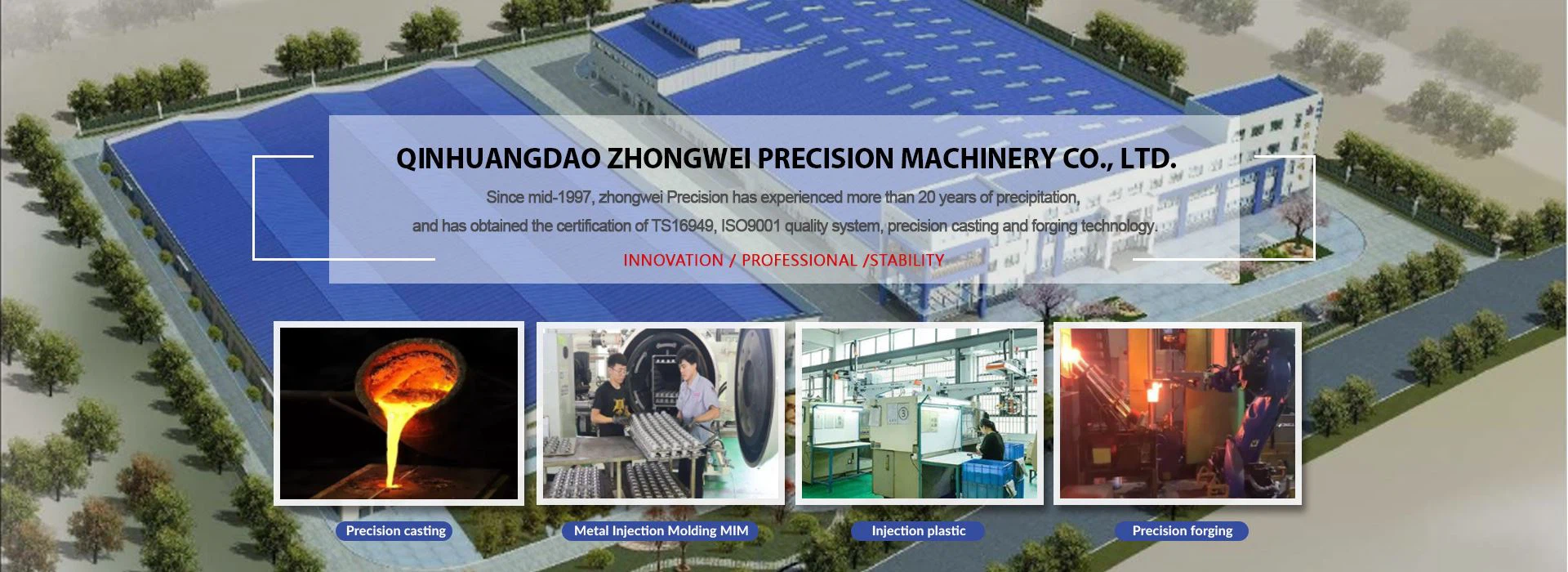
Qinhuangdao Zhongwei Precision Machinery Co., Ltd.
(1) Forging and casting business
The company's forging business involves domestic and foreign aviation, aerospace, electric power, ships, railways, construction machinery, petroleum, automobiles and many other industries. Domestic products are mainly aircraft fuselage wing structure forgings, small and medium-sized forgings, aero-engine shaft and ring forgings, small and medium-sized forgings, aerospace engine ring forgings, small and medium-sized forgings, steam turbine blades, nuclear power blades, high-speed rail accessories, mining scrapers , Automobile crankshaft and other products. Foreign products are mainly engine forgings for Rolls-Royce, IHI, ITP and other companies, and aircraft forgings for Boeing, Airbus and other companies. The company's foundry business is mainly for hydraulic castings such as pumps, valves, reducers, forklift parts, pipeline valves, and aviation castings in the fields of automobiles and construction machinery.
(2) Hydraulic environmental control business
The company's hydraulic environmental control business mainly includes two parts: hydraulic pressure and heat exchanger. The hydraulic products are mainly high-pressure plunger pumps and motors. The products are widely used in aviation, aerospace, construction machinery and other fields. Some products are exported to Europe and the United States and other countries and regions, and supporting the production of civil aviation parts for GE, Smith and other companies in the United States. The heat exchanger business mainly develops and produces tube type, plate-fin type, annular radiator, expansion assembly type, casing type heat exchanger and heat exchangers of various materials and forms such as copper, aluminum and stainless steel. And environmental control accessories, which are widely used in domestic aerospace, construction machinery, air compressors, medical, wind power and other civil fields, and civil products are exported in batches.
The company's gross profit margin is relatively stable from 2017 to 2020, and will increase by 1.68PCT to 28.33% in 2021, mainly due to the increase in the gross profit margin of the forging business, which accounts for a large proportion of revenue, and the significant increase in the gross profit margin of hydraulic products. Since 2019, the company's expense ratio has decreased year by year, among which the sales expense ratio and financial expense ratio have continued to decline year by year, and the general management expense ratio has shown a downward trend, showing the improvement of the company's operating efficiency.
(3) Metal injection molding mim business
The company's metal injection molding business is mainly divided into pistol series metal accessories and titanium alloy metal injection molding parts. The products are widely used in aviation, aerospace, construction machinery and other fields. Some products are exported to Europe and the United States and other countries and regions.