

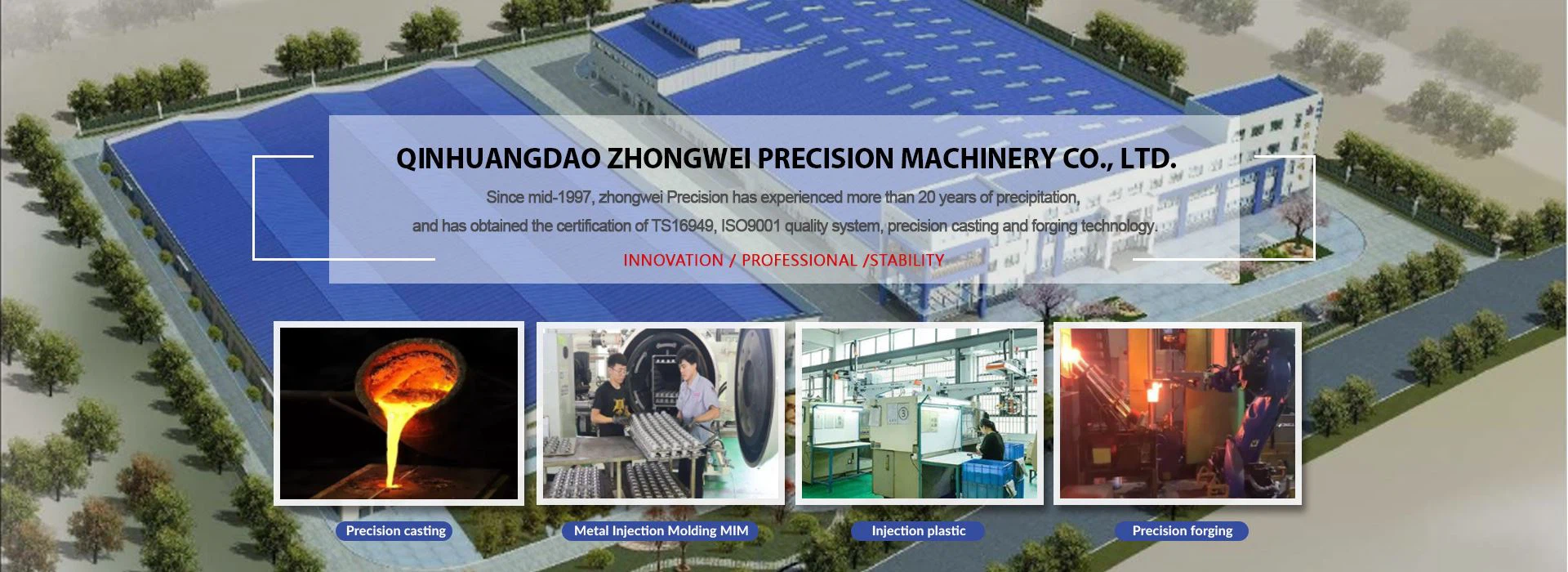
Casting
Application of precision casting in digital electronics manufacturing
Precision casting products are precise, complex, and close to the final shape of the part, and can be used directly without processing or with little processing. Therefore, precision casting is an advanced process with near-net-shape shape, also called investment casting. Generally, a suitable investment material (such as paraffin) is used to make the investment; the process of dipping the refractory coating and spreading the refractory sand on the investment mold is repeated, the shell is hardened and dried, and then the internal investment mold is melted away to obtain a cavity and a roasting type. The shell obtains sufficient strength, burns the residual investment material, pours the required metal material, solidifies and cools, and cleans the sand after shelling, so as to obtain high-precision precision castings. The smallest product can be customized for a few grams, and the largest product can be customized for dozens of kilograms.

The characteristics of precision casting are: a wide range of applications, not limited by the size, thickness and complexity of the shape of the casting. Flexible production methods; a wide range of materials can be used, a large number of scrap metals and renewable resources can be used, and power consumption is small compared with forging; castings have a certain dimensional accuracy, small machining allowances, saving processing time and metal materials; low cost, comprehensive Good economic performance, low energy, material consumption and cost.
Precision casting products can be used in all industrial sectors, especially electronics, petroleum, chemical, energy, transportation, light industry, textiles, pharmaceuticals, medical equipment, pumps and valves and other sectors with relatively fine requirements.
There are many types of precision casting processes, mainly including: investment casting technology, metal mold casting technology, pressure die casting technology, lost foam casting technology, etc. However, investment casting technology is commonly used. Mainly through the comparison and analysis of the precision casting process of the transmission bearing and the commonly used welding process, the research and analysis are carried out from the aspects of cost and production cycle.

1. Introduction to precision casting technology
Precision casting process, also known as lost wax casting process technology, the products processed by this method are very precise, complex in shape, almost the same as the final shape of the part, and there are few places that need to be processed or directly. Products that can be utilized, therefore, investment casting technology is an advanced process technology for forming. As early as the 1940s, the process of investment casting technology has been widely used, such as copper lion products, copper ban products, etc. are produced by investment casting technology. At present, the process of investment casting technology is applied in all walks of life, such as the transportation industry, aerospace industry, energy industry, pharmaceutical industry, etc., and the development speed is very fast. Through precision casting technology, not only small casting products but also large casting products can be produced.
2. Application of precision casting process in production
Welded transmission support, it is a transmission support structure with complex shape, which is produced by welding technology. It first processes the required parts, and then assembles them. For the whole piece, the processing time is relatively long, and the quality cannot be guaranteed. Through the analysis of the entire structure of the transmission support, as well as the selection of materials and the design analysis of the geometric dimensions, the final use of precision casting technology for processing and forming is the best choice, and the quality of the casting products is also very high. , only a very small number of important dimensions need to be selectively machined. The precision casting transmission bearing is a transmission bearing processed by the precision casting process.
3. Comparative analysis of the manufacturing cost of the two process technologies
By comparing and analyzing the manufacturing costs of the two process technologies, it can be seen that the cost of a single cast product is 1:1.4, and the processing labor cost ratio is 1:2.7. The biggest difference between the two methods in terms of processing costs is the cost of a single piece of material and the cost of processing labor. Therefore, in the process of mass production, due to economies of scale, the processing cost of precision casting technology is much lower than the cost of machining welding technology.
4. Compare and analyze the cycle of the two processing technologies
Regarding the cycle of the machine-welded transmission support, the support is assembled by 4 parts and welded by brazing. The Z-length processing process of the parts is 11, and some processes are very time-consuming and labor-intensive, such as Forging process, heat treatment process, wire EDM process, etc. are very time-consuming and labor-intensive. Next, it is processed through the assembly process, and then the entire transmission support can be manufactured through the welding process. Generally speaking, a batch of 20 transmission bearings takes 6 to 7 months to produce. In the precision casting technology, there are only 9 processing procedures for its parts, which mainly include the manufacture of related models, mixing of materials, vacuum grouting, investment, pouring in vacuum, crystallization under pressure, cleaning of castings and Correct relevant important dimensions and other processes.
5. Issues that need attention
In the actual machining production, the use of which processing method is restricted by many factors, such as the structural shape of the parts, geometric dimensions, the materials used, the desired quality effect, cost, time and other factors. The practical application of precision casting technology is also affected by the above factors. Therefore, careful thinking and measurement should be carried out before precision casting processing, so as to achieve a multiplier effect.